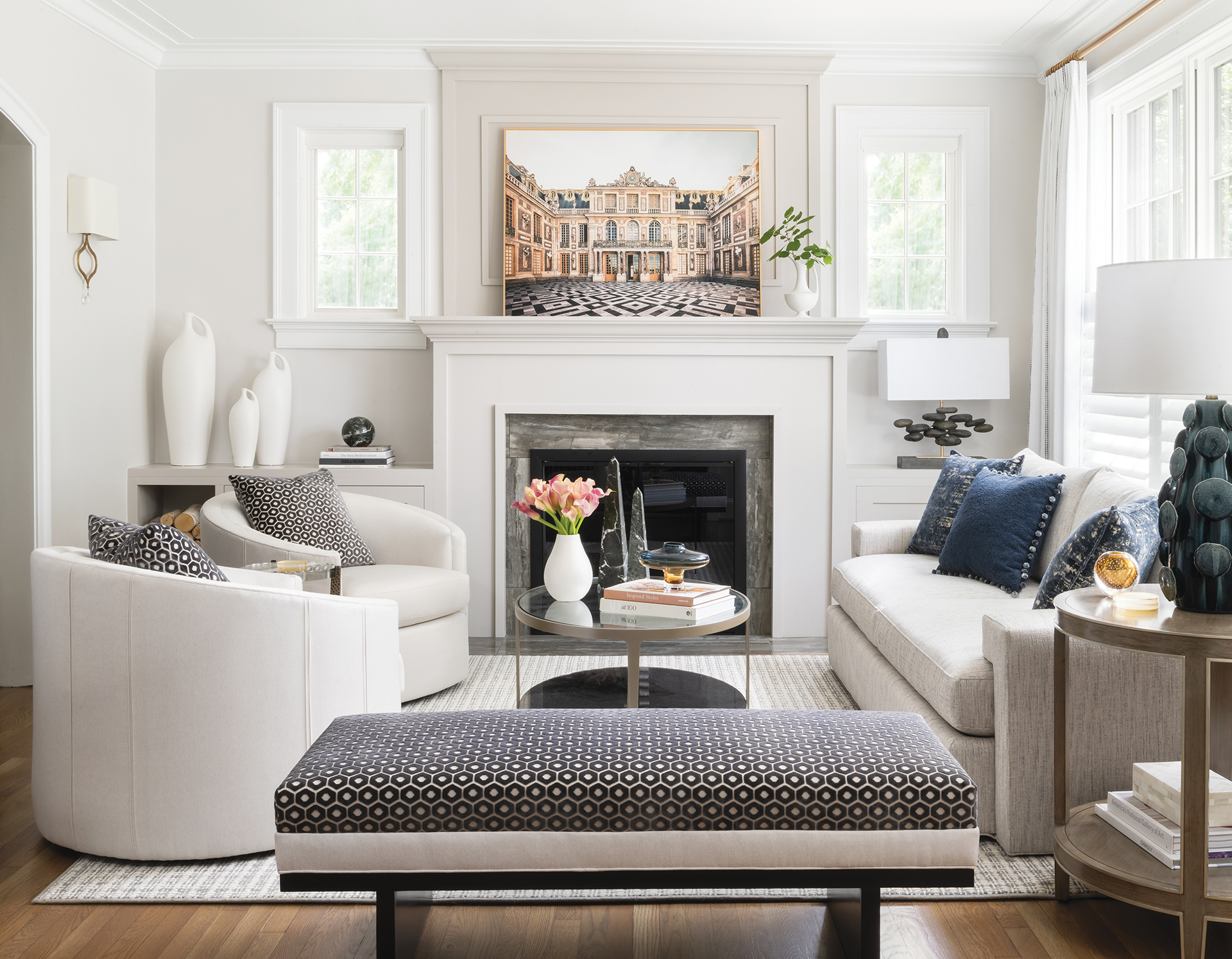
The light and airy living room gathers guests on a Vanguard sofa, Caracole chairs and a Fabricut bench topped in Architex cut velvet. The coffee table is from Charleston Forge.



Ready to update their early-1900s Tudor in Bethesda’s Edgemoor neighborhood, empty nesters engaged designer Todd Howard Ezrin to fashion a main-level makeover. “They wanted to take the interiors in a contemporary direction, with clean lines that don’t fight with the architecture,” he notes. “We envisioned a lighter, brighter aesthetic—except in the dining room, where we went for drama.”
Ezrin overhauled the disjointed lighting plan and elevated form and function with new and improved millwork. “In the living room,” he says, “we completely redid the mantel with a new tile surround, then added built-ins to give the space some weight.”
A kitchen redo replaced patched-in tile with wood flooring, and introduced new appliances, hardware and a large island perfect for baking. “I believe the cabinets are Wood-Mode and didn’t need replacing,” explains Ezrin. One bank was moved to the dining room, making way for a new coffee station/bar.
The owners, who often entertain, are thrilled with their reimagined retreat. A Q&A details the process.
What drove your color palette?
We interviewed the clients and landed on a color scheme that spoke to them: classic shades of cream and blue. In the living room, the bench’s charcoal-blue cut velvet reflects the color of the Arteriors table lamp. Though the dining room leans more green, we wove blue accents throughout the family room and the kitchen. But I wanted the study to be dark and moody, so it almost feels like a smoking lounge.
How did you play up dining room drama?
I wanted it to be a showstopper. We painted the cabinets that came from the kitchen in high-gloss Iron Ore by Sherwin-Williams and added panel molding to the ceiling to frame in the decorative wall covering. Then we selected a more textural paper for the walls and the beautiful Schonbek chandelier and companion sconces. Finally, we reupholstered the Caracole chair backs in a stunning Romo fabric.
Why did you forgo a rug in the dining room?
I didn’t specify a rug because the room is asymmetrical and we didn’t want to draw attention to that. I often shy away from dining room rugs because they can be a trip hazard and tend to get dirty.
Detail the most game-changing moves in the kitchen.
Our client’s mandate was to install a larger island and get rid of dark, dated finishes on some of the cabinets. Our faux painter refinished them and the new hood to match the lighter cabinets so the whole perimeter is now uniform. We installed new appliances and added a coffee station with a built-in Miele espresso machine.
Was durability a factor in fabric selection?
They have a large, older dog and a cat so we did think about durability. The family room sectional is upholstered in a Crypton fabric that is moisture-, stain- and odor-resistant. We know the dog likes to sleep on the study window seat, which we treated with Alta to be stain- and spill-repellent. Nothing is impervious, but we try to get close to it.
What inspired the statement lighting?
In the dining room, I was looking for a chandelier that’s a little more organic—not too rigid—to play off the floral pattern on the ceiling. I continued that organic feel in the kitchen with the John Richard pendants that are made of natural quartz crystals. All of the lighting is on separate dimmers so you can create a mood.
How did you reimagine the study’s existing millwork?
We painted it a sage green and added wall covering on the shelf-backs. On the desk side of the room, we wanted to hide a radiator below the shelves. So we designed slatted wooden doors in a metallic finish; they anchor the shelves and add a bit of architectural detail.
What factors went into furniture selection?
We were going for elegant simplicity. Some people think simple lines are boring but when a piece has the right proportions—such as the Decca Home desk in the study—it’s super-elegant. I also love furniture that has an architectural feel, such as the Uttermost console table in the dining room. It reminds me of the Coliseum in Rome.
What role does nature play throughout the home?
We balanced the architecture in the house with organic-feeling elements of nature, from the light fixtures in the dining room and kitchen to the wallpaper, window shade fabric and rounded hide rug in the study. And we wove nature into the powder room, with Kravet’s Peony & Blossom wall covering.
Interior Design: Todd Howard Ezrin, ASID, NCIDQ, LEED AP, TOBE DesignGroup, Bethesda, Maryland. Contractor: Matthew Stoddard, Stoddard Built Contracting, Silver Spring, Maryland. Styling: Charlotte Safavi.
Ask Todd
Share a signature element on your holiday table.
I believe people should have fun and express their personalities with tabletop décor.
I happen to love Legos, which even topped our wedding cake. So in addition to elegant linens and candlesticks, little Lego ornaments are always part of my table display.
Is there a furniture debut you covet?
I am dying to feature Abner Henry’s Lauren credenza in a project. I adore its simple lines, paired with asymmetrical “feet.”
Name an architect or designer who inspired you.
I admire architect Hugh Newell Jacbosen’s modern take on classical architecture. He was a master at balancing scale and proportion.
Describe a possession in your home that is meaningful to you?
A Rosewood secretary that belonged to my grandparents, which I have turned into a bar.