“We loved the diversity, community and dynamism of Bloomingdale,” says the husband, who works in tech start-ups. “We picked this house because of its location in the heart of the neighborhood we loved.”
They had come across the home as a local developer was completing an update on it. While they loved the layout, after a year in a sleek, modern environment they wanted to embrace the abode’s classic structure and felt the renovation had stripped away some of its historic relevance. Before moving in, they contacted Zoë Feldman Design “to restore some of the traditional design to the space,” says the wife, a school teacher. “We wanted the house to feel warm, layered and inviting.”
The 2,000-square-foot residence encompasses five bedrooms and four and a half baths. Its typical row-house layout features a front entrance with the living room on the left and the dining room and kitchen straight back. The renovated home “mostly needed soul brought back into it,” designer Zoë Feldman observes, adding that the couple “naturally aligned with my own style, more than many of my clients. They had a good sense of what they wanted and trusted that we could get them there.”
The project began with some minor architectural changes. They traded a wood mantel for one of Carrara marble from Chesney’s and added built-ins to the owners’ suite. New stair railings were installed and the renovated kitchen had its cabinetry painted a soft gray-green and the hood replaced with one in a more sculptural style. They also overhauled the bathrooms.
When it came to furnishing the home, a collected sensibility prevailed. “We wanted pieces that feel both timeless and a bit eclectic, and we weren’t opposed to plenty of color and pattern,” says the wife; she and her husband brought some artwork and other items to the project but were otherwise ready for a fresh start.
Feldman began with a detailed space plan. “We find if we’re going to be more eclectic, we need some balance or it will feel chaotic,” she explains. “We start with a classic plan that’s intelligible to the client. Once we have that natural balance in each room, it becomes easier to layer in a Regency piece here, a modern piece there. Almost everything in this project is new or repurposed. We used a ton of vintage and antique pieces—I find them everywhere.”
The living room—the owners’ favorite spot in the house—marries furnishings ranging from an Empire commode and a French Directoire daybed to a mid-century, acid-etched coffee table by Bernhard Rohne for Mastercraft. Antique Caucasian rug-fragment pillows adorn a Baker sofa and a Napoleon III-style Louis Phillippe mirror presides over the mantel. Contemporary artworks include a charcoal nude by Bess Cutler and a colorful abstract canvas by Jenny Prinn that belonged to the owners; it hangs in the entry above a marble-topped Directoire-style console.
Separated from the living room by a partial wall, the dining room is distinguished by Pierre Frey textured wallpaper; Feldman opted to paint the ceiling black “to add a little punctuation to the quiet space,” she explains. “The dining room tends to be a moodier experience, so we didn’t worry about it darkening the room.”
Dramatic, modern lighting takes center stage in both the living and dining rooms. “Even when we’re harkening to a more historic vibe like we were here, we don’t want it to feel like you’re walking into an actual Victorian townhouse,” Feldman notes. “Modern lighting can make a space feel relevant.” The Calder-esque fixture by Andrew Neyer in the dining room “feels like art,” says the designer. “It’s a living piece and moves all day as a mobile would.” In the living room, a mid-century chandelier by Lawson-Fenning has a large footprint but isn’t visually obstructive. Its black shades pick up on other black moments in the room—furnishings and stair railings, for instance—and serve to unify the room’s disparate design elements.
Upstairs, the owners’ suite packs a punch with rich botanical wallpaper by William Morris in deep green—the wife’s favorite color. As she admits, “We were a bit nervous we might drown in so much pattern, but Zoë balanced it beautifully with pale-blue trim and built-ins.” Another favorite spot: a massive window seat that Feldman designed for the bedroom’s bay. “The drawers underneath provide a huge amount of storage,” the wife enthuses, “and the size means it’s roomy enough to hold the whole family—two humans and a pup—for an afternoon nap.”
Interior Design: Zoë Feldman, Zoë Feldman Design, Washington, DC.
RESOURCES
ENTRY
Console: chairish.com. Art over Console: jennyprinn.com. Lamps on Console: kellywearstler.com through circalighting.com. Umbrella Stand: goodwooddc.com. Hanging Hands: globalviews.com. Art Above Hanging Hands: Tenley Masson through zoefeldmandesign.com.
LIVING ROOM
Light Fixture: lawson-fenning.com. Orange Sofa: karamann.com through bakerfurniture.com. Rug & Daybed Pillows: oldnewhouse.com. Chair beside Bar, Black Curio Cabinet, Biedermeier Game Table & Chairs, Vintage Daybed, Mirror, Coffee Table & 19th-Century Commode by Fireplace: 1stdibs.com. Game Chair Fabric: jab.de. Daybed Upholstery: pindler.com. Chair & Daybed Fabrication: rockvilleinteriors.com. Paint on Daybed: Railings by farrow-ball.com. Side table by Daybed, Jacks on Coffee Table: chairish.com. Art above Commode: Bess Cutler through chairish.com. Hermes Bust & Art Deco Horse Sculpture: chairish.com. Mantel: chesneys.com. Sconces: circalighting.com. White Vases on Curio Cabinet & Bar: warehouse.davidiatesta.com. Curtains: arabelfabrics.com. Fabrication: Pilchard Designs, Inc.; 202-669-8760. Bar Cabinet by Stairs: avehome.com. Lithograph above Bar: Gene Davis.
DINING ROOM
Wallpaper: pierrefrey.com. Installation: Michael DiGuiseppe; 202-731-2634. Paul McCobb Dining Table & Milo Baughman Sideboard: 1stdibs.com. Dining Chairs: dwr.com. Art over Sideboard: Suzani Print through stfrank.com. Lamps on Sideboard: chairish.com. Roman Shades: arabelfabrics.com. Fabrication: Pilchard Designs, Inc.; 202-669-8760. Chandelier: andrewneyer.com. Art by Window: jessalinbeutler.studio.
KITCHEN
Faucet, pot filler &backsplash tile: waterworks.com. Cabinet Hardware: sirodesigns.com. Cabinet Paint: Card Room Green through farrow-ball.com. Antique Oushak Rug: oldnewhouse.com.
OWNERS’ BEDROOM
Wallpaper: William Morris through stylelibrary.com. Installation: Michael DiGuiseppe; 202-731-2634. Rug, Bedside Tables & Bench: 1stdibs.com. Bench Fabric: hollandandsherry.com. Fabrication: rockvilleinteriors.com. Bed: leeindustries.com. Upholstery on Bed: brantanofabrics.com. Art by Window: Tenley Masson through zoefeldmandesign.com. Throw & Mirror over Bed: westelm.com. Bedding: matouk.com. Swing Arm Sconces: hudsonvalleylighting.hvlgroup.com. Daybed Cushion & Roman Shade Fabrication: Pilchard Designs, Inc.; 202-669-8760. Sconces flanking Daybed: circalighting.com. Daybed Pillows: luluandgeorgia.com. Custom Wardrobes and Daybed Frame: The Craft; 301-706-0873.
Sconces, Sink & Shower Fixtures, Washstand & Tile: waterworks.com. Washstand Fabrication: atlasstonefabricators.com. Hooks: rejuvenation.com. Gothic Revival Wood Chair: chairish.com. Recessed Medicine Cabinets: rh.com. Antique Rug: oldnewhouse.com.
A new, marble-clad kitchen opened to a rear addition housing a light-filled family room with a master bedroom above. The 3,566-square-foot abode already included five bedrooms and four-and-a-half baths.
The owners, both lawyers, lived in the house for a couple of years without making any changes. But they knew from the start that the tastefully neutral interiors were missing something: a sense of character that would make the home their own. Eventually, they tapped DC-based J.D. Ireland Interior Architecture & Design to transform it by introducing the bespoke touches they desired.
“My clients liked what was there and wanted to stick with the bright, neutral palette, yet they wanted a new aesthetic,” principal Joe Ireland recalls. “The images they provided had a coastal vibe, with colors like blue and beige that you might find in a waterfront home—light, simple and a little preppy, but still clean and neutral.” Ireland and his team retained the off-white palette and dark-stained oak floors—and relied on furniture, fabrics and accessories to do the rest.
Did you take cues from the existing kitchen and interior architecture?
I treat a kitchen like architecture. We have to follow that and the interior moldings and architectural elements; in this case, it all has a traditional feel and we considered that in our design.
Was there a springboard for the colors you introduced?
The home has its original front vestibule, with exposed brick walls and a tile floor. It turned out everything was in that tile: the blues and earth tones of the upholstered pieces, accents and woods. It all tied in nicely.
Throughout the house, bold moments make an impact. How did you choose them?
I’d say the theme of the whole redesign was pattern. In what was otherwise a quiet house, we injected bits of pattern to kick it up—in the living room shades, in the mirrors in the owners’ bedroom. In the family room, the bamboo chairs act as a pattern.
How do you decide when to go bold?
I think that’s an instinct. In my opinion, every house should incorporate quirky, one-of-a-kind pieces; they’re what give a room character. For instance, the bamboo chairs look like they could have been inherited from a grandparent or purchased on a trip overseas. They impart an inherited quality.
How did the concept for the living room develop?
The rug came first. After that, the clients wanted plain upholstered pieces, so I thought I’d put more emphasis on the window treatments and make them pop.
Why does the unexpected combination of a traditional Oriental rug work with modern, geometric Roman shades?
I think it’s because it’s such a style and scale change. The rug has a tighter pattern and the Romans are graphic with a larger pattern that’s very visible in the room. The scale change is what makes them work together.
Is there a reason the living room furniture plan is very symmetrical?
The sofa is centered with the fireplace, but the bay is off-center and I wanted to counteract that. Also, placing cabinets on either side of the fireplace was an opportunity to present ambient light evenly in the room.
What’s your view on lighting?
I pick lighting while I’m picking furniture. To me, lamps are little pieces of sculpture. I mostly base my choices on shape and texture. We always consider how rooms will look in the evening, when you want warmer light. You need soft illumination—even if it’s a warm LED.
Describe the design elements in the dining room.
The 60-inch Mitchell Gold table opens up with one or two leaves. It only comes in a dark finish, so we had Billet Collins faux-finish it in a lighter shade. The chairs are vintage, reupholstered with indoor/outdoor Pindler fabric. All the fabrics in the house are kid-friendly.
How did the dining room rug evolve?
There’s a bump-out in one corner of the room, so we chose a custom square carpet, but clipped all four corners of the rug rather than just one. This way, the rug can be rotated for even use, as the room gets a lot of sun.
How did you make the family room more functional?
The garage is at the back of the house so the owners usually come in through the family room. In an otherwise useless corner by the door, we created a mudroom area with a built-in bench, coat closet and drawers. A big mirror keeps it from looking like a solid block of wood. We also added built-ins along one wall for the television.
How did you adapt the master bedroom to the family’s needs?
The parents spend a lot of time there with the kids, who are young enough that they still want to come in and climb in bed. So they wanted space for that. There was room for chairs, an ottoman and a TV too.
How important is accessorizing?
Accessories are super important. My advice is to pick up way more than you think you’ll use; you’ll be surprised that things you didn’t think would work do. Plants are also important because every room should have some green.
How do you find the right accessories?
Staying power: That’s the difference between something special and the stuff you pick up at a retail chain. A designer will know the difference but the trick is living with it for a couple of weeks before you pull the trigger. If you’re like “eh,” then it should go out the door.
 ASK JOE
What’s your go-to source for unexpected treasures?
GoodWood and Miss Pixie’s are where I find a lot of quirky things. I also like to look at Etsy, which is where the dining room chairs came from.
Name a current design trend that you embrace.
Color. I’m happy to see people wanting color again—and pattern. I think it’s truly what will make your house stand out.
What design element is often overlooked?
The next level of detail. For instance, every time I put wallpaper up, I trim it with just a little fabric cord at the top or bottom. That tiny addition makes the wallpaper look like you paid twice what you did for it.
We’re enjoying doing colorful custom window shades.
Interior Design: Joseph Ireland, principal, J.D. Ireland Interior Architecture & Design, Washington, DC.
The six-light Apollo Chandelier from Mitchell Gold + Bob Williams pairs a clean-lined brass frame with smooth, matte-black plates that direct light upward with understated warmth.
Designed by Aviva Stanoff for Currey & Company, the Forest Light Gold Chandelier resembles a tree limb, with irregular crystals dangling from wrought-iron branches in which 10 chandelier bulbs are nestled. Finishes include Washed Lucerne Gold (pictured) and Natural. Available at area Dominion Lighting locations. dominionlighting.com; curreyandcompany.com
Designer Marie Christine Dorner conceived the versatile Azabu for Ligne Roset with three functions in mind: It’s an occasional table with a removable lid, a storage container and a ball-shaped light fixture. A mouth-blown Murano glass globe sits atop the wire structure, which comes in various sizes and finishes. At Ligne Roset in Upper Georgetown. ligneroset-dc.com
The Edderton pendant by Park Harbor Lighting combines on-trend, textured-black and rose-gold finishes to chic effect. Measuring 25 inches in diameter, the six-light fixture is enhanced by clear crystal accents. Available at area Ferguson Bath, Kitchen & Lighting Gallery locations. fergusonshowrooms.com
The sculptural Iride, designed by Bernhardt & Vella for Arketipo Firenze, marries lines and circles in a wall fixture that doubles as art. Made of metal finished in light- and dark-gray hues, its four discs employ LED lights that emit a halo-like glow. Available at Theodores in Upper Georgetown. theodores.com; arketipo.com
With its layered Belgian linen shade and dark trim, the two-light Zara semi-flush mount fixture from Mitzi by Hudson Valley Lighting conveys a tailored look. The base and sphere-shaped finial come in aged brass (pictured) or polished nickel. Zara is also available as a pendant or linear chandelier. Find all three fixtures at Burgess Lighting in Forestville, Maryland. burgesslighting.com; mitzi.hvlgroup.com
Cascading driftwood-gray beads and a weathered-zinc finish put a rustic spin on an otherwise traditional design in the Nori chandelier by Feiss Lighting. Six exposed bulbs mimic the look of candles. Available at Dulles Electric Supply in Sterling, Virginia. dulleselectric.com; murrayfeiss.lightingnewyork.com
A delicate arrangement of clear, hand-blown glass blooms on gold-leaf stems distinguishes the Maison des Fleurs pendant from the Metropolitan Lighting Fixture Co., a Minka Group subsidiary. Integrated into the fixture’s bronze frame are four six-watt LEDs that illuminate the flowers. Available at Annapolis Lighting locations. annapolislighting.com
Designed by Fabrice Berrux for Roche Bobois, the Cirque Pedestal Light comprises a matte-gray concrete base that doubles as a tabletop, with a slender, round fixture attached to it. Available at Roche Bobois in Friendship Heights as a floor or table lamp; the circular element comes in different sizes and finishes. roche-bobois.com
Conceived by Thomas O’Brien for Visual Comfort, the Whitman Large Pendant brings chic style to task lighting. Pictured here in Bronze and Hand-Rubbed Antique Brass, it also comes with a white-glass shade and in a range of finish combinations. At Circa Lighting in Cady’s Alley. circalighting.com; visualcomfortlightinglights.com
The irregular curves of antique apothecary jars inspired Kohler’s Damask Cloud five-light chandelier, which pairs rounded metal fittings with a small, frosted-glass globe. Pictured here in oil-rubbed bronze, this fixture and the rest of the Damask Cloud collection are available at the Kohler Signature Store by GROF USA in Bethesda. grofusa.com
ASK THE PROS
What’s the latest news in LED lighting?
New technology is developing around the study of circadian rhythms and the effect light has on our health. LEDs now mimic daylight and allow for color-temperature and brightness adjustment based on the time of day. Bright daylight can boost productivity while evening light can be dimmed to promote rest and sleep. —Lisa Dugan, CLC, Burgess Lighting
How do you suggest customers develop a lighting plan for a space?
To develop a lighting plan, start by defining the objectives and desired feel for each space. Work areas require task lighting, while soft ambient and accent lights can set a mood in casual areas. The trick is knowing what you want to achieve. —Charles Camacho, lighting designer and AIA lighting specialist, Circa Lighting
How do you guide customers in choosing lighting that will best suit their spaces?
When helping customers select the right lighting, we ask certain questions: What colors are they working with? How big is the space they’re lighting? How do they plan to use it? We need all this information to be able to capture the features and the look that they want. —Allison Heyman, residential lighting consultant, Dulles Electric Supply
We’re seeing significant interest in natural materials, whether they be neutral fibers like wicker and jute or moodier, carved materials like wood and stone. Crisp, matte-black finishes are already popular as part of the hot modern-farmhouse aesthetic. —Matt Rowan, ASID, lighting specialist, Dominion Lighting
This newest addition to DC’s monument landscape creates a park-like, four-acre plaza amidst the unprepossessing bureaucratic office buildings that line the Mall’s south side.
As conceived by architect Frank Gehry, the $150 million memorial in stacked pink limestone is anchored by two tableaux of heroic-sized bronze figures and stone bas relief, crafted by Russian sculptor Sergey Eylanbekov. The statues depict the 34th president in two historic roles: as a general commanding troops on D-Day and a president flanked by advisors as he prepares his second inaugural address.
The tableaux stand against the backdrop of a 60-foot-tall, 450-foot-wide stainless-steel tapestry by industrial designer Tomas Osinski that maps the Normandy coastline. In daylight, the screen-like installation partially obscures the behemoth Department of Education building behind it, while lit up at night, the effect is dramatic. Freestanding limestone columns—two of them bearing plaques that record the dates of Eisenhower’s military service and presidency—accentuate the tapestry and bookend the plaza. Commemorative speeches by Eisenhower are etched on the back of each tableau. At one end of the plaza, a sculpture of Eisenhower as a boy appears to contemplate the future.
The Eisenhower Memorial faces the Air and Space Museum. Off to the right down Maryland Avenue, the Capitol is in view (above), making an important visual connection.
Architecture: Frank Gehry, FAIA, Gehry Partners, LLP, Los Angeles, California. Construction: Clark Construction Group, LLC, Bethesda, Maryland.
In one particular unit, the owners had tired of interiors that reflected a bygone era. They hired designer Bonnie Ammon to create a contemporary aesthetic that would refresh their abode. “The owners envisioned a tailored, modern space,” Ammon says. “We transformed it with metal stair rails, steel doors, paneled-metal walls and plaster cove moldings. Entertainment areas hold intimate and large gatherings.”
Ammon conjured drama with a high-contrast palette of light and dark. In the living room, original oak flooring was stained ebony and charcoal window treatments offset light-gray walls. A sleek limestone fireplace is a focal point against a dark-gray accent wall. A Vanguard sectional and wingback chairs from Jessica Charles surround the fireplace, while swivel chairs and an ottoman by Vanguard occupy another seating area. “With this palette,” Ammon notes, “just a punch of color from art and accessories can change the mood.”
“Forces of Nature,” the ninth rendition of the Renwick Gallery’s biennial showcase of craftsmanship, examines this powerful combination at just such a time, recognizing four artists whose work explores our ever-evolving relationship with the environment. The 2020 Invitational jury selected Lauren Fensterstock, who draws on decorative arts such as mosaic-making; Timothy Horn, whose work in bronze, glass and other media marries natural and manmade worlds; Debora Moore, who fashions extraordinary flowers and trees out of glass; and Rowland Ricketts, whose installations are made from handwoven textiles dyed with indigo he cultivates himself. “These artists look to nature in a variety of ways, seeing it as a guide, partner, adversary, ward or inspiration,” says exhibition curator Emily Zilber. “Craft’s complex relationship with the natural world can help us understand our place in the order of things.”
Note: After publication, the Renwick Gallery temporarily closed due to the Covid-19 pandemic. Please check with the gallery before visiting.
Pella’s Architect Series of wood-framed windows offers a wide range of functions and styles. Coated in EnduraClad, a patented exterior finish that protects wood, the series features security products and various hardware collections. Pictured: black-framed windows and doors—mainstays of the current modern-farmhouse look. pella.com
PICTURE PERFECT Loewen’s Series 36 Picture Window boasts a streamlined design with expanded glass and no glazing stops. Available through The Sanders Company in various shapes and sizes, the windows’ minimal wood framework makes them a good fit for contemporary spaces. loewen.com; thesanderscompany.com
OPEN PLAN Folding-glass wall manufacturer NanaWall introduces SL45, which uses the company’s patented FoldFlat technology. The panels pivot back 180 degrees and stack inside or out to create an unimpeded opening between indoor and outdoor spaces. A minimalist, all-aluminum frame and integrated hardware convey a clean look. nanawall.com
San Diego-based Maiden Steel manufactures customizable steel doors—among them the statement-making Zero pivot door (above), which boasts heavy-duty strength and an industrial-chic aesthetic. Designed for interior or exterior use, it comes in a galvanized or powder-coated finish; pictured here in custom powder-coating. maidensteel.com
After years of putting up with a substantial outside-the-Beltway commute, Dia and Rudy Bejarano were ready for a change. Leaving behind a traditional house in Rockville’s sleepy Derwood neighborhood, the couple began looking at dwellings closer to DC. This time, they were interested in a home with a modern, European sensibility; he is Bolivian and she is from Hungary. “We thought we might buy a lot and build, but then we saw this house and it was perfect for our needs,” Dia recalls.
The previous owners had purchased the builder-grade abode in Maryland’s Cabin John community while it was under construction in 2015, customized it with clean lines, contemporary features and an open main-floor plan—then ended up moving within a year or so of its completion. With three kids aged six, five and three, the Bejaranos—who both work for a tax processor (he is a COO and she’s an analyst)—were drawn to the home’s roomy, 4,500-square-foot size as well as its streamlined style.
The couple hired Nancy Twomey of Finnian’s Moon Interiors to appoint their new residence with a modern aesthetic to match the interior architecture. “We told her we wanted clean-lined spaces with ‘spice,’” recounts Dia, laughing. “We used that word a lot.” She mentions the red-leather counter stools, which pop in the monochromatic kitchen, as an example of how the designer opted to spice things up.
In addition to the kitchen’s sleek charcoal cabinetry and marble-slab backsplash, modern architectural elements in the other main-floor spaces offered Twomey her style cues. An open, industrial-style steel staircase grounds the front hall and a wall in the living room incorporates a double-sided gas fireplace with flat-fronted, light-wood cabinetry and an integrated mantel. A small, red-painted adjoining lounge area shares the fireplace and offers convenient play space where the kids can be under supervision without being underfoot. A simple coffered ceiling delineates the living room, while the adjacent dining room boasts a similarly unadorned tray ceiling.
Against this spare backdrop, Twomey introduced a quiet palette of gray and blue that plays off the colors of the kitchen, with sprinklings of gold and red. “We kept the same threads of color throughout,” she explains. “The red accents we added were dictated by a Link Suspension light fixture in the kitchen and the color in the playroom, both of which were already there when my clients moved in. Along with the kitchen stools, which I had upholstered and powder-coated in red, they create a visual balance between the spaces.”
When it came to furniture, the designer started from scratch. She eschewed stark, contemporary pieces “because they have little kids and were looking for something softer,” she observes. “It was a matter of keeping the aesthetic modern but softening the edges.” Comfortable Wesley Hall sofas and custom TCS Designs chairs beckon in the living room while rounded pieces such as Modway dining chairs, upholstered in patterned Romo velvet and paired with a walnut Modway table, impart warmth. Twomey added vintage pieces, such as an antique Chinese chest in the dining room, for layering and interest.
Upstairs, the master suite, guest room and three children’s rooms all needed work. Twomey painted the master bedroom a pale, restful blue that conveys the sense of an oasis from hectic family life, anchoring it with furniture from Vanguard and a plush, neutral carpet. Her firm, Finnian’s Moon, is known for its stylish, creative children’s décor—and it was no effort, says the designer, to conjure pretty and playful rooms for each child. “Kids’ rooms just come to me,” she marvels. “I really like picking out all that cute stuff.”
With a spacious finished basement and a recently added pool and patio, the Bejaranos’ home feels complete. A bonus, notes Dia, has been getting to know the Cabin John community, which was new to the couple before their move. “We feel blessed to have found this spot and this house,” she says, “and to have had Nancy’s help in making it great.”
Interior Design: Nancy Twomey, Finnian’s Moon Interiors, Alexandria, Virginia.
How do you create a collected look when you’re buying everything at once?
This house already felt layered because of the architectural elements, and vintage pieces here and there added to the effect. I reupholster antiques and look for vintage rugs online; I like the trend of putting real rugs in the kitchen.
How did you conceive the kids’ rooms?
Each room started with a wallpaper accent wall and I pulled all the colors I used in the room from that. For practicality, I kept the other walls neutral and saved the bright colors for lamps and accessories. I covered the desks in the boys’ rooms in the same paper as the walls.
What’s your philosophy on color and pattern?
I’m not a color or pattern person, but I’ll go bold if the context is right. In that case, it should feel interesting as opposed to bold—like the Romo fabric on the dining room chairs.
Most established DC neighborhoods present a similar scenario: treelined streets fringed with vintage homes set a bit too close together. The privacy and space constraints inherent in these older enclaves often prove challenging for architects asked to conjure something new—or refresh something old—for clients. This was certainly the case for Mark McInturff, who was tasked with realizing a bold, modernist vision on a small corner lot in Wesley Heights.
“The existing house was little and there were other versions of it around the neighborhood,” he recalls. “I looked at trying to save it, but it was hopeless. It would’ve been more work and more expensive to keep it.”
However, building anew on the narrow, 6,750-square-foot lot was complicated by zoning issues and two intrusive setbacks. For inspiration, McInturff and project manager Colleen Gove Healey (who has since launched her own firm) turned to an architectural vernacular found in Charleston. “It’s called a Charleston single house,” McInturff explains. “Each is long with a garden on one side. They all open from the side into the garden.”
The architects sited the 24-foot-deep, 4,000-square-foot structure close to the house next door, keeping it largely closed off on that side to give both the neighbors and homeowners privacy. The street-facing side of the house is open, connected to the garden by tall sliding doors and large expanses of glass. Since the southern exposure faces the neighbors, there’s no direct sun. “If you are facing north you have to get sun someplace else,” McInturff reasons. “We put in clerestory windows on the south side that reach over your shoulder to get the light.”
A smooth, collaborative process unfolded among the architects, contractor Dave Tillman of Mauck, Zantzinger & Associates and the owners, a finance executive and his wife. The couple trusted McInturff and Healey to conceive the home’s exterior aesthetic, which combines stucco, vertical and horizontal Hardie siding and glass to create a woven effect. At the request of the wife, dark-wood louvers are suspended four feet in front of some street-facing windows. “Colleen showed me a house with these louvers. I love lines and I fell in love with this idea,” the wife explains. “The wood against the glass adds warmth, texture and a layer of privacy.”
Visitors, who enter the three-story house at the west end, find themselves in the open-plan living/dining area with the staircase to their right. Straight ahead, the kitchen is delineated by a floating wall—so the whole space feels like one big room. “The kitchen is really just three units of cabinetry,” Healey explains. “They’re positioned to provide some screening from the dining/living area.” Beyond the kitchen, a screened porch beckons, along with a guest room, bath and pantry with extra space for a future elevator.
The second level is strung along a long gallery overlooking the main level on one side; bedrooms belonging to the couple’s two kids are on the other. The master suite lies at the far end. At the top of the stairs, a built-in desk has become a center for home-schooling during the pandemic. The partially below-ground lower level is made light by clerestory windows. It features the husband’s office, a family room, exercise room and garage.
A material palette of steel, white oak and glass keeps the spaces unified. Pale, white-oak floors and built-ins impart lightness while gray-painted, exposed-steel beams extend horizontally and vertically from the main floor to the second level. “Because our houses are very open, they need a lot of steel,” McInturff relates. “Clients usually want to cover it up, but we don’t do that. The beams create rhythm and texture. I think of the second floor as a big tray sitting on these steel beams.”
Compounding challenges posed by the cramped site was the top item on the husband’s wish list: a swimming pool. “This was hard because a pool has to be level and the lot has a slight hill. A retaining wall on a corner lot would be a zoning issue,” McInturff explains, adding, “With this house and pool, if anything had moved two inches we’d have had a problem—the boundaries and zoning were that tight.”
After addressing regrading issues with landscape architect Lila Fendrick, who joined the project early on, McInturff and his team were able to accommodate a pool measuring 75 by seven-and-a-half feet—without a retaining wall. “This was a very organized landscape composition designed to support the architecture,” notes Fendrick. “The pool was at the site’s lowest point, so we graded away from it to a storm-water retention area.” Fendrick also located painted-cedar fencing around the pool and implemented privacy plantings—an outer hedge of skip laurels with tree form hollies inside that are synchronized with the home’s vertical architectural elements.
Clad in a black-plaster surface, the pool conveys a grotto-like effect. An elevated ipe walkway stretches from the front entry back to the porch. Below the porch, a poured-concrete ramp connects the pool to a bath and shower on the lower level. Permeable pavers framed in bluestone clad the pool and adjacent seating areas.
The owners, who embraced the building process, are now enjoying its fruits. “Now—when the pandemic has forced us to stay home—is the time we should be restless,” the wife observes. “But we love our house and are not itching to go anywhere."
Architecture: Mark McInturff, FAIA, principal; Colleen Gove Healey, AIA, NCARB, project manager, McInturff Architects, Bethesda, Maryland. Contractor: Dave Tillman, Mauck, Zantzinger & Associates, Washington, DC. Landscape Architecture: Lila Fendrick, RLA, ASLA, GRP, Lila Fendrick Landscape Architects, Chevy Chase, Maryland.
RESOURCES
GENERAL
Windows & Sliding Doors: pella.com. Flooring: classicfloordesigns.info. Shade & Upholstery Fabrication: rockvilleinteriors.com. Home Automation: dcpowerhouse.com. Second-Story Railings: northeastironworksinc.com
KITCHEN
Cabinetry: Custom by christianacabinetry.com through kitchenandbathstudios.com. Countertops: Caesarstone and Marble through gramaco.com. Stools: dwr.com. Appliances: subzero-wolf.com.
LIVING/DINING AREA
Sofas: boconcept.com. Hide Rug: dwr.com. Dining Table: roomandboard.com. Pottery on Coffee Table: marimasot.com. Artworks in Dining Room: isabelmanalo.com. Built-in Steel Cabinet & Fireplace: akmetalfab.com.
MASTER BATH
Tub: corian.com through porcelanosa-usa.com.
OUTDOOR POOL & LOUNGE AREA
Furniture: crateandbarrel.com. Lighting: outdoorillumination.com
After starting her career in Washington, designer Anna Kemper honed her aesthetic for 20 years in Columbia, South Carolina, where she fashioned residential interiors and ran a shop with a partner. Now back in DC, she launched her first eponymous brick-and-mortar location, Anna Kemper Atelier, on July 15. The 2,430-square-foot boutique in DC’s Union Market district showcases furnishings, lighting, rugs, art and accessories, reflecting the designer’s layered, globally inspired aesthetic. Rotating works by local and international artists will be on display.
“As a small, woman-owned business, I was drawn to Union Market. It aligns with my desire to be in an international city alongside fellow entrepreneurs,” Kemper says. “My space is a physical expression of my brand in a neighborhood with a longstanding passion for art and culture.” 1266 5th Street, NE; 202-548-2525. annakemperatelier.com
John Rosselli & Associates—John Rosselli, who opened his Manhattan antiques shop 60 years ago, curates hand-painted reproductions, fabrics, wallpaper and lighting in his DC showroom, formerly a Georgetown fixture. The new, 2,000-square-foot design center location adds custom Nepalese rugs from Tufenkian and New Moon to the mix. Suite 325; johnrosselli.com
David Sutherland Showroom—The company’s first DC outpost offers Perennials fabrics and Sutherland outdoor furniture, plus such vendors as Hellman-Chang and Ochre Lighting, in a 5,000-square-foot showroom. Suite 410; sutherlandfurniture.com
Baker—In a move from Cady’s Alley, Baker brings its Milling Road and McGuire brands to a new 6,000-square-foot space. Suite 400; bakerfurniture.com
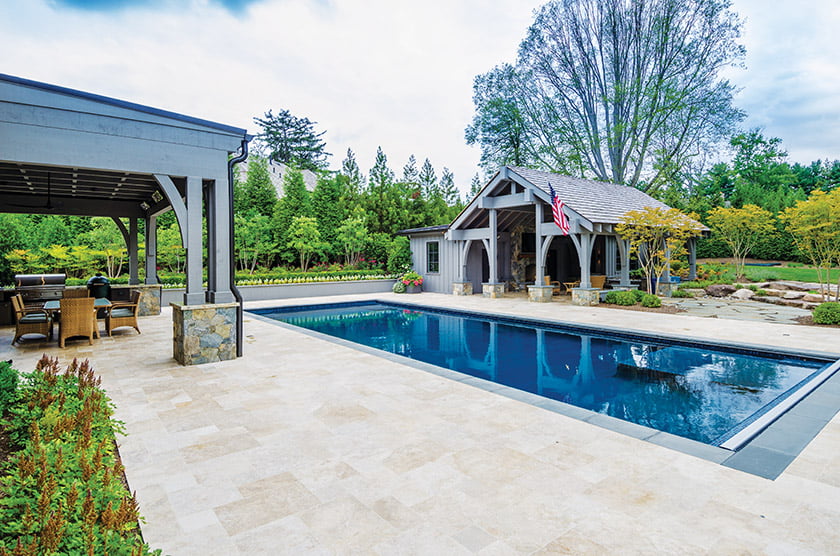
VACATION LIVING After experiencing a resort with outdoor spaces chock-full of indoor-living amenities, McLean clients tasked McHale Landscape Design with turning their suburban backyard into an elaborate outdoor-living environment. Overcoming challenges posed by an awkwardly situated septic field, setbacks and proximity to neighbors was the first step for landscape architect Anthony Cusat. “We then created a loggia/outdoor kitchen addition to the home and a swimming pool and freestanding pool house and pavilion,” he recounts. “Both have overhead heating systems for year-round use.” A patio of travertine and Pennsylvania flagstone around the pool connects the stone-veneer and red-cedar structures while Green Giant arborvitae, crape myrtle, boxwood, Knockout roses, nandina, astilbe and cryptomeria provide decoration and privacy. Photo: John Spaulding
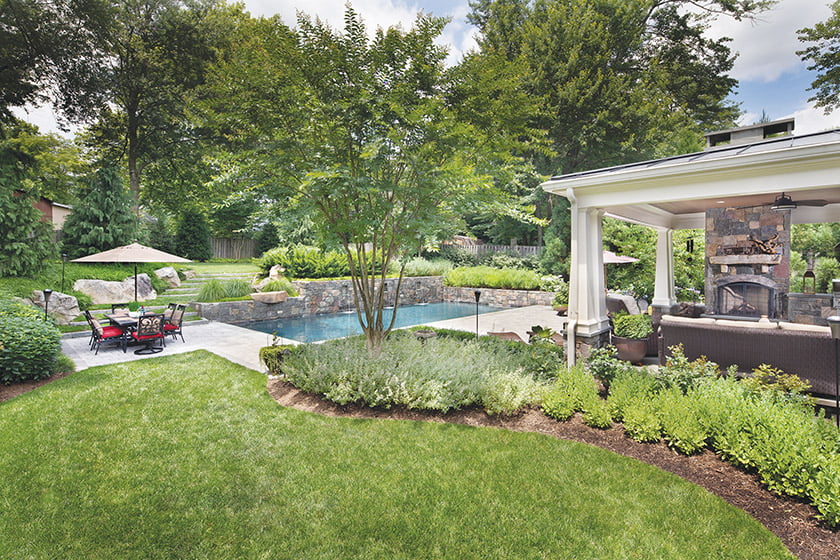
PROBLEM SOLVED Tapped to create a backyard oasis on a Vienna property complete with a pool and pavilion, Surrounds, Inc., first had to tackle significant drainage issues. “The house was sited well below the rear yard, so water flowed toward it,” recalls landscape architect Chad Talton. “The entire area sloped that way.” The solution was a design that terraced the backyard, creating an upper level for the kids with space for entertaining off the house. The pavilion centers on a fireplace and outdoor grill. The pool is bordered by a granite retaining wall, and patios and walkways combine random concrete pavers and full-color rec-tangular bluestone. Plantings include crape myrtle, weeping Alaskan cedar, cryptomeria, hydrangea, viburnum and more. Photo: Morgan Howarth
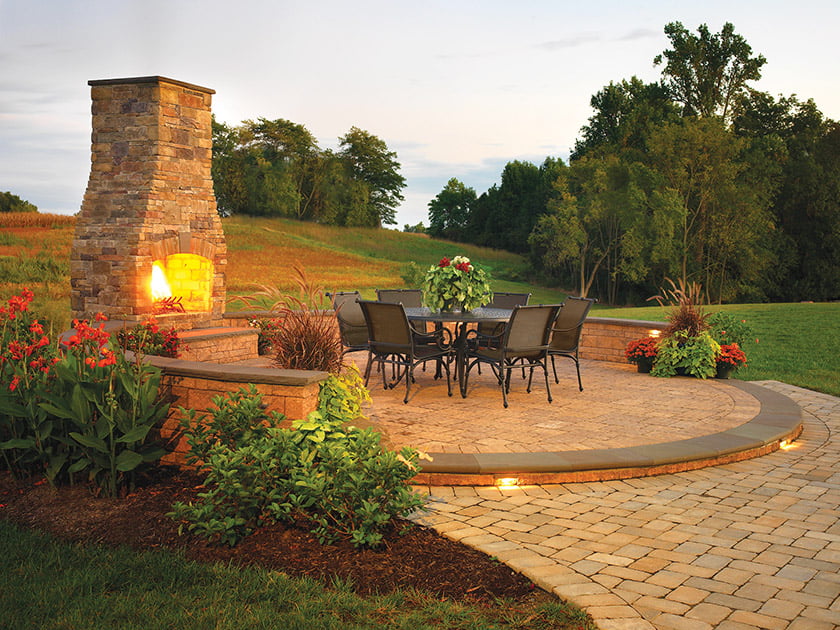 CIRCLE OF LIGHT Homeowners in Lothian, Maryland, enjoyed an expansive lawn and patio—but the property felt one-dimensional. They contacted Scapes, Inc., to create a focal point in the backyard that would be a draw for family and friends and a comfortable spot in which to entertain. “They envisioned a raised outdoor-living area beyond the patio,” recounts Scapes principal Jeff Crandell. He and his team conceived a circular gathering spot centering on a ledgerstone-veneer fireplace, flanked on each side by sitting walls. Strategically placed lighting illuminates the step up to the seating area, which is paved in engineered cobblestone from EP Henry. A mix of canna, hibiscus and annual blooms borders the structure, adding color and softness. Photo: Jeff Crandell

FAMILY FRIENDLY Clients in Leesburg brought a detailed wish list to Kane Landscapes when they were ready to convert their blank-slate backyard into a family-friendly retreat complete with pool and spa. “They wanted their home to be a hangout for their teenage kids, and for the pool to be near the spa, which would cater to the adults,” says principal Josh Kane, whose team designed and installed the pool and surrounding hardscape and integrated plantings, irrigation, low-voltage lighting and fencing. Techo-Bloc paves the pool scape, anchored by a picturesque waterfall; an outdoor fireplace and seating area are beyond the spa. Oakridge stone veneer clads the fireplace and Japanese cryptomeria and holly screen the property from the neighbors. Photo: Julie Kane
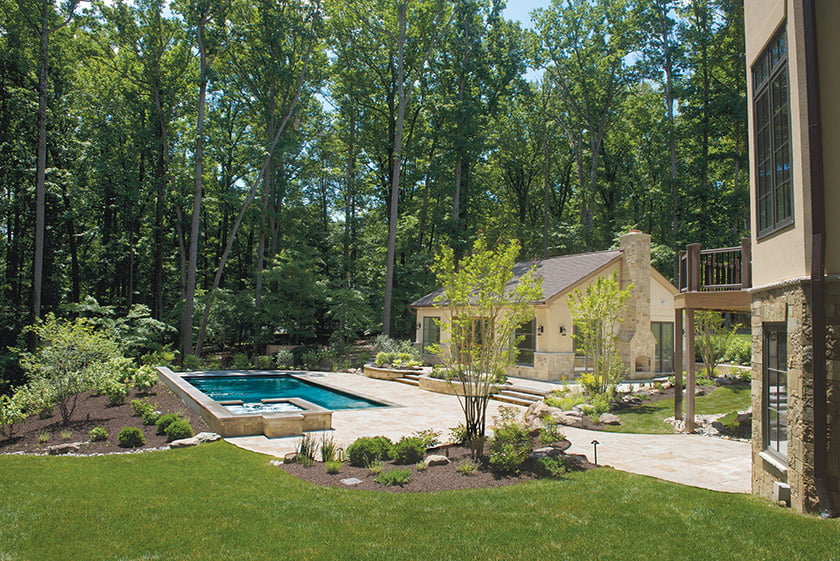
WOODED REFUGE Great Falls homeowners loved their mature forest of oak and tulip poplar—so when asked to design and install their swimming pool and pool house, the team at Fine Earth Landscape, Inc., strove “to impact the remaining trees as little as possible,” says landscape architect Bernie Mihm. To address grading and drainage issues that caused water to collect in the area slated for the pool, Mihm relied on planted or turf slopes for containment. Concrete piers support the travertine pool decking, which stands on fill. The pool wall and spa are veneered with Oklahoma Stone to match the house, while coping, spillover and retaining walls are capped with limestone. Plantings include crape myrtle, viburnum, hydrangea and coreopsis. Photo: Hilary Schwab
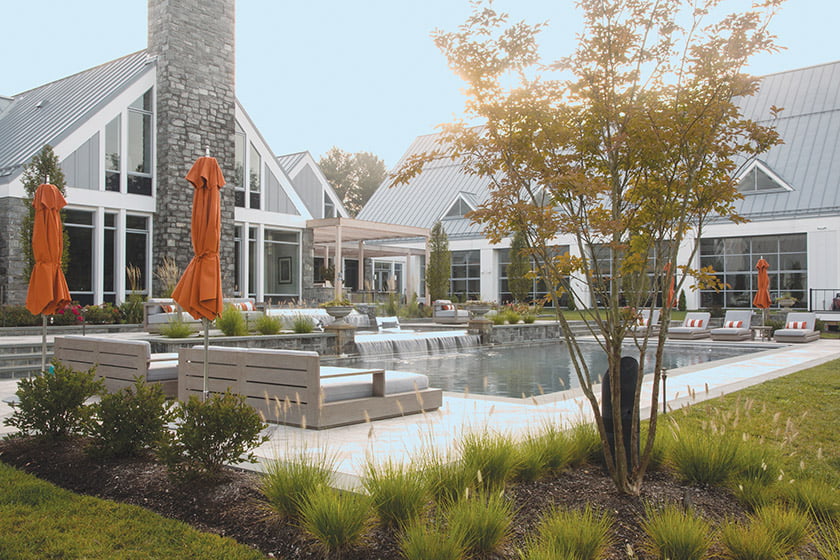
GARDEN SPOT While their new residence in Great Falls was under construction, clients hired State of the Art Landscape to transform the flat expanse surrounding it. “The site had a great deal of usable open space,” recalls principal Greg Powell. “The challenge was creating a sense of intimacy. The clients requested outdoor rooms to make it feel more residential.” The wish list included an elaborate pool scape to complement the home’s contemporary aesthetic; complete with waterfalls, a lounge basin and a spa, the finished project links to the house via extensive travertine and thermal-bluestone paving. An outdoor kitchen and fire pit provide gathering spaces, and maples, hornbeams, ornamental grasses, climbing hydrangea, crape myrtle, boxwood and Oso Easy roses soften the landscape. Photo: George E. Brown
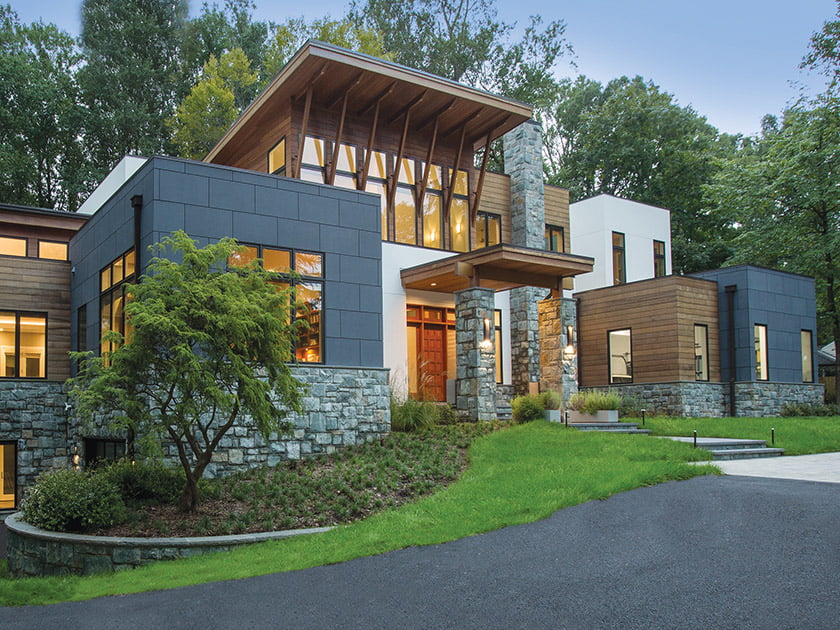
MODERN OASIS Clients in Great Falls envisioned a landscape plan that would mirror their home’s contemporary aesthetic. “They wanted an open feel that would be true to the modern architecture,” notes J.R. Peter of Colao & Peter Luxury Outdoor Living, who spearheaded the project. “Our job was to integrate the landscape with the house and with nature, establishing elegant, modern flow between the two.” He and his team employed granite and Techo-Bloc pavers to create the clean-lined hardscape. Features include masonry walls and a two-tiered masonry terrace in back, complete with a linear fireplace and an outdoor kitchen. A paver driveway leads to the house through automated cedar gates flanked by Carderock stone pillars. Photo: Curt Pulleyblank
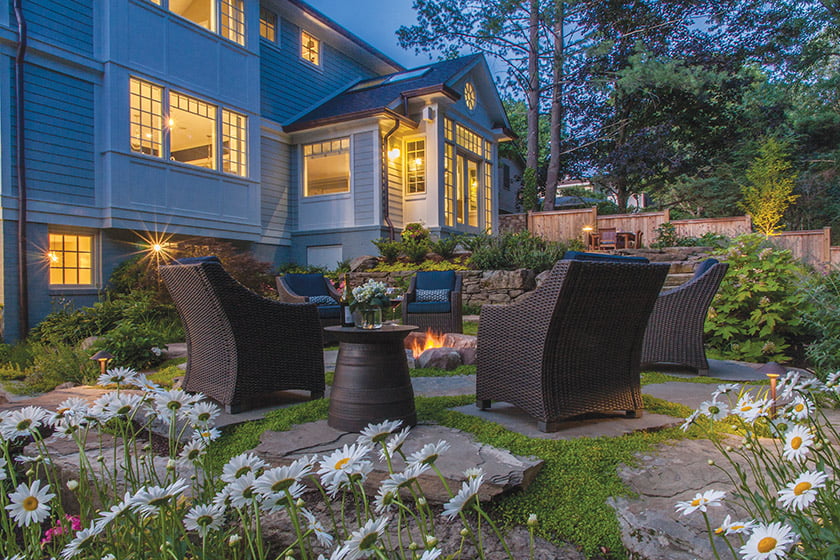
CREATIVE PLAN During a whole-house renovation of their McLean abode, clients hired Joseph Richardson Landscape Architects to make the most of their property’s dramatic, sloped topography. “The clients’ goal was to show how creative design can solve a property’s shortcomings,” principal Joseph Richardson says. He conceived a tiered plan beginning with an upper terrace/grilling station and descending via boulder steps first to a dining terrace and then to a mid-level terrace (pictured) centering on a boulder fire pit and surrounded by lush plantings. A lower terrace accesses the kitchen garden. The project combines Pennsylvania flagstone and boulders, a mix of native and adapted plant materials and high-tech low-voltage lighting. The landscape, installed by Wheat’s Landscape, overlooks woods and a creek. Photo: George E. Brown
In keeping with its historic Somerset neighborhood in Chevy Chase, a 1937 brick center-hall Colonial boasted period charm, but sorely needed an update. The residents contacted Landis Architects/Builders for a whole-house renovation that would enlarge and modernize the interiors while retaining—and improving—the exterior.
”The owners’ most pressing issue was the size of the garage,” recounts Tahani Share, who spearheaded the project. “Both it and the driveway were only nine feet wide, which rendered them almost unusable.” A 16-foot-wide, front-facing side addition—which replaced a dilapidated sun room—solved the issue by extending the width of the existing garage, and also added three stories of living space above it. The project, which required approval by the county’s historic commission, also included a new rear patio complete with hot tub and al fresco dining space.
Share and her team safeguarded the home’s period details, enhancing the dingy brick façade with a pale taupe color. They clad the addition in HardiePlank siding and added a new garage door. The widened driveway is bordered by a stone retaining wall.
Renovation Design & Contracting: Tahani Share, Landis Architects/Builders, Washington, DC.
The owners of a penthouse in The Darcy in Bethesda wanted a contemporary upgrade. They contacted architect Greg Wiedemann to design a sleek remodel that would forge a better connection with the unit’s rooftop terrace. “The goal was a light-filled space that would draw you in and then up,” Wiedemann says. “We took the relatively dark and asymmetrical space and imparted clean lines and lots of light and glass, with enough wood to make it warm and inviting.”
The plan hinged on replacing a wood stair that divided the entry from the main living area with one made of glass. “The glass stair allows light to descend from the upper level and transforms the once-dark plan,” Wiedemann explains. Made of low-iron structural glass with stainless-steel anchors, the new stair’s glass rails and etched-glass treads also allow uninterrupted views through the unit. The adjacent wall is finished in Venetian plaster and the walnut base merges visually with the existing floor. Recessed LED strip lights illuminate the treads while complementary Tech Lighting glass pendants hang overhead.
Renovation Architecture: Greg Wiedemann, AIA, Wiedemann Architects LLC, Bethesda, Maryland. Renovation Builder: Alliance Builders, Annapolis, Maryland.
McCormick, the spice giant founded in Baltimore in 1889, has embraced collaboration and sustainability in its new global headquarters. Located in Baltimore’s Hunt Valley, the seven-story, 350,000-square-foot campus consolidates more than 1,000 employees from four locations into one light-filled, modern environment combining next-generation workspaces with facilities for research and development.
The $170 million project began as a renovation of an existing office building, spearheaded by the DC-based office of STUDIOS Architecture, which stripped the structure down to concrete and steel, enclosing it in aluminum and nearly 85,000 square feet of high-performance glass. IA Interior Architects’ DC office masterminded the interiors, which received a 2019 AIA Northern Virginia award. A soaring atrium and skylight channel light into the building’s core; a 60-by-20-foot display screen anchors one end. The first floor incorporates test, demonstration and culinary kitchens for recipe and product development, flavor forecasting, presentations and filming—including a demonstration kitchen facing a 50-seat auditorium. The upper floors hold flexible workstations and collaboration areas while executive suites and a rooftop terrace occupy the top floor. Custom carpets sport company branding, in colors inspired by spices (think anise, cinnamon and vanilla).
An indoor green roof above the atrium blooms with native Maryland plants.
Furnishings are made with locally sourced wood and recycled, low-VOC materials. The waste-management system reduces energy use. Insulated glass and a horizontal sunshade system on the south-facing elevation bathe the interiors in light while shielding unwanted solar gain. The building is slated for LEED Gold certification.
Architecture: STUDIOS Architecture, Washington, DC. Interior Architecture: IA Interior Architects, Washington, DC. Contractor: Gilbane Building Company, Washington, DC. Photography: Eric Laignel.
Dubbed Sanctuary for its down-filled cushions and generous size, this modular sectional is part of a seating collection by Bernhardt. Composed of slipper and corner chairs and ottomans, it offers multiple configurations and can be customized in a choice of hundreds of fabrics. Available locally at Belfort Furniture. belfortfurniture.com; bernhardt.com
Astair, a chic armchair designed by Pierre Charpin for Ligne Roset, combines comfort and playful style. Its deft construction features sturdy suspension with steel springs layered between high-resilience foam pads, supported by a tubular-steel frame. A matching round footstool and low pedestal table are also available. ligneroset-dc.com
Designer Alexa Hampton riffs on classic French furniture with the Mirabella Writing Table, part of her collection for Theodore Alexander. Crafted of mahogany with a gilt, tooled-leather inset and flower-head fretwork, the three-drawer piece comes in multiple finishes through area Sheffield Furniture & Interiors locations. sheffieldfurniture.com; theodorealexander.com
Sergio Bicego updates his modular Pixel seating system for Saba Italia with Pixel Light, a streamlined version with a slender silhouette (the sectional sofa is pictured). Marrying form and flexibility with a customizable back and armrests, it’s available through Theodores in a range of configurations and leather and fabric options. theodores.com; sabaitalia.it
The works of American artist Hunt Slonem are inspired by nature. Best known for his series of bunnies, butterflies and birds, Slonem’s canvases can be found in 250 museums world-wide. Pictured here, Untitled, in oil and acrylic with diamond dust, is available through Merritt Gallery in Chevy Chase and Renaissance Fine Arts in Baltimore. merrittgallery.com
A traditional silhouette characterizes the Gigi Skirted Full Swivel Chair from Mitchell Gold + Bob Williams—but a crisp, tailored skirt keeps its lines updated and clean. Part of a collection that includes sofas, chairs and ottomans; most pieces are also available in fabric or leather with tapered-wood legs. mgbwhome.com
cool+collected continued…
Going Virtual: A host of local furniture showrooms offers remote shopping and online design services.