After raising four kids in a sleepy Chevy Chase, Maryland, enclave, Jodi Macklin was ready for city living on a smaller scale. When her youngest went off to college, the designer approached a real estate agent: “Find me a dump in Georgetown,” she requested.
A year later, the agent delivered with an 1890 row house that had just been gutted in the heart of the venerable DC neighborhood. “I opened the door and there was literally no drywall and barely any floor. I texted my husband, ‘We’re done,’” Macklin laughs. “We hadn’t looked or really even talked about moving yet!”
With buy-in from a surprised Rodd Macklin, a financial analyst, the designer was ready to go; she’d always envisioned doing her next house from the ground up, and this was her chance. “I didn’t want to pay for someone else’s kitchen that I didn’t like but they’d just done,” she explains. “I wanted to do it all myself.”
A dream team was quickly assembled for the job. Architect Anne Decker had worked with Macklin on numerous projects, while builder Richard Zantzinger had constructed her previous house. Campion Hruby Landscape Architects would tackle the dilapidated yard. As Macklin tells it, she’d been planning this project for years. “I knew what I wanted before I ever saw the house,” she avers.
“Jodi’s view was modern, and we love that juxtaposition of old and new,” Decker relates. “We distilled the body of the house to simplify its lines and bring the outside in. And we tried to create a grander scale. We wanted the house to live larger than it is.”
Now complete, the 2,800-square-foot dwelling features an open-plan, main-floor living/dining area elevated by 11-foot ceilings. A wide, cased opening to the kitchen with pocket doors delineates the spaces while fostering easy flow and sightlines to the backyard. Interior doors extend to the ceiling. A reveal replaced traditional baseboards; doors and windows are unadorned by trim.
Natural light pours in via a skylight above the sculptural, glass-and-white oak stair. Floor-to-ceiling, glass-and-steel doors in the kitchen spill out to the backyard. A four-and-a-half-by-nine-foot panel of glass in the dining area overlooks the side garden. “We took a big bite out of the wall to bring light into the heart of the house,” the architect explains. The glass expanse frames an up-lit magnolia nestled in pea gravel for a picturesque tableau.
Macklin envisioned a kitchen outfitted with black cabinetry and dramatic swaths of Nero Marquina marble—black with strong swirls of white—for the countertops and backsplash. “Black was the perfect choice,” enthuses Decker, who designed the space with marble-framed niches for the sink and range. “The walls recede and your eye immediately goes out to the back.” The palette continues in the moody powder room, clad in textured, black wallpaper.
A staircase with a landing was removed in favor of a stairway that runs straight up, making room on the second floor for a spare guest room. The serene primary bedroom flows into a luxe bath, which Macklin calls “a little slice of heaven.” It boasts a frosted glass-enclosed shower and a custom vanity. Nero Marquina marble adorns the floor and vanity. An ensuite bedroom across the hall awaits their son’s visits from college.
The existing basement was small and dark, with low ceilings. An extensive excavation created a welcoming lower level that utilizes the whole footprint. Media, laundry and guest rooms, plus a bathroom and exercise zone, are part of the mix.
When it came to furniture and finishes, Macklin channeled her minimalist design philosophy. “I gravitate towards ‘less is more,’” she says. “It makes me feel like I can breathe.” She and Decker repeated the same color and material elements throughout—white oak floors and Nero Marquina marble, which crops up again as a sleek surround on twin fireplaces in the living and dining areas. A palette of black, white and gray on the main level is warmed by earthy accents on upholstery and rugs. The designer bought everything new for this fresh chapter, from the white sofa and swivel chairs in the living area to the velvet-upholstered dining chairs.
On the main level, four mirrored cabinets designed by Decker and fabricated by Atrium Interiors ingeniously solve home-organization issues. “Thanks to Anne, I have a lot of storage in a house that has no closets,” Macklin declares. Each freestanding unit plays a unique role: a coat closet, a TV cabinet, a walnut-paneled bar.
Landscape architect Amber Phaire, who has since left Campion Hruby to launch her own firm, mirrored the home’s clean lines in her backyard design. “The lot jogs out sideways to meet the footprint of the garage,” she recalls. “This configuration created an upper dining terrace beside the garage and a lower rear terrace by the back door.” In the side yard, ornamental trees nestle in pea gravel. Hardscape and plantings balance airiness and warmth.
These days, Macklin is enjoying her downsized abode, perfectly tailored to her vision. “I’m so happy here,” she says. “Our previous house had gotten too big. In this one, we use every inch.”
Renovation Architecture: Anne Y. Decker, AIA, principal; Amanda Mosher, AIA, project manager, Anne Decker Architects, Bethesda, Maryland. Interior Design: Jodi Macklin, Jodi Macklin Interior Design, Washington, DC. Renovation Builder: Richard Zantzinger, Zantzinger, Inc., Washington, DC. Landscape Architecture: Amber Phaire, ASLA, PLA, Campion Hruby Landscape Architects, Annapolis, Maryland. Landscape Contractor: Somerset Stoneworks, Bethesda, Maryland.
RESOURCES
THROUGHOUT
Stonework: imaginesurfaces.com through rbratti.com.
DINING ROOM
Light: siemonandsalazar.com. Chairs: cuffstudio.com. Chair Fabric: hollyhunt.com. Dining Table & Fireplace Surround: Custom through oldtownwoodworking.com. Art on Walls: robinroseart.com; cushnerama.com. Mirrored Cabinets: Custom through atrium-interiors.com.
LIVING ROOM
Sofa: custom through gretcheneverett.com. Rug: interiors.hollandandsherry.com. Club Chairs: aneesupholstery.com. Coffee Table: atrium-interiors.com. Side Table: andriannashamarisinc.com. Fireplace Surround: oldtownwoodworking.com. Art on Walls: colbycaldwell.com; andyfriedman.net. Mirrored Cabinets: Custom through atrium-interiors.com.
STAIRWELL
Art: ellsworthkelly.org.
KITCHEN
Cabinets, Millwork & Island Stone: atrium-interiors.com. Counter Stools: bakerfurniture.com. Light over Island: apparatusstudio.com.
POWDER ROOM
Sink: atlasplan.com/en-us. Faucet: brizo.com through build.com. Sconces: articolostudios.com. Wallcovering: gregoriuspineo.com.
GUEST BEDROOM
Bed: roomandboard.com. Bed Linens: matouk.com. Pillow Fabrics: romo.com; fabricut.com. Bedside Table: crumpandkwash.com. Hanging Reading Light: alisonbergerglassworks.com.
PRIMARY BEDROOM
White Boucle Chair: suiteny.com. White Boucle Chair Fabric: romo.com. Window Treatments Fabrication: gretcheneverett.com. Window Treatment Fabric: otistextiles.com. Wall Reading Sconces: apparatusstudio.com.
PRIMARY BATHROOM
Soaking Tub: signaturehardware.com through fergusonhome.com. Sconces: articolostudios.com. Vanity: gilmerkitchens.com.
BACKYARD
Sitting Area: tribu.com. Dining Table & Chairs: dedon.de/en-us; janusetcie.com. Exterior Paint: Iron Ore by sherwin-williams.com.
When Chris Boutlier made his first DC real estate purchase, his husband, David Cromer, asked him, “Are you insane?” The condo, occupying the top two floors of a 1910 row house in Columbia Heights, was a dated sea of yellow travertine, orangey terracotta and cherry wood, with a choppy layout that blocked sightlines.
“I told him, ‘I promise, it will be very cool when I’m done!’” the designer recalls with amusement.
He had a distinct vision that sprang from a particular source: a biography of New York art dealer Samuel Wagstaff, an intimate of Robert Mapplethorpe and one of the first collectors of fine art photography in the U.S. (Upon Wagstaff’s death in 1987, his collection went to the Getty Museum.) “I became interested in that 1980s period when Wagstaff lived in New York City,” Boutlier recounts. “Spaces were being redone to double as homes and art galleries. The gallery world was open, white-box spaces with black leather and chrome.”
Boutlier was excited to embrace that sleek, graphic aesthetic—but the 1,500-square-foot unit had been renovated badly in the 1990s and an intervention was in order first. He and Cromer “spent a lot of money redoing the internal components,” Boutlier says. “We installed new HVAC, water heaters and plumbing.” Trim, baseboards, doors and casings were all updated, and odd ceiling heights corrected. Switches, outlets and recessed lights were replaced.
Structural changes also took place. The entrance to the abode is accessed from street level via a staircase. To create a foyer and a sense of openness, Boutlier reorganized spaces: The powder room shifted locations to allow for a short hallway; it runs past a newly added laundry room and closets to a spare bath and a bedroom used by the couple as a home office. The hall provides a sightline to a back balcony, visible from the stair.
The once-outmoded kitchen, which anchors one end of the living/dining area, got an overhaul that retained its footprint while transforming it with fresh, contemporary custom finishes. Black-stained oak cabinets are paired with Statuario marble countertops and backsplash showcasing dramatic swirls of gray and taupe.
The upper floor is now a dedicated primary suite. On the street-facing end, Boutlier switched out a problematic beam for one of steel, bringing functionality to a disused room tucked into the eaves; it became a home gym accessed from the bedroom via French doors.
The primary bath was reimagined in hotel-spa style, with a marble-clad shower replacing the tub and an oddly angled toilet relocated inside a WC. Nero Marquina marble tops the black-stained vanity and clads the floor in hexagonal mosaic tiles. The closet, which connects the bedroom and bath, is lined with sleek, custom cabinetry made of dark oak.
According to the designer, the existing stair adjoining the main and second levels “was the one nice treat in the house.” He kept its basic steel structure and replaced the treads with white oak. Corehaus DC fabricated a black-steel louvered screen to replace a wall of glass that doubled as the stair railing. A half railing of the same material was installed on the upper level.
A graphic, black-and-white palette prevails throughout, warmed by white oak floors that replaced orange-hued planks. Boutlier applied a white limewash to exposed, red-brick walls. “I wanted the texture of the brick, but for it to feel light and airy,” he explains.
Against the backdrop of expansive, white walls, mid-century and contemporary furnishings in glass, chrome and shades of black were purchased to reflect the gallery-esque aesthetic Boutlier had envisioned. A Mies van der Rohe coffee table was placed before a DWR sofa in the living area, while vintage Italian leather chairs surrounded a glass-and-steel dining table. Upstairs, the primary bedroom featured a vintage Dunbar lounge chair, ottoman and nightstands and a Brutalist dresser. Throughout the dwelling, pieces were positioned to enhance bold, modern art and photography hung or leaning, gallery-style, along the walls.
While Boutlier and Cromer have since moved on to an abode in Georgetown, the designer remembers this first home with great fondness. “I never really thought my skills as a designer would afford me the opportunity financially to do the things in my own home that I was doing for clients,” he reflects. “While we lived there, I felt so lucky. This house was especially meaningful to me.”
Renovation & Interior Design: Christopher Boutlier, Allied ASID, Christopher Boutlier Interiors, Washington, DC. Renovation Contractor: District Contracting Group, Washington, DC. Photo Styling: Kristi Hunter.
A peninsula that points due south into the Chesapeake Bay has lured summer sojourners to Annapolis since the 1920s. Back in those pre-air-conditioning days, the scenic spot was a warm-weather resort boasting several dozen small cottages where DC and Baltimore residents converged to beat the heat. Over the years, the cottages disappeared as a new era of vacationers purchased lots and razed dated buildings to create their own getaways.
Among these were Jill Daschle and Richard Cuite, Washington-based financiers who built a spacious retreat for their family of four in 2010. Seven years later, they scooped up the lot next door to construct a guest house on site. Then in 2020, the last lot in the resort went up for sale—one that abutted their property. The couple added it to the mix, envisioning a new pool and a cabana there.
The journey to the three-acre compound they now enjoy—full-time since covid—was circuitous, due to critical area restrictions. Thankfully, architect Marta Hansen, who’d designed her own house a stone’s throw away, provided the roadmap the couple needed. “I’d been in Marta’s home. It’s all about being a part of the water and the environment, which is what I wanted to create for us,” Daschle recalls. “And Marta had a lot of experience working with the county on permitting.”
The couple hired Hansen to conceive the guest house and cabana. Having completed the owners’ previous residences, DC-based interior designers Jose Solis Betancourt and Paul Sherrill were also on board. And Campion Hruby Landscape Architects, who designed the main site, returned to tame and integrate the new parcels into a cohesive plan.
County regulations required each new structure to occupy the footprint of what stood before. Two cottages were razed to make way for the guest house and cabana, while a swimming pool replaced a third cottage.
The four-story, 3,450-square-foot guest house went up first. “We abstracted a traditional, gabled form with simple massing and minimal detailing,” Hansen says. “In the new building, wall-to-wall windows on the south face take in the coastal setting on three levels, with smaller windows on the east and west sides for privacy.” A main-floor deck and second-floor balcony provide al fresco options for lounging.
The 700-square-foot cabana mimics the guest house’s architecture and material palette. A bar at the far end hides pool storage and a luxe bathroom. Both buildings are clad in durable Boral siding and trim to withstand the estuary environment—and painted to match the main house. Horizontal ipe panels accent both structures and form all the decking.
The guest house encompasses an open-plan main level with a Poliform kitchen, plus dining and lounge areas. A basement contains storage and a full gym. Second and third floors feature a total of four ensuite bedrooms. “They are all more or less the same,” says Daschle, noting, “We were going for a boutique hotel feel.”
Solis Betancourt and Sherrill masterminded the interior architecture. “We worked with Marta and Jill, tweaking the kitchen layout and adding subtle details,” Sherrill recounts. The designers conceived a sculptural, floating wood stair that spans three floors; in lieu of railings, glass panels meet the ceiling for a cleaner look. Throughout the house, linear trays on the ceilings contain recessed lights, sprinklers and speakers, adding interest while keeping the expanses quiet and uncluttered.
The designers followed their client’s mandate on finishes and furniture. A modern aesthetic prevails, with clean-lined, low-slung furniture in quiet hues that send attention out to the scenery. “Jill wanted the interiors to relate to the main house, which is serene and comfortable,” says Solis Betancourt. Shiplap siding, gray-washed oak floors and a palette of blues and grays are among the repeated elements.
Landscape architects Kevin Campion and Meredith Forney Beach extended their plan for the main house to encompass the overgrown additional lots. “The clients wanted more privacy and the feel of an oasis,” Beach says. Working around a challenging 100-foot buffer, she and Campion collaborated with Hansen to position the pool, with its bluestone surround, conveniently between the main house and other structures. Shoreline plantings including grasses and hydrangea lean native, while Loblolly pine, swamp white oak and river birch punctuate the grassy yard.
A spring-fed wetland now thrives at the water’s edge—thanks to Daschle, who has labored for the whole community to eradicate invasive phragmites that would otherwise swallow it up. Such vision and effort have reaped rewards at her family’s welcoming retreat. “This place affords us the chance to have all the people we love in our life around us,” she enthuses. “We use it to bring people together.”
Architecture: Marta Hansen, AIA, Hansen Architects, Annapolis, Maryland. Interior Design: Jose Solis Betancourt, Paul Sherrill, Solis Betancourt & Sherrill, Washington, DC. Cabana Builder: Emory Construction LLC, Annapolis, Maryland. Landscape Architecture: Kevin Campion, PLA, ASLA; Meredith Forney Beach, PLA, ASLA, Campion Hruby Landscape Architects, Annapolis, Maryland. Landscape Installation: Olmo Bros. Construction & Landscaping, Annapolis, Maryland.
After spending 30 years in California, doctors Taraneh Razavi and Stuart Schlisserman became bicoastal when they purchased a modest, circa-1950 rancher in Chevy Chase to live in part-time. Raised in the DC area with relatives nearby, Razavi had always pictured returning someday—but the allure of this particular abode was its location next door to her aging mother. “Family is important to us,” Razavi explains. “We wanted a gathering place for everyone near my mother.”
The rundown, 4,198-square-foot structure hadn’t been renovated since the ’70s, so an immediate redo was first on the agenda. The owners, who have grown children and grandkids, hired Landis Architects | Builders to achieve their vision. “They wanted to be close to family but still have a home that feels like California,” explains project manager Jim Caw. “They requested a high level of finishes, greater functionality and aging-in-place features that would allow Taraneh’s mom to navigate the space.”
The Landis team gutted and rebuilt the single-story house, removing portions of the foundation walls and replacing the roof. Conceived by project designer Chris Williams, a three-story, 4,928-square-foot residence took shape on the original footprint. “It was important to the owners that it fit into the neighborhood and not be out of scale, but they did prefer something more modern,” Williams relates. “So, although the rooflines and forms are traditional in terms of sizing, the building materials are contemporary.”
Nichiha siding—a durable, cementitious material—clads the exterior. The pre-finished, two-by-three-foot panels resemble blocks of sandstone and are stacked in front of a rain screen that creates a moisture barrier. Marvin windows were installed throughout, and a path flanked by sleek cable rails leads to an inviting front porch. An exterior plan by landscape designer Tomi Landis implemented extensive hardscaping and plantings in both front and back for a lush, welcoming feel.
A bump-out in front accommodates a flagstone porch that doubles as the main entry, imparting visual interest to the home’s front facade. The reconfigured main level boasts a center-hall layout, with a spacious entry leading to a dining room on one side and a powder room, primary suite and den on the other. Extending the rear wall of the structure by about four feet allowed for an airy great room at the back of the house; it contains a sitting area, a luxe kitchen and a breakfast nook within a bay. Sliding-glass doors open out to a flagstone patio equipped with an outdoor kitchen.
The project added on a full second story that accommodates four bedrooms; two are ensuite while the other two share a bath. The existing basement was finished and features a full bath and an exercise room equipped with a kitchenette. The garage remained at the side of the house, but its opening was shifted from the side to front-facing.
When it came to the interiors, Williams worked with staff interior designer Zulma Puhl to realize the clients’ wishes. “They wanted a high-end retreat that would be sleek and modern but also organic and soft,” Puhl recounts. “That combination really captured the essence of their California home.”
Clean-lined, airy rooms are full of natural light. Eight-foot-tall interior doors, trim-less windows with stone sills and wide-plank, white oak floors all contribute to a light, contemporary feel. A new staircase marries oak treads with iron balusters in a tuning-fork motif. Book-matched quartz slabs surround the fireplace in the great room, where vaulted ceilings elevate the sitting area and breakfast nook.
Williams designed the roomy kitchen lined with custom, solid and veneered white oak cabinetry by Henrybuilt. Puhl added Silestone countertops and backsplash along with flourishes such as fluted panels on the island front. Floating vanities with integrated stone basins grace the dwelling’s primary bath, where large-format porcelain tiles conjure a contemporary vibe.
Razavi selected what she terms “refined modern” furniture and lighting with an assist from Zahraa Alwash of ZEE architecture + interior design. Comfortable upholstered pieces in a neutral palette marry modern silhouettes with pops of color for warmth.
A main priority of the remodel was accessibility. With that in mind, Williams and his team installed an elevator that connects all three levels, situated the primary bedroom on the main floor and installed a curb-less shower and linear drain in the bathroom for wheelchair accessibility. And since the idea was to integrate Razavi’s mother into the household, a path now connects her home with the renovated one next door. “My mom likes her own space,” Razavi says. “This way we can always be close by.”
Architectural & Interior Design, Contracting & Landscape Design: Chris Williams (project design), Jim Caw (project manager), Zulma Puhl (interior design), Tomi Landis (landscape design), Landis Architects | Builders, Washington, DC. Landscape Installation: Great American Landscapes, Clarksburg, Maryland.
DRAWING BOARD
Q&A with Landis Architects | Builders
WHAT AMENITIES DO YOU RECOMMEND SPLURGING ON?
Zulma Puhl: Lighting and stone are a great splurge because they have a huge impact. Extending the stone to the backsplash made a dramatic statement here.
SHARE YOUR FAVORITE SIDING MATERIAL.
Jim Caw: I prefer durability, a longer life and no maintenance. We use a lot of Hardie products for that reason. They’re constructed with a cement-fiber base.
HOW OFTEN DO YOU ENCOUNTER SURPRISES ON A REMODELING JOB?
Jim Caw: Every project has a surprise that arises once you demo and see what’s there. After that, changes can be up to you instead of up to the house.
HOW SHOULD CLIENTS WEIGH BUDGET CONSTRAINTS?
Andrew Kerr, COO: I always start with the infrastructure. You need a solid foundation; you don’t want to put lipstick on a pig. I tell clients things can be done later if the right foundation is in place.
Outside DC, the Potomac River wends its way past Bethesda’s quaint Glen Echo neighborhood, where homes in a patchwork of architectural styles border tree-lined streets. Inclining uphill, one such byway is flanked mostly by modest Cape Cods—but a couple of years ago, a bold, modern abode joined the mix.
Owners Karen and Don Thibeau, a real estate agent and retired nonprofit executive respectively, had lived for 35 years at the top of the same street, in a mid-century residence that satisfied their penchant for contemporary design. They also owned a nondescript rental property just down the hill featuring a tiny, two-bedroom Cape. When they decided to build a new house for themselves, they selected that slice of land. “We loved our previous home, but wanted to design one where we could age in place,” Karen explains.
The couple envisioned a modern dwelling scaled to fit its modest neighborhood. They tapped Janet Bloomberg of KUBE Architecture to turn their vision into reality. Contractor HaighDeCastro and Campion Hruby Landscape Architects’ Stephen Makrinos also joined the team. Karen, who has a background in commercial design, decorated the interiors with input from Bloomberg.
On the small, 6,700-square-foot lot, a mature oak tree dominates the front yard. Houses are close in on three sides. “We tried to be as nonintrusive to the neighbors as possible,” says Bloomberg, “so maintaining the site naturally was really important.” She eschewed regrading and designed the structure around the oak, cantilevering it several feet over the tree’s massive root system. Utilizing the existing basement was a cost-saver that also minimized the impact of construction on the land.
The mandate was to devise an open, modern building that would offer privacy as well as indoor-outdoor flow. “The Thibeaus love the outdoors and that relationship,” Bloomberg recounts, “so one goal from the beginning was to create almost as much outdoor as indoor space.”
Now complete, the home measures 3,225 square feet, with four bedrooms and three and a half baths; courtyards extend its livable spaces. A central, two-story zone containing the kitchen and living area boasts 20-foot-tall expanses of glass on both front and back; multi-slide glass doors open to the large rear courtyard, creating one big indoor-outdoor space. The dining room and front entry lie on one side of the kitchen/living area. The main-floor owners’ suite, located on the other side, was designed with accessibility in mind. In the front-facing home office, a picture window frames the venerable oak. The building’s side walls are solid, save for clerestory windows that let in light but maintain privacy.
Upstairs are two guest bedrooms and a hall bath. Another bedroom and bath, plus a library nook, are reached via a catwalk that spans the living area below. East- and west-facing courtyards open out—one through a glass door by the stair and the other from the nook. The original basement is now a finished recreation room for grandkids. Crawl spaces under the new parts of the house provide storage.
Bloomberg clad the home’s glassy exterior with stucco and shou sugi ban, or charred wood. Inside, the floors are white oak, and black steel makes a statement in the living area where it forms the stair and integrates with the two-sided Viroc fireplace opposite. The upper-level railing wraps the space on three sides. This sculptural composition of steel panels, slats and screens also anchors the stair—and it’s a showstopper. Says Bloomberg, “We wanted to do something that would be like a piece of art, and relate to the owners’ modern art collection.”
Slats and panels are a theme outside as well. The main-level courtyard is protected by a fence of horizontal shou sugi ban panels, which conceal a hot tub. Slatted cedar screens, painted dark to match the charred wood, were crafted specifically for their locations around each courtyard, angled to answer privacy needs or for orientation to the sun.
Karen, who loves to cook, requested Bloomberg duplicate her previous kitchen in the new house—but with a welcome change from maple cabinets to easy-maintenance laminate. The sleek, black-and-white cabinetry was custom-made by Mersoa Woodwork and Design and is complemented by a wall of shou sugi ban. A fan of bright colors, Karen specified bold accent walls throughout. Most of the furniture and modern art was repurposed from the couple’s previous home.
Landscape architect Steve Makrinos designed a Japanese courtyard garden to complement the structure’s modern aesthetic. “Our goal was to maximize privacy while maintaining a light, open-courtyard atmosphere,” he says. Stands of bamboo create a privacy screen and planters filled with rough horsetail reflect a minimalist sensibility.
Despite its small footprint, the house lives large due to 10-foot ceilings that make spaces feel larger than they are. “We didn’t need a huge house,” reflects Karen. “We just needed it to work for us. This way, we can live here forever.”
Architecture: Janet Bloomberg, FAIA, principal; Jorge Concepcion, design associate, KUBE Architecture, Washington, DC. Contractor: Tim Haigh and Paulo DeCastro, HaighDeCastro, Washington, DC. Landscape Architecture: Stephen Makrinos, PLA, ASLA, principal, Campion Hruby Landscape Architecture, Annapolis, Maryland.
RESOURCES
THROUGHOUT
Fabrication: Metal Specialties; 540-967-4836. Cabinetry: mersoa.com. Countertops: countercollective.com; caesarstoneus.com through marblexinc.com. Appliances: subzero-wolf.com through adu.com. Pendant Lighting: moooi.com through illuminc.com. Plumbing Fixtures: totousa.com; duravit.us; hansgrohe-usa.com through build.com. Furniture: dwr.com; bludot.com. Windows & Doors: windsorwindows.com through thesanderscompany.com.
DINING ROOM
Paint: Aura Spice by benjaminmoore.com.
OUTDOOR
Gas Fire Pit: paloform.com.
Jodi Berger grew up in Potomac—so when she and her husband Adam returned to Maryland after six years in the New York area, it was a natural choice to rent a townhouse in her old stomping ground. After a couple of years, they purchased a 1988 Colonial a block away from the designer’s childhood home.
The 4,640-square-foot, four-bedroom house was in good shape, but its interiors were dated and traditional. Orange-hued cherrywood ran amok, from the kitchen and family room to the home office. Chair rails, wainscoting and heavy trim adorned nearly every room. Berger, whose taste runs contemporary, jumped right in.
“I gave myself a blank slate, painting the walls white and removing much of the millwork,” she recalls. “And I stained the red oak floors light, which gave me a start on the palette.” The kitchen immediately got a major facelift. The rest of the redesign happened piecemeal over six years, during which every room in the house was transformed. In the meantime, Berger and her husband welcomed two daughters, now one and three years old.
Reconfiguring the basement—home to the nanny’s quarters, a playroom and JLA Designs’ studio—is next. A Q&A details the design process so far.
Define your aesthetic and the ways it’s reflected in your home.
We call ourselves “classic contemporary with a twist,” which I think of as fresh, bright and modern. Here, I left enough traditional architectural details—for instance, the wainscoting in some rooms and the curved stairwell—to make it feel transitional. Keeping those elements allowed me to bring in modern influences. I replaced a classic, checkered-marble floor in the foyer with a large-format porcelain version in light gray and white, paired with an ombré stair runner and abstract wallpaper.
How did you modernize existing elements?
We kept the cherry built-ins in spaces like the family room and home office but simplified their trim and gave them a high-gloss lacquer. We replaced white-framed windows throughout the house with new Andersen ones and painted the wood frames black.
Describe your color palette and how it impacts the design.
I went with black, white and gray with gold accents to create drama through contrast. I gravitate to neutrals; I see color all day in my work and find it hard to infuse it into my own home.
Share your take on wallpaper.
I would put wallpaper in every room if I could! It adds so much depth and texture, it just completes a space for me. When I couldn’t find a wallpaper I wanted, I designed something and had my faux painter, Nicolette Capuano, create it. My designs are always watercolor-y and ombré, going from light to dark.
Detail the design of your living room, which exemplifies your style.
I think of it as my Chanel room—no kids’ toys or chaos. I designed the organically shaped rug, made by Carpet Creations, with all my colors. I chose a curved Jonathan Adler sofa and designed the cerused-oak coffee table. I saw the textural wall covering and was obsessed with it! I painted the ceiling black for contrast. Since our office is on site, we often use my home as a showhouse to help clients visualize what’s possible.
How did you formulate your plan for furniture and rugs?
This is our first home, so we bought everything new for it. A lot of the rugs and furniture are custom pieces I designed and had fabricated.
What changed in the kitchen?
We used the existing footprint, but everything is new. I extended the island top for seating and added white cabinetry. I took down upper cabinets on one wall and extended the rest to the ceiling. A desk zone is now a pantry wall. The countertops, backsplash and shelves are quartzite; I’m a big fan of natural stone, which imparts a sense of history.
Explain your philosophy on decorating children’s rooms.
Kids’ rooms should have personality yet still be sophisticated enough to grow with your child—don’t put up alphabet wallpaper, for instance. In my older daughter’s room, we sponge-painted the ceiling in candy clouds and I designed a fluid pink stripe that’s painted on the walls.
Interior & Kitchen Design: Jodi Berger, JLA Designs, Potomac, Maryland. Kitchen Design: Amy Collins, Division12Design, Glen Echo, Maryland. Photo Styling: Charlotte Safavi.
After completing their custom, Richmond-area home, a couple hired designer Jamie Ivey to turn the unfinished walk-out basement into a chic zone “with a clean, hotel look,” she says. “We created space-planning options to figure out how to fit in everything they wanted.”
Plumbing was already roughed-in for a bathroom and kitchenette, so the designer worked around existing lines. Today, an expansive main room includes lounge, dining and conversation areas and a kitchenette. A well-equipped home gym occupies a spot framed out for a bedroom during the original construction. And a reading nook and craft room are part of the mix.
Ivey upped the game throughout with sophisticated finishes and custom details. A sleek, linear fireplace is clad in water-resistant tadelakt, a Moroccan-inspired limewash plaster. LED-lit ceiling coffers delineate zones. Walnut adorned with a brass reveal frames the reading nook and craft room, concealing ductwork and structural beams; it also forms a sculptural stair rail. The kitchen’s custom cabinets are paired with a backsplash and countertops of marble-look porcelain.
Pops of color and interest crop up via stylish, comfortable furnishings and lively art. Saturated in Benjamin Moore’s Montpelier, the reading nook beckons with built-ins and a luxurious daybed.
Interior Design: Jamie Ivey, Ivey Design Group, Richmond, Virginia. Contracting: Chopper Dawson Inc., Richmond, Virginia. Text: Julie Sanders. Photography: Ansel Olson.
TROPICAL TOUCH Kichler’s Nani fan conjures an island vibe with its five palm-leaf blades. Made of flexible, saltwater- and weather-resistant thermoplastic, with finishes in Matte White or Satin Natural Bronze. kichler.com
IT’S A WRAP The Modern Fan Company’s Leather Luxe Ceiling Fan marries a cylindrical base wrapped in stitched leather, wooden blades and an optional LED light. Intended for indoor use. Find in five hues at Design Within Reach. dwr.com
COOL COMBO Hunter’s Brookside Fandelier combines an LED light fixture and a concealed ceiling fan with three 29-inch blades. Suitable for small indoor spaces, it comes in Matte Black or Luxe Gold-Fresh White. Remote control is included. hunterfan.com
SIMPLE LINES Three angled, aluminum blades and a downrod comprise the minimalist, indoor-outdoor Superfan by Michael Anastassiades for Kettal. Controlled via Kettal’s Kode app or by remote. Choose among 33 hues, including Desert Storm. kettal.com
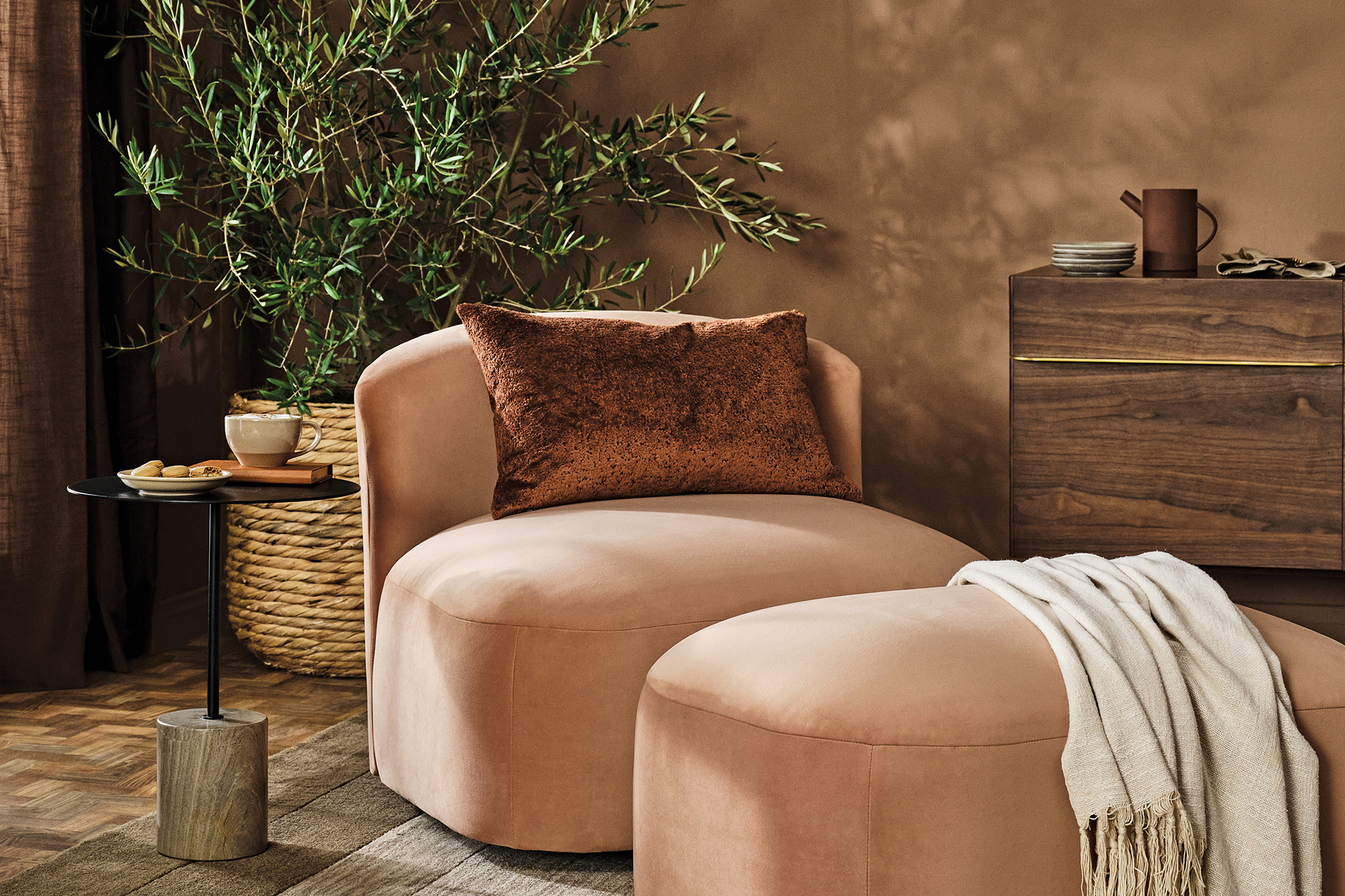 | COLOR COLLAB In partnership with color authority Pantone, Joybird has unveiled a new version of its Royale performance fabric in Mocha Mousse, the 2025 Pantone Color of the Year. The fine-knit velvet with fleece backing can be specified on more than 300 Joybird furniture selections, including the Amelia Grand Chair; joybird.com. |
 | SITTING PRETTY Designed by Elisa Ossino for Italian brand Dieffebi, the Club collection’s armchair and sofa feature painted-metal frames with leather stretchers on sides and backs. Cushions here are upholstered in Narita, from Camira's Sumi fabric line. dieffebi.com |
 | HAIR SAY Italian studio LucidiPevere conceived the playful Chignon chair for Gebrüder Thonet Vienna—and named it after the hairstyle that the chair back resembles. A beechwood frame completes the design; Kvadrat's Ria fabric is shown here. gebruederthonetvienna.com |
 | WHAT’S COOKING Constructed of metal with a steel or Fenix laminate top, Fantin’s minimalist, freestanding Frame kitchen cabinets come in a wide range of colors and finishes; Pink Clay is pictured. fantin.com |
 | OLD WORLD Marca Corona’s Longarine Calcecreta porcelain tiles mimic concrete and terracotta. Slender, rectangular pieces, pictured in a chevron pattern, come in seven colors; Spuma and Terracotta are shown. marcacorona.it |
Venerable Healy Hall is renowned on Georgetown University’s campus. The landmark building was conceived in the late 19th century by architects Paul J. Pelz and John L. Smithmeyer, who would later design the Library of Congress. Among its draws, the High Victorian Gothic structure is home to Gaston Hall, a grand, 750-seat auditorium spanning the third and fourth floors that is used for convocations, performances and even speeches by world leaders.
Over the years, the ornate venue, adorned with coats of arms and rich allegorical scenes, has undergone numerous updates. The most recent of these was orchestrated by architecture firm Hord | Coplan | Macht. “After more than a century of use, the cantilevered wood balconies had begun to show signs of fatigue,” explains project architect Pete Blum. “When occupied, they vibrated uncomfortably and visibly deflected.” Unsightly temporary posts had been installed that didn’t address the issue.
The design team’s intervention reduced vibration by replacing original iron crosses and tie rods that anchored the wooden support brackets with solid, stainless-steel fabrications. Existing wood beams were shored up for greater stability. Original carpentry, joinery and finishes were restored to match adjacent historic finishes, and a new, custom wool carpet was installed.
The project received a 2024 Merit Award from the AIA’s Northern Virginia chapter.
Renovation Architecture: Pete T. Blum, AIA, NCARB; Paul Lund, AIA, LEED AP BD+C; Justin Manongdo, Associate AIA, Hord | Coplan | Macht, Alexandria, Virginia. Renovation Contractor: The Christman Company, Washington, DC. Text: Julie Sanders. Photography: Anne Chan, Hord | Coplan | Macht.
“It is the materials’ own language, I seek to express,” the Danish, mid-century furniture designer Poul Kjaerholm once declared. His observation reflected not only his own philosophy but that of the modernist movement, which utilized materials to dictate form and function.
It was this ideal that first attracted a serious present-day collector, inspiring him to build a prodigious catalog of furnishings and decorative objects spanning the late 1920s to the 1960s. “What appeals to me are the clean lines, general sensibility and emphasis on functionality above all else,” avers the collector, an entre-
preneur in the technology world.
The fruits of this oeuvre—and an impressive array of contempory art—are on full display in the Kalorama row house he shares with his wife, a career civil servant. The couple bought the 1890 residence in 2017 as a backdrop for their collection. But differences in preference and design strategy hampered the process of furnishing and decorating the home. Multiple storage units needed to be sifted through (the trove includes some 190 chairs, for instance), and the vision was complicated by the goal of retaining the home’s traditional bones while modernizing its interiors.
The duo turned to designer—and fellow collector—Nestor Santa-Cruz for guidance. Says the wife, “My husband and I have different approaches. He collects because he likes an object. But I always want to know, ‘where will it go?’ We joked that Nestor was our mediator.”
Santa-Cruz brought what the collector calls “a strong foundation in both scholarly knowledge and broader design styles” to the project. “Nestor is an extraordinary resource,” he reflects. “He created an eclectic mix where pieces are in conversation with each other. His balanced perspective helped us understand how everything would come together.”
The three-story, 3,700-square-foot dwelling had been recently renovated when the couple purchased it. A foyer opening onto the living and dining rooms occupies the main floor, with the kitchen spilling out to the landscaped backyard. The second level houses the primary suite and a book-lined study where the wife works remotely. A guest room, hall bath and TV room span the third floor. High ceilings and south-facing windows celebrate natural light. The remodeled kitchen and bathrooms were classically conceived with white cabinetry and marble surfaces.
“The renovation embraced what I’d call a Washingtonian aesthetic—traditional and decorative,” Santa-Cruz recounts. “It has its personality, and that was critical. We determined what to keep from the original framework, to connect the story of the house with its new contents.”
Painting the interiors in Farrow & Ball’s neutral Ammonite was a first step. In the dining room, overbearing wallpaper was removed and existing built-ins adorned in raffia with Scandinavian hardware for a mid-century vibe. The original crystal chandelier nods to the home’s provenance while the living room draperies have been streamlined and shortened for a more contemporary look. Traditional light fixtures from the main floor moved to other parts of the house “to create a through-line,” Santa-Cruz explains.
The designer plotted a road map of furniture layouts for each room. He and his clients determined where to put the things that were in the house already and mined the storage units for treasures. Then, “we started with pieces I had already collected,” says the husband. “Nestor helped us identify which ones should be brought to the house and placed in specific rooms.” Along the way, additional items were purchased to fill in gaps.
Selections were made with careful consideration as to how they’d work together in each space. The aim was to land on a mix of provenances, materials and influences in each room. For instance, says Santa-Cruz, “we had a lot of Scandinavian pieces and wanted to bring in some American ones. So we added the living room sofa by Florence Knoll. It’s not a vintage piece but is juxtaposed with pieces that are.”
The main floor provides a taste of the home’s bounty. In the foyer, the Artichoke chandelier by Poul Henningsen illuminates a Fornasetti side chair beside a chest of drawers belonging to the wife; Santa-Cruz topped it with marble. In the living room, a steel-and-wicker PK-25 chaise by Poul Kjaerholm for Fritz Hansen and 1956 Gio Ponti Lounge Chair for Cassina face a vintage inlaid coffee table by Finnish designer Tapio Wirkkala. Saarinen chairs in the dining room surround a vintage PK-54 dining table by Kjaerholm for E. Kold Christensen that has been customized with new leaves by Fritz Hansen.
Modernist furnishings are offset by vibrant contemporary art; large-scale, mixed-media works dominate. “We focused on abstract, geometric and minimalist works with a quiet disposition,” says the collector. “Our goal was to create an environment where the art complements the space without overwhelming it.” A painted-steel piece over the living room mantel by Erin Shirreff employs dye sublimation and archival pigment prints while a Johnny Abrahams oil-on-canvas presides in the dining room. A mirrored, LED-lit creation by Iván Navarro anchors the upstairs hallway.
Though perfectly curated, the home remains something of a work in progress, according to both clients and designer. Says the collector, “I’m always making small refinements and evolutionary changes, so it will never be the same for more than six months—although hopefully it will have the same feel.”
Santa-Cruz concurs. “In this house, pieces will always be rotated in and out. You have to add and subtract, or it becomes static.”
Interior Design: Nestor Santa-Cruz, IIDA, LEED AP, Nestor Santa-Cruz Decoration, Washington, DC. Contractor: John L. Juenemann Services, Inc., Silver Spring, Maryland.
RESOURCES
ENTRY
Side Chair: fornasetti.com. Coat Hanger: loyalloot.com. Ceiling Chandelier: louispoulsen.com. Diptych: johnhouck.com. Art: shereehovsepian.com. Wood Stool: chapo-creation.com/en.
LIVING ROOM
Sofa & Sofa Fabric: knoll.com. Coffee Table & Stools: Vintage. Chaise: fritzhansen.com. Lounge Chair: cassina.com. Floor Lamp, Side Chair, Reading Lamp, Triangular Metal Side Table & Bronze Rectangular Side Table: vintage. Rug: Owners’ Collection. Coffee Table Tray: skultuna.com/en-us. Bowl on Mantel: vintage. Throw: lenarewell.com/en-us through furniturefromscandinavia.com. Artwork: kesselmar.se; erinshirreff.com. Paint: Ammonite by farrow-ball.com. Large Table at Window: vintage. Daybed: fritzhansen.com. Side Chair & Round Side Table: vintage. Table Lamp: flos.com. Artwork: maggiemichaelart.com.
DINING ROOM
Chest of Drawers: Vintage George Nelson for hermanmiller.com. Dining Chairs: knoll.com. Dining Chair Fabric: gretchenbellinger.com. Dining Table & Table Lamp: Vintage. Leather Mirror: gubi.com. Built-In Closet Hardware: skultuna.com/en-us. Wallpaper on Closet Doors: Donghia for kravet.com. Paint: Ammonite by farrow-ball.com. Candlestick: fritzhansen.com. Bowl: hayonstudio.com. Art: maxlamb.org; johnnyabrahams.com; Andrea Brandt; Artur Lescher.
BREAKFAST AREA
Chairs, Table & Pendant: Vintage. Art: caitlintealprice.com; timdoud.net; linnmeyers.com. Paint: Decorator’s White by benjaminmoore.com.
HALLWAY
Chest of Drawers & Stool: vintage. Art: ivan-navarro.com. Vase: vintage. Sculpture: Pierre Forsell for skultuna.com/en-us.
HOME OFFICE
Desk & Desk Chair: Vintage Marcel Breuer. Coffee Table: Arne Jacobsen for fritzhansen.com. Sofa: Vintage Borge Mogensen for federicia.com. Lounge Chair: knoll.com. Tulip Table: Vintage Eero Saarinen through knoll.com. Desk Table Lamp: vintage. Floor Lamp: gubi.com. Stool: vintage Poul Kjaerholm. Wood & Parchment Box: Vintage Jean Michael Frank. Clock: Vintage Cartier. Area Rug: mattcamron.com. Carpet: starkcarpet.com. Sculpture: humblematter.com.
PRIMARY BEDROOM
Bed: dwr.com. Table, Rug & Stool: vintage. Sofa: finnkuhl.com. Sofa Fabric: kvadrat.dk/en. Reading Lamp: vintage. Throw: hermes.com. Linens: pratesi.com. Faux Fur Throw: rh.com. Art: fannysanin.com; Tony Lewis.
GUEST BEDROOM
Armchairs: vintage. Bedside Table: Owners’ Collection. Bed & Bedside Table Lamps: dwr.com. Linens: parachutehome.com. Paint: Elephant’s Breath by farrow-ball.com. Carpet: starkcarpet.com. Throw: lenarewell.com through furniturefromscandinavia.com. Sculpture: Matthew Angelo Harrison. Art above Bed: davidbenjaminsherry.com.
GUEST BATHROOM
Wallpaper: fornasetti.com; cole-and-son.com/us through kravet.com. Folding Stool: vintage. Towel: ralphlauren.com.
 | A petite kitchen goes big on charm with exuberant hues |
 | A modern kitchen makeover conjures a moody vibe |
 | An elegant kitchen emphasizes a connection to nature |
 | Color and pattern create a warm welcome in a cheerful kitchen redo |
The residents of a 1944 BUNGALOW in Silver Spring waited 25 years to redo their cramped, outmoded kitchen. After the kids had flown, they hired Tanya Smith-Shiflett of Unique Kitchens and Baths to execute a vibrant and colorful redo. “The original space was tiny,” recounts the designer. “We decided to tear a wall out between the kitchen and dining room to make space for everything they needed.”
A new layout shifted appliance locations. Facing the range, a cabinet wall comprises a paneled fridge, coffee bar and pantry; the sink overlooks the backyard. “The wife wanted an island but was afraid she couldn’t fit one,” says Smith-Shiflett, who was able to supply a baker’s island from UKB’s stand-alone collection for small kitchens. Its dark-stained maple base is topped with black soapstone.
When it came to finishes, the wife specified a timeless, British aesthetic—and a bright, warm palette. She loved the green hue of the glazed-ceramic backsplash tile—but when juxtaposed with matching green cabinetry, “the cabinets kind of got lost,” Smith-Shiflett explains. Once she and her clients upped the blue tones, she relates, “it just worked!”
Embracing a vintage look, the backsplash tile extends to the ceiling. The cabinets—including a window seat in the breakfast nook—are painted in Farrow & Ball’s Inchyra Blue. Slate-look porcelain tile clads the floor.
PROJECT TEAM
Kitchen Design: Tanya Smith-Shiflett, Unique Kitchens and Baths. Contractor: Carrmichael Construction.
KITCHEN DETAILS
Cabinetry: uniquekitchensandbaths.com. Countertops: eurostonecraft.com. Floor & Backsplash Tile: tilebar.com. Appliances: monogram.com, fisherpaykel.com, subzero-wolf.com through adu.com. Sink, Faucets, Lighting & Chairs: devolkitchens.com. Hardware: houseofantiquehardware.com.
The owners of a 1990s abode in Cockeysville, Maryland, tasked Katalin Farnady with elevating its interiors in chic, contemporary style. When it came to the dated kitchen, Farnady recalls, the owner “wanted white, but I persuaded her to go with something colorful and moody.”
Two kitchens in the designer’s portfolio caught her client’s eye—both showcasing sleek SieMatic cabinetry. With a vision already in mind, Farnady reached out to frequent collaborator Jonas Carnemark, whose company, Konst SieMatic, represents the brand.
Due to the home’s architecture, the kitchen was oddly angled. “The clients needed help making sense of it,” explains Carnemark. Working with Farnady, he created a layout that added a wall between the kitchen and adjacent sunroom, simplifying the angles; a deep pantry is concealed behind it. A central island incorporates a table for casual dining while a second island is intended for serving.
The cooktop shares a wall with double convection ovens. Integrated fridge and freezer columns line another wall, with a lit, recessed display cabinet nearby.
Farnady combined SieMatic’s matte-lacquered Stone Grey and stained Pecan Wild Oak cabinetry. Slender sintered stone in Vint Gris was used for the countertops, backsplash and hood while thick slabs of gold-veined Dekton Laurent add drama on the table and behind the beverage bar.
PROJECT TEAM
Interior & Kitchen Design: Katalin Farnady, Farnady Interiors. Kitchen Design & Cabinetry: Jonas Carnemark, CR, CKD, CLIPP, Konst SieMatic. Contractor: Five One Eight Contracting, LLC. Photography: Steve Buchanan.
KITCHEN DETAILS
Cabinetry: konstsiematic.com. Countertops & Backsplash: stone-design.com, cosentino.com through konstsiematic.com. Appliances: subzero-wolf.com, fulgor-milano.com, gaggenau.com, amoredesignfactory.com through konstsiematic.com. Sink & Plumbing Fixtures: thegalley.com through konstsiematic.com. Flooring: elitefloor.com. Island Pendant: sonnemanlight.com.
While masterminding Falls Farm, A Great Falls residential development, Artisan Builders tapped Lobkovich to design the kitchen in one of its homes. Founder and principal J. Paul Lobkovich conceived the layout for the open-plan space around a large island with seating for five. He then turned to the enclave’s aesthetic for inspiration. “The concept for the community was heavily influenced by a connection to nature,” he explains. “We wanted to carry that idea into the kitchen.”
He and his team opted for a sophisticated take on the home’s modern farmhouse architecture. They delineated the kitchen with rift-cut, white oak ceiling beams that have a tailored appearance. Customized Cabico peripheral cabinetry boasts an olive-green hue that conjures the colors of leaves and grass. On the range wall, windows boast leafy views, bringing the outdoors in.
A quarter-sawn, white oak island complements the ceiling details. Polished, stainless-steel accents by AK Metal Fabricators frame the refrigerator wall and band the custom stucco hood fabricated by Artisan Builders. “The combination of plaster and beams feels elegantly European,” Lobkovich notes. “And the metal lends a chic, modern touch.” Marble-look quartz clads the countertops and backsplash.
Paired with the hood, a cream-colored La Cornue range with stainless-steel and satin-chrome trim makes a statement. Vintage-look pendants complete the space.
PROJECT TEAM
Kitchen Design: J. Paul Lobkovich, Lobkovich. BUILDER: Artisan Builders.
KITCHEN DETAILS
Cabinetry: cabico.com through lobkovich.com. Countertops & Backsplash: msisurfaces.com. Appliances: kohler.com, subzero-wolf.com, lacornueusa.com through adu.com. Plumbing Fixtures: kohler.com through build.com. Cabinet Hardware: topknobs.com. Island Pendants: potterybarn.com.
A couple in the DC Metro area tapped Jack Rosen Custom Kitchens to redesign their outdated, early-2000s kitchen, then enlisted designer Melissa Colgan to finesse the room with materials and finishes. “They wanted a brighter, happier, fresher-feeling family space,” Colgan recalls. “And they wanted it finished in six to eight weeks—so we needed a transformation that wouldn’t involve moving plumbing and mechanical systems.”
Colgan collaborated with kitchen designer Stephanie Fried, who designed the custom cabinetry and conceived a convenient layout that retained appliance locations while improving storage and functionality. “We had a list of appliance needs—and this client is a big cook, so we had to deliver,” says Fried. A cooktop in the center island was replaced with an eye-catching La Cornue range and custom, matching hood. Left of the coffee station, shiplap siding and built-ins delineate a mudroom-style wall for storage.
The palette of soft green and blue picks up on colors in the adjacent family room. Peripheral cabinetry was painted in Farrow & Ball’s Vert de Terre and paired with a backsplash of handmade Tabarka tiles depicting delicate blue flowers. The furniture-style white oak island is stained for contrast. A cozy breakfast nook features a built-in bench and chairs from Theodore Alexander.
PROJECT TEAM
Kitchen & Interior Design: Melissa Colgan, Melissa Colgan Interiors. Kitchen Design: Stephanie Fried, Jack Rosen Custom Kitchens. Contractor: McHale Landscape Design.
KITCHEN DETAILS
Cabinetry: elmwoodcabinets.com. Countertops: caesarstoneus.com. Backsplash: tabarkastudio.com through architessa.com. Sink: franke.com. Plumbing fixtures: waterstoneco.com. Appliances: monogram.com, lacornueusa.com through abwappliances.com. Hood Fabrication: modernaire.com. Counter Stools: bakerfurniture.com. Light over Breakfast Table: urbanelectric.com. Valance & Seat Pillow Fabrication: pilcharddesigns.com.