SECOND PLACE: BEFORE & AFTER
A cramped Chevy Chase kitchen was in dire need of an update. Tapped for the job, Meghan Browne of Jennifer Gilmer Kitchen & Bath first removed the wall between the kitchen and dining room and took over a space behind the kitchen leading to the basement. “These adjustments transformed the kitchen from a closed-off room to the center of the home,” explains Browne, who added an island with seating and replaced a small window on the back wall with two large ones to bring in light.
Cabinets in light maple and gray-blue channel a clean, Scandinavian vibe while walnut accents on the beams and island countertop create contrast. A backsplash of glazed, blue-gray tiles completes the space.
Kitchen Design: Meghan Browne, Jennifer Gilmer Kitchen & Bath, Ltd., Chevy Chase, Maryland. Contractor: J & S Contractors LLC, Frederick, Maryland.
Cabinetry: decorcabinets.com through gilmerkitchens.com. Countertops: caesarstoneus.com through classicgranitemarble.com. Walnut Countertop: glumber.com. Backsplash: mod-craft.com. Appliances: bosch-home.com, geappliances.com, lg.com through abwappliances.com. Plumbing Fixtures: kohler.com through thesomervillebathandkitchenstore.com. Pendants: wayfair.com. Counter Stools: roomandboard.com.
A long-awaited expansion of the Kennedy Center for the Performing Arts rolled out amid much fanfare in September. The imposing original building—an icon on the DC skyline for 48 years—is joined by a sprawling 72,000-square-foot complex housing much-needed rehearsal studios, classrooms and informal performance venues. In keeping with its venerable neighbor, the new structure also honors John F. Kennedy, taking its name—the Reach—from a quote by the 35th president: “I believe the problems of human destiny are not beyond the reach of human beings,” which speaks to the strength and power of cultural and artistic enrichment.
Designed by New York-based Steven Holl Architects on four-and-a-half landscaped acres, the Reach comprises three geometric, interconnected pavilions made of titanium-white concrete and glass. Because the pavilions nestle into the downward slope leading to the Potomac River, the interiors are largely subterranean—though skylights, cutouts and window walls bathe them in light. The pavilions shape the outdoor spaces around them, framing views of the Washington Monument, Lincoln Memorial and Potomac River.
A landscaped plaza (above) features a grove of 35 ginkgo trees and a reflecting pool. This space is slated for outdoor concerts and screenings, which will be projected onto a wall of the largest pavilion. Green roofs connect the structures and a pedestrian bridge spans Rock Creek Parkway, connecting the Kennedy Center and the Potomac riverfront for the first time.
Architecture: Steven Holl Architects, New York, New York. Landscape Architecture: Hollander Design Landscape Architects, New York, New York. Contractor: Whiting-Turner Contracting Company, Baltimore, Maryland.
Long & Foster is branching out. Partnering with venerable French parfumerie MANE, the real estate behemoth has introduced a signature home fragrance intended to enhance the home-buying experience by evoking positive emotions and memories and reducing stress. LF68, a scent that marries notes of champagne rose, rhubarb, lavender leaves and citrus, comes in a decorative, eight-and-a-half-ounce Italian glass bottle. Available in time for the holidays through Long & Foster. $150. lfhomescents.com
OLD WORLD AMBIANCE
Named for a medieval Spanish fortress-cum-palace, the stately Alhambra fireplace surround from Chesneys comes in a variety of sizes. Made of limestone, it balances a traditional form with clean, contemporary lines. chesneys.com
SLEEK SILHOUETTE
The horizontal line of an elongated flame complements a contemporary environment, and EcoSmart Fire’s popular XL900 linear burners are designed with that aesthetic in mind. Suitable for indoor or outdoor use, they are fueled by bioethanol; a flip lid shut-off system ensures safety. Available in brushed stainless steel. ecosmartfire.com
SCREEN TIME
An antique bow-front cabinet inspired the looped design on the Moore Fire Screen by Annapolis-based Niermann Weeks. The curved-steel screen marries the cutout motif with a steel-mesh backing; it can be customized to fit any fireplace. Myriad finish options include Venetian silver leaf; the screen can also be powder-coated for outdoor use. niermannweeks.com
LIGHT MY FIRE
Ortal’s Stand Alone freestanding natural gas fireplaces allow homeowners to install a fireplace with minimal construction. With a surface that remains cool to the touch, they come in an array of shapes and styles. ortalheat.com
With two young children, the owners of a vintage abode on a cramped Chevy Chase lot were looking to spread their wings. After a long search, they purchased a property in Bethesda, intending to replace the existing circa-1970s house with a spacious new custom home—traditional but with a modern, family-friendly layout. They turned to GTM Architects for the job. “We drove around Bethesda checking out new homes and GTM seemed to have designed the ones we liked best,” relates the wife, an educator who currently stays home with their kids, ages eight and five.
She and her husband, a real estate developer, worked with GTM partner Mark Kaufman on the project. The firm, which also designs speculative homes, had a portfolio of house plans at the ready. “We started with a standard plan, then customized it to their program goals and needs,” Kaufman explains.
The nearly 7,000-square-foot house features a formal dining room and small, secondary living room flanking the wide front foyer. An open kitchen/family room lies straight back past a generous central staircase. Behind the kitchen, a mud room-cum-back hall is delineated by a black-and-white ceramic-tile floor and shiplap siding; it leads to the garage, home office and an additional staircase up to the kids’ rooms. The kitchen and family room flow onto a screened porch with plenty of outdoor-living space.
Classical architectural elements, including millwork, moldings and tray and coffered ceilings, abound. “The woodwork is on the traditional side,” Kaufman says, “but we nodded to a more modern look with the open floor plan and widened case openings between spaces. We also eliminated the dividers on the windows at the back, making it feel more connected to the outdoors—another modern concept.”
The wife had a strong vision for the kitchen, which showcases white custom cabinetry by Walkers Creek Cabinet Works topped with double-thick slabs of white quartz; a marble backsplash adds subtle contrast. The island seats four while a breakfast nook features a built-in banquette. A convenient butler’s pantry connects the kitchen and dining room; it adds a dash of color with dark-blue cabinetry and an antiqued-mirror backsplash that makes the space feel larger.
The couple hired interior designer Elizabeth Spratt Cooper to help them establish an updated feel against the home’s traditional backdrop. “They wanted a modern take on classic appeal,” Cooper says. “They’re young and social and gravitated to a fun, pop-art vibe.”
Furnishings in blues and grays impart a transitional sensibility. “We tried to be classic enough so that there would be longevity,” notes the designer. “We were aiming for approachable, put-together, family-friendly, yet stylish.” Dark-stained oak floors contrast with crisp-white woodwork and built-ins; eye-catching light fixtures, mainly by Visual Comfort, introduce an edgy attitude.
Working with The Art Registry, Cooper and her clients selected bold, playful pieces that pop against neutral walls and furnishings. A large-scale piece painted on site by street artist KeyHan was commissioned for the living room, where it dominates the space. The family room displays whimsical Cory Oberndorfer paintings of popsicles. “Most of the art is local,” says the wife. “We enjoyed finding and meeting local artists.”
Kaufman and his team created a sense of openness throughout. The main staircase was bumped out to make room for a built-in window seat on the landing, while the airy upstairs hall is flanked by the master suite and guest room; it eventually narrows into a corridor leading to the kids’ rooms. “The thing we enjoy the most about the house is the openness,” the wife observes. “We don’t have to be on top of each other, but we can feel like we’re all together.”
What factors do you consider when siting a house?
On larger lots, the biggest considerations are solar orientation and views. For infill lots, garage location is important; the garage is usually placed on the less desirable side of a site and can help retain steep sloped lots.
Compare natural versus synthetic building materials.
Natural materials are preferable when they can be enhanced, like stained wood. When the plan is to paint, synthetics such as closed-cell PVC or fiber cement are better because they are not susceptible to rot.
What sustainable features are clients requesting?
High-efficiency HVAC systems and thermal envelopes; geothermal and solar heat; and low-VOC and high recycled-content materials. We’re also providing 220V 50-amp chargers in garages for future electric cars.
Advice for people embarking on a custom-build project?
Put together a great team. Building a home is very personal, and trusting in the people helping you is critical.
Architecture: Mark Kaufman, AIA, RA, LEED AP, GTM Architects, Bethesda, Maryland. Interior Design: Elizabeth Spratt Cooper, Art & Design Partners, LLC, Washington, DC. Builder: ERB Properties, LLC, Beltsville, Maryland. Landscape Architecture: Kevin Campion, ASLA, Campion Hruby Landscape Architects, Annapolis, Maryland.
The spacious stone-and-clapboard spec home, located on a sweeping acre and a half in McLean, had been on the market for a year when Ryan and Stacy Miyamoto bought it in 2018. They were looking for land and a large house, and it fit their needs perfectly. “We were living in Arlington but knew we’d be getting married and starting a family,” recounts Stacy, a sales manager for a medical device company. “We wanted a home we could grow into.”
She and her husband, an orthopedic surgeon, moved in two days after their wedding. Some aspects of the 7,000-plus-square-foot, six-bedroom home already suited the couple—including its stylish yet comfortable open-plan kitchen, which combines creamy-white cabinetry with a glazed ceramic-tile backsplash in soft, muted gray. But, says Stacy, “we struggled with the fact that our taste is a little more modern and the house is traditional. And in a home of this size, we wanted to do it right from the start. We didn’t want to have to redo things down the road.”
They turned to designer Joanna Abizaid, who quickly gleaned their taste and goals. “The kitchen was a driving factor in how we did the rest of the house. We used its creamy, taupey tones throughout,“ she observes. “We talked about color but couldn’t land on a palette that felt sophisticated enough, so instead we went with contrasts—whites and neutrals with black as a strong presence.”
Taking cues from the home’s dark-stained, reclaimed-wood floors, Stacy and Ryan selected additional rustic-farmhouse elements after buying the house. They replaced white-painted beams in the family room with ones of stained, reclaimed wood and added reclaimed-wood panels to a ceiling coffer in the entry hall. Abizaid painted the family room window frames black. “Steel is having such a big moment in windows and doors and this gives a little nod to that,” she explains.
The home’s center-hall layout features a small room—now the study—on one side of the foyer and the dining room on the other. Abizaid commissioned a wall of black-painted, built-in shelving and drawers for the study; in the dining room, she went bold with walls of black Schumacher grass cloth and crisp-white wainscoting. Restoration Hardware furniture—scaled to match the existing Visual Comfort light fixture—rests atop a custom hide-and-wool rug. Romo draperies sport a raised, embroidered motif. “Any time you’re working with neutrals, you have to add texture,” Abizaid notes.
A butler’s pantry connects the dining room and kitchen; its barrel ceiling was love at first sight for the designer. “I knew I wanted wallpaper on it,” she says. “I love small spaces where you can do something graphic and bold.” She covered the walls and ceiling in Phillip Jeffries Rivets grass cloth embellished with nail heads. The owners loved the effect so much they specified the same paper in another colorway for the powder room.
The family room centers on a stacked-stone fireplace flanked by built-ins. A sectional from Room & Board is paired with Restoration Hardware chairs covered in a nubby, graphic Romo fabric. A modern light fixture by Stilnovo hangs overhead; adjacent to the seating area, stools from Restoration Hardware pull up to the massive kitchen island with Visual Comfort pendants hanging above.
Abizaid carried her color scheme to the master bedroom, where black-painted walls are offset by a fluffy white rug from Lulu & Georgia. Mirrored nightstands and black-glass bedside lamps from Arteriors add sparkle to the mix.
The Miyamotos couldn’t be happier with their home’s fresh, transitional look. In fact, they’re already making plans with Abizaid for the next phase. In the meantime, the couple welcomed a daughter to the family about six months ago. Abizaid designed the nursery, of course. It’s painted a perfect pale pink.
What trends are you seeing now?
Muted shades of buttery yellow keep showing up. I’m also noticing greater interest in using patterns and mixing them.
What trends have you had enough of?
Basic white subway tile. These days, you can find the classic shape reinvented in unique sizes, finishes and materials. I’m all about using something standard in a fresh, new way.
How do you accessorize?
Accessories for me are trial and error. During the course of a project, I pull accessories from a variety of sources and decide on their placement during furniture installation. It’s the last opportunity to add height, introduce color and achieve balance.
How do you ensure furnishings will fit?
Measure, measure, measure—in all directions, not just length. Check end-table heights against the arm heights of chairs. Check the diameter of lamp shades. Don’t go anywhere without measuring tape.
Interior Design: Joanna Abizaid, NCIDQ, Cline Rose Designs, Inc., Alexandria, Virginia.
It was the view that sealed the deal. On the market for a waterfront home, David and Maria Welch walked into a run-of-the-mill, circa-1970s house in Edgewater, Maryland, took in its magical perch above the scenic intersection of the South River and the Chesapeake Bay, and decided to make it their own. “You don’t even see the backyard until you get close to the windows,” marvels Maria. “It’s like being on a boat; all you see is water.”
However, the dated and poorly laid-out house left much to be desired. The Welches—David is a mechanical contractor and Maria is a homemaker—felt an addition was necessary, but the house was sited so close to the water that the critical-area buffer prohibited rear expansion. To ensure they’d be able to make the changes they wanted, they consulted architect Cathy Purple Cherry and eventually hired her to tackle the job.
Ultimately, the Welches’ wish list centered on improving sight lines to the landscape and waterfront; redesigning and enlarging the interiors to create an open-plan kitchen/dining/family room; and reimagining the nondescript front façade. “They very much wanted a classic Shingle-style home,” notes Purple Cherry. “But they had no preconceived notions of how to get to the end they wanted.”
She and her team devised a program that answered all their requirements—and more. Enlarging the windows along the back of the house maximized the views, while adding onto the front instead of the back allowed them to revamp the façade in the style the Welches desired.
“We used a siding product called NuCedar that gives the effect of a newly constructed Shingle-style house,” Purple Cherry explains. “It’s synthetic and stays the color of new cedar shingles.” She also enlarged the driveway and designed a commanding new entry beneath a sloping, Shingle-style roof. The eye-catching result is high on curb appeal. “The sweeping roofs and bands of white trim allowed this great contrast against the brown shingles,” Purple Cherry points out.
With its center-hall floor plan, the interior presented its own issues. On entering the house, “the stairs down to the basement were the first thing you saw,” relates Maria. And their central location split the house in half, making it a challenge to create the open-plan living space the owners envisioned.
Purple Cherry reversed the direction of the staircase, so the upstairs flight now faces the front door. On one side, the original combination galley kitchen/family room became a spacious family room that flows into a massive kitchen, housed in the 2,110-square-foot addition. At the kitchen’s center, a banquette is integrated into the island and paired with a dining table.
Off the kitchen, a smaller addition holds a laundry, mudroom and bathroom; it leads out to the back deck and swimming pool. On the other side of the staircase, the former living/dining room is now a rec room with a full bar, a seating area around a gas fireplace and space for games (the couple has three children, the youngest of whom is in college).
An en-suite bedroom occupies the space above the kitchen addition, while the Welches’ bedroom, at the back of the house, overlooks the water. Purple Cherry redid the bathrooms, added a two-sided fireplace to the master suite and finished the third floor, outfitted with a home
theater and bar.
Embracing a traditional aesthetic, the owners specified extensive millwork throughout the house as well as built-in shelving in the family room. “Maria expressed a desire for a more coastal, relaxed interior,” says designer Gina Fitzsimmons, hired to outfit the interiors. She selected colors and finishes that evoke the waterfront setting: deep blue for the rec room walls and on the oak floors throughout, a fumed finish that conjures the look of driftwood. Michele Yeatman of Ethan Allen in Annapolis worked with the owners to pick out additional furniture and accessories.
The backyard was transformed to complement the renovated house. Rotted railroad ties that terraced the property were replaced with stone retaining walls. The existing swimming pool was enhanced with a Western Maryland stone surround, built-in outdoor kitchen and fire pit. An ipe deck and pergola-covered patio beside the house provide seating and space for al fresco meals. New storm-water regulations required that the owners incorporate a retention pond planted with native grasses.
The Welches couldn’t be happier with their refurbished abode—and its waterfront location. “We love it here,” says Maria. “It’s amazing—even when the front yard is super-hot, in back it’s so much cooler. There’s always a breeze blowing off the water.”
Renovation Architecture: Cathy Purple Cherry, AIA, LEED AP, CAS; Doug Kuchta,
Associate AIA, project manager, Track tool for architects, Purple Cherry Architects, Annapolis, Maryland. Interior Design: Gina Fitzsimmons, ASID, Fitzsimmons Design Associates Inc., Annapolis, Maryland. Renovation Contracting: C.A. Desimone Inc., Edgewater, Maryland.
Commanding hilltop views of Rosslyn, Virginia, are just icing on the cake for visitors to the German ambassador’s residence on Foxhall Road in Northwest DC. Located on picturesque grounds next to the embassy compound, the home was designed in 1994 by renowned German architect O.M. Ungers. While its contemporary aesthetic was intended to symbolize modern Germany, classically inspired columns and porticoes also evoke a sense of history. In this sprawling, clean-lined building, harmony and order prevail—down to furnishings the late architect specifically designed for every room in the house.
“The residence is ‘traditional-meets-modern’ and is functional as well as artistic,” says Ambassador Emily Haber, who arrived in June 2018 with her husband, Hansjörg Haber. “The clearest representation of the relationship between Germany and the U.S. is in the sheer size of the space. We have a tight-knit bond and need to be able to accommodate a large number of guests.”
Ungers created a striking motif of squares that he carried throughout the building. Window walls, imposing glass doors, lighting, artwork and even furniture all repeat this geometric form, while a largely black-and-white palette is offset with bold modern works by German artists. The public spaces, including a grand reception hall, ladies’ and gentlemen’s sitting rooms, a library and a formal dining room, are the perfect setting for what Haber calls “diplomacy through hospitality”—which, she notes, “takes place every time a guest walks through the entrance hall. Our intention is to make the rooms as comfortable as possible, to facilitate fruitful discussions.”
Events at the residence range from black-tie dinners to lively book discussions facilitated by Haber and her husband in the Berlin Bar, an atmospheric, cabaret-style space on the lower level lined with glamorous black-and-white photographs of Hollywood icon Marlene Dietrich, who hailed from Berlin. Delegation visits, expert round tables and concerts are also part of the mix. In October, the compound’s rolling, park-like grounds host the annual Day of German Unity, commemorating the 1990 reunification of East and West Germany. More than 2,500 guests join in festivities that celebrate the nation’s music, culture and cuisine.
Benoît Teisseire, the residence’s executive chef since 2000, specializes in German fare with a French spin—think lobster strudel and flourless Black Forest cake—served in a dining room that accommodates anywhere from 30 to 200 people, often twice in one day. Buffets for 450 are not uncommon.
Now a year into her stint in DC, Haber emphasizes bonds Germany shares with the United States rather than their differences. A year-long program called Wunderbar Together was launched in October 2018 with the Goethe Institut and Federation of German Industries; the initiative fosters German-American relations with activities related to science, the arts, culture, language, business and sports taking place in all 50 states.
Educated as a historian, Haber rates one of the first events she hosted in the residence as her most significant to date. “It was a citizenship restitution ceremony,” she recounts. “The guests were Germans and their descendants who had been deprived of German citizenship due to persecution on political, racial or religious grounds between 1933 and 1945. The ceremony formally gave them their citizenship back. It was a powerful and moving afternoon.”
Though she has spent many years as a diplomat in Russia and Turkey, Haber’s current post in Washington is her first ambassadorship; her husband, a career diplomat, recently retired from an ambassadorship in Yemen—allowing the couple, who have two grown sons, to reside together for the first time in 12 years. Both are enjoying their remarkable surroundings.
“It is humbling to live in a place that is so thoughtfully designed,” Haber comments. “When we first moved in, we made it our goal to arrange the furniture in the way the architect originally intended. The design is holistic—you can feel how one room flows into the next.”
Around the corner from the White House, the fabled W Washington DC recently reopened after a $50 million facelift that revamped its guest rooms, lobby, restaurants and meeting spaces. The Beaux Arts grande dame began life in 1917 as the Hotel Washington and famously became part of the W Hotels brand in 2009. New York’s Studio GAIA spearheaded the latest makeover, revealing cutting-edge, modern interiors and both serious and playful references to politics and DC culture.
The redesign brings the number of guest rooms to 326, including 31 suites. A waterfall wall greets visitors in the Living Room lobby, where glass columns are a modern take on DC’s ubiquitous pillared landmarks. Equipped with retractable glass windows, the hotel’s popular rooftop POV lounge can now be enjoyed year-round. The redo also introduced two new restaurants onsite: Cherry features an open kitchen centered around a custom, 15-foot wood-fired grill; Corner Office serves up wood-fired pizza and rotating craft beers. Rooms start at $229 a night. wwashingtondc.com
[metaslider id=44861]
MID-CENTURY OASIS The owners of a Frank Lloyd Wright-style house wanted their small Vienna, Virginia, backyard to reflect their home’s special appeal. They asked McHale Landscape Design to create a focal point on the mundane lot: a diminutive pool and water wall that would complement the architecture.
“We crafted Pennsylvania flagstone ledgestone walls to frame the pool,” recounts Steven McHale, who collaborated with colleague Phil Kelly on the project. “Each stone was hand-cut on site.” Gauged, premium-blue flagstone was used for the pool coping and wall caps, which boast rock-face, hand-chiseled edging. A sun shelf in the pool offers a spot for seating, while pre-cast limestone planters add interest. Plantings include Sweetbay magnolia, nepeta, daylily, Japanese anemone, heuchera and mazus.
[metaslider id=44860]
FAMILY AFFAIR A McLean couple enlisted Surrounds, Inc., to design a functional backyard featuring a pool, patio and lawn where their kids could play. “The original space was unusable,” relates landscape architect Chad Talton, who headed the project. “There was little space that was flat enough for children’s activities.”
Fortunately, excavating for the pool leveled the ground around it. Positioning the pool and patio to one side helped maintain the expansive lawn for the kids while creating easy access to the entertainment areas from the house. The bluestone patio with brick inlay beckons guests, who congregate by the stone fireplace and built-in grill; banks of shrubs and perennials soften the hardscape. The entry gate is made of stone and cedar. Photography: Morgan Howarth
[metaslider id=44873]
MODERN TWIST Clients with a waterfront lot in Alexandria hired Colao & Peter to transform their property, where Potomac River setbacks prevented them from replacing their dated pool and hardscape. “The space was a concrete jungle with little interest,” recalls principal J.R. Peter. “They wanted a modern, harmonious environment with visual impact.” Also on order: a water feature, pergola, retaining walls, plantings, irrigation and lighting. Peter says that he decided “to embrace the natural surroundings with a modern twist.” Large-format Israeli limestone paves the pool surround and patio. A stone veneer and ipe accents connect the pergola with the house, and a radius stucco water wall enlivens the pool. Evergreens screen the yard and Japanese maples accent the pool scape.
[metaslider id=44879]
FRESH APPROACH A couple with four children struggled with drainage problems on their Bethesda lot. They contacted Fine Earth Landscape to resolve these issues while improving the home’s street presence. “The house sits low with the front lawn sloping towards it,” recounts Fine Earth’s Judith M O Petersen. “Water ran to the front door, eroding the foundation.” Fine Earth created a new driveway to the side of the house that channels water to a rain garden in back. A low Carderock stone retaining wall in front directs water away from the foundation. A generous Pennsylvania bluestone walkway now leads to the front entry, which has been enhanced with a portico. Deer-resistant perennials and shrubs frame the lawn. Photography: Hilary Schwab
[metaslider id=44882]
BACKYARD DELIGHT Clients with a newly built home in Leesburg, Virginia, turned to Kane Landscapes, Inc., to transform their empty, post-construction lot into a welcoming backyard complete with pool, spa, patio and gardens. “The property was just a poorly graded lawn,” explains principal Josh Kane, who provided a well-thought-out and comprehensive design that covered the homeowners’ wish list. Techo-Bloc pavers with masonry walls and steps clad the pool area and hot tub, with accents of bluestone in step and wall caps and pool coping. Broken-bluestone walkways are enhanced by shrubs, grasses, perennials and ground cover. Stands of trees provide screening and decoration. A waterfall creates a picturesque focal point, spilling over strategically stacked boulders. Photography: Julie Kane
[metaslider id=44885]
WEEKEND ESCAPE Located on Maryland’s Eastern Shore, a vacation house overlooking the Wye River lured a couple based in McLean. After buying it, they contacted Walnut Hill Landscape Company to create an extensive outdoor entertainment area in back with a pool, patio and cabana that accommodates overnight guests. “We worked with architect F. Carl Schwartz on a cabana with a fireplace, open seating area and guest rooms above,” says Walnut Hill principal Michael Prokopchak. Full-color, natural-cleft Pennsylvania flagstone clads the patio and walkways, while mass plantings of shrubs, perennials and grasses provide year-round color and texture. Among the extras: In the pool, a solar shelf with an umbrella holder provides shade for swimmers.
[metaslider id=44890]
COURTYARD OASIS An estate home in Potomac was calling for a front yard that would complement the grand style of the house. “The owners wanted a more formal look with multiple garden rooms,” explains Mark Finlayson of Wheat’s Landscape, hired to orchestrate the project. Working with some existing masonry and hardscape, he and his team designed a series of outdoor rooms—including a walled courtyard garden to one side of the front door. It boasts a stone archway, an ornamental iron door and a curved, precast-concrete garden bench. Tall shrubs line the walls and carefully manicured rows of boxwood frame neat sections of grass and clusters of drift roses; wide pebble pathways traverse the space. Photography: George E. Brown
[metaslider id=44893]
GARDEN SPOT After the two-year renovation of a vintage bungalow on a corner lot in Alexandria, the property around it needed a complete overhaul. The owners asked Botanical Decorators to design a garden that would fit the character of the home. “They also wanted it to feel as if it had always been there,” says landscape designer Morgan Washburn, who conceived an intimate cottage garden with a loose and airy feel. The owners’ wish list included a flagstone patio; gas fire pit; Bocci court on the side lawn; new walkways; cedar fencing; and screening from the side street. Mature plantings such as magnolia and Green Giant arborvitae convey a sense of timelessness in the space.
[metaslider id=44897]
POOL PARTY The owners of a Vienna, Virginia, property tapped State of the Art Landscape to install a pool and hot tub and to replace a dated pavilion with a more functional one featuring a kitchen, fireplace and TV. However, “the yard was problematic, with slope and drainage issues,” remembers principal Greg Powell. “It hadn’t been utilized properly to support a pool.” State of the Art’s design addressed grading problems with a high retaining wall that terraced the backyard, doubling as a water feature at one end of the pool. A drainage system under the renovated deck, now partially screened, handles excess water. Travertine pavers banded by flagstone and thin-veneer stone walls are softened by perennials and shrubs. Photography: Bob Narod
With chatter about global espionage dominating daily news cycles, the May opening of DC’s new International Spy Museum felt especially timely. But headlines aside, the boldly modern gem has another goal: to invigorate DC’s L’Enfant Plaza, long a no-man’s-land of government office buildings. With more than double the floor space of the museum’s previous location in Penn Quarter, the 140,000-square-foot structure is a first step toward revitalizing 10th Street, Southwest, where it nestles between the National Mall and District Wharf.
The design by British architecture firm Rogers Stirk Harbour + Partners was inspired by the espionage-related concept of “hiding in plain sight.” A pleated, diagonal-walled box with bright red fins conceals three floors of exhibits; a glass veil over the structure encloses the two-story atrium yet clearly reveals the box within. Two top floors in the atrium, including a rooftop terrace, host special events.
The new museum boasts a widened scope and an ambitious agenda. “The world of espionage has been transformed since we first opened in 2002,” notes the museum’s founder, philanthropist Milton Maltz. “We felt it was vitally important to update and expand the stories we tell and the insights we provide.” Among the highlights: a section of the tunnel that once connected East and West Berlin; the axe that killed Leon Trotsky; and—ensconced in the lobby—007’s original, tricked-out Aston Martin. spymuseum.org
Architecture: Rogers Stirk Harbour + Partners, London, England. Architect of Record: Hickok Cole, Washington, DC. Contractor: Clark Construction, Bethesda, Maryland.
Husband-and-wife architects Francisca and Antonio Alonso first formed Great Falls, Virginia-based AV Architects in 2001. By 2003, they had made a discovery. “We realized we were leaving our clients hanging after the design phase,” relates Francisca. “We wanted to control the construction phase of their projects as well.” They formed AV Builders with this goal in mind, later combining the two companies.
In the beginning, renovations of traditional homes were the firm’s bread and butter—not surprising, since the DC area is chock-a-block with traditional architecture. Today, however, the architect-led design/build firm focuses on new construction that is primarily contemporary in style.
“We prefer designing with a modern aesthetic,” explains Tony. “It goes beyond the popular trend of designing open floor plans in traditional homes. We have found there’s a need for contemporary architecture, which lends itself to today’s lifestyles. Our clients now are asking for a more modern look, both inside and out.”
Homes by AV Architects + Builders focus on clean lines; simple geometry; integrated indoor and outdoor spaces; and lots of glass to bring the outdoors in. Eschewing the notion that modern design often means spare, cold interiors, the architects strive to bring a sense of warmth and intimacy to the homes they build. “We scale our projects so that the rooms are proportionate to the human body,” Francisca notes. “For instance, we don’t design cavernous, two-story spaces that tend to feel over-sized and can be hard to make welcoming. Instead, we use 10-foot ceilings that lend a feeling of coziness.”
AV Architects + Builders also emphasizes functionality and ease of living. “People don’t want to come home after a stressful day and feel more stressed out by to-do lists,” Francisca says. The architects prefer materials such as wood- or stone-look porcelain tile over actual stone and wood because they are easier to maintain yet look like the real thing. Long-lasting, low-maintenance Nichiha, a commercial-grade fiber-cement material imported from Japan, is their frequent choice for exterior cladding as it comes in numerous large-format styles and looks.
In fact, easy living is a theme for AV Architects + Builders, which promotes “vacation-style living” at home as a philosophy and incorporates universal elements into all its designs. Another philosophy is that dynamic, contemporary homes with functional, comfortable spaces should be readily available in the DC area. Says Tony Alonso, “We want to make great modern architecture available for everyone.”
FACTS & STATS
AV Architects + Builders encompasses six team members building three to four custom homes per year in Northern Virginia. 9903 Georgetown Pike, Suite 201, Great Falls, Virginia 22066. 703-865-5065; avarchitectsbuild.com
[metaslider id=44916]
Designer Erika Bonnell brings organization and chic style to a once-mundane home office in McLean
A lawyer with elementary school-age kids contacted Erika Bonnell for help transforming her drab home office. “She was desperate for a working office and wanted a place where she and the kids all could function together, where everything would be organized and hidden away,” Bonnell explains. Located off the foyer, the room is the first space visitors see when entering the home, so the mandate also included “giving it a pretty-room feel,” says the designer.
Working with Cornerstone Kitchen & Bath, Bonnell designed a built-in wall unit to serve the family’s needs. A quartz work surface accommodates both kids, with the client’s desk tucked away to one side. Storage cabinets abound and shelves showcase decorative objects.
To bring in light, solid doors and plantation shutters were replaced by French doors and draperies made of fabric designed by Richmond decorative artist Lindsay Cowles. In crisp contrast to the white cabinetry and quartz surfaces, Bonnell papered the backs of the shelves in a deep-blue wall covering by Martyn Lawrence Bullard. A West Elm light fixture adds a feminine touch.
Interior Design: Erika Bonnell, Erika Bonnell Interiors, Haymarket, Virginia.
Photography: Stacy Zarin Goldberg.
[metaslider id=44935]
House to Home Solutions overhauls a dated abode, creating an airy kitchen addition
Proximity to the picturesque Potomac River was the draw for Rickin Shah, principal of Capitol Construction LLC, who was looking to purchase and renovate a property for resale purposes. When he discovered a circa-1950s abode, he knew the cramped, run-down house could be revamped to fit its alluring Mount Vernon, Virginia, locale.
Working with House to Home Solutions, Shah embarked on a renovation that encompassed three additions—including a bump-out for the kitchen that expanded the property into the backyard. “The original kitchen was where the dining room is now,” explains House to Home Solutions’ Daniel Carrero. He and his team removed a load-bearing rear wall to connect the new open-plan living/dining space with the kitchen addition, now separated from the dining area by a peninsula with space for casual meals.
Part of the open plan, the kitchen is delineated by a soffit above the peninsula; it conceals the steel support beam needed to replace the load-bearing wall. A vaulted ceiling in the kitchen imparts a sense of light and airiness. Sliding-glass doors open onto the backyard patio.
Embracing a transitional look, Carrero and Shah selected Shaker-style kitchen cabinets, quartz countertops and a glossy glass subway-tile backsplash. Vytex windows overlook the backyard and hand-scraped, engineered-wood floors on the main level unify the spaces.
Renovation Design & Construction: Daniel Carrero, House to Home Solutions, LLC, Rockville, Maryland; Rickin Shah, Capitol Construction Group LLC, Washington, DC. Photography: BTW Images.
Many designers will tell you that the greatest professional compliment they can receive is a repeat client. Mary Drysdale—a venerated star in DC’s design constellation—boasts a stable of clients who hire her again and again to work her magic in their homes.
After collaborating with Drysdale on 11 projects over the past 20 years, one particular couple, now empty nesters, turned to the designer for help on their latest abode: a penthouse apartment in Bethesda with great views and a bustling, downtown location but underwhelming, builder-grade interiors. “Mary has a wonderful ability to bring together a project as a whole,” comments the wife. “She brings a natural flow between spaces that gives a home a sense of beauty and comfort.”
Drysdale began the transformation while the apartment was still unfinished. The original floor plan had called for a small entry vestibule and door into the living room, a short hall with closets off the entry and a separate kitchen. However, Drysdale and her clients envisioned a more open plan. “My goal was to create a sense of individual rooms in an open, light-filled space designed to show art well,” the designer says.
To bring in light and openness, she removed a wall separating the entry and hall. She also removed a bulky closet structure and in its place added an architectural room divider just large enough to accommodate a concrete structural column and plumbing lines. The change allows for easy circulation among spaces while also providing an opportunity for varied art display. The unit’s top-floor location made it possible for Drysdale to raise the ceiling height; she also eliminated bulkheads that obstructed the windows. Niches and recesses in the walls impart interest and frame artworks while glossy, white-lacquered built-ins below the windows offer storage and display space.
In the original plans, the kitchen was closed off and poorly laid out. Drysdale designed a new plan with a working island for food prep and one for gathering and casual meals. The kitchen flows into the living area, but concealed wall panels pull out to create a Dutch door-style barrier that contains the owners’ dogs when necessary, They wanted to pet-proof home for keeping their dogs safe. Decorative painter Tom Hickey complemented deep-gray custom cabinetry and gray quartz countertops with vertical gray-on-gray stripes of varying widths on the walls—a signature Drysdale decorative element that has cropped up in more than one of this couple’s homes.
A short hallway off the entry leads to the laundry and powder rooms, guest room and master suite, which was reconfigured to accommodate spacious his-and-her baths, closets and a home office. Drysdale designed glazed-maple panels that clad the walls of the master bedroom and deftly conceal storage, as well as matching, built-in glazed-maple nightstands. The room is an uncluttered study in restful neutrals, with the light wood tones offset by cream-colored bedding and Colefax & Fowler drapes. “It’s designed to be sort of quiet,” she explains. “It’s not a big room, but the light colors make it feel larger.”
The apartment offers vistas on three sides; roofs, softened by treetops, frame a wide expanse of sky. Balconies off the kitchen and master bedroom emphasize the views, but the star of the apartment is the spacious terrace, accessible through double glass doors in the living room. Designed by Guy Williams of DCA Landscape Architects, the outdoor oasis features containers of boxwood that frame living and dining areas. Clean-lined furnishings, a gas fireplace and a water feature lure guests outside to relax.
Drysdale and her clients have completed a range of residences over the years, from a cozy and traditional Shingle-style Maine cottage (their first project together) to a grand and formal 16,000-square-foot Potomac manse. By contrast, the penthouse is sleek and contemporary, showcasing dynamic modern art and low-slung furnishings that emphasize the views. “The story of the building dictates what you do for the house,” Drysdale comments. “I am not so interested in a particular style; I like the problem-solving within a space. I feel a personal connection to all the projects I’ve done.”
Now finished, this latest project perfectly reflects its owners’ vision. “We have a comfortable collaboration that has made each of our projects unique and exciting,” the wife notes. “As we’ve progressed through life, Mary has supported us with designs that fit our changing lifestyles.”
Drysdale concurs. “It’s not styles that have changed over time so much as how everyone is living their lives,” she says. “When we first met, my clients had young children. Now the kids are off to college and they’re ready for the next chapter.”
She adds, “I am the lucky person who gets to live their lives with them, respond to their needs and help them fulfill their dreams. It’s a really wonderful thing.”
Architectural & Interior Design: Mary Douglas Drysdale, Drysdale Design Associates, Washington, DC. Developer & Contractor: Toll Brothers, Horsham, Pennsylvania. Landscape Design: Guy Williams, DCA Landscape Architects, Washington, DC.
RESOURCES
FRONT HALL
Custom Rug: marydouglasdrysdale.com. Entry Art: wendyconcannon.com. Stool: janusetcie.com. Cabinet: hickorychair.com. Art above cabinet: rolandfischer.com.
LIVING ROOM/DINING ROOM
Art above chest: donaldsultanstudio.com. Sculpture: through marydouglasdrysdale.com. Art over Black Stool: hemphillfinearts.com/artists/pat-steir. Sofa, Dining Table & Dining Chairs: theodores.com. Custom Pillows: marydouglasdrysdale.com. Pillow Fabric: romo.com. Custom Rug: marydouglasdrysdale.com. Custom Coffee Table: mitchellyanosky.com. Swivel Chairs: davisfurniture.com. Dining Stools: janusetcie.com. Demi-lune Chest: Clients’ collection. Art: hemphillfinearts.com/artists/linling-lu. Wall Piece: linnmeyers.com. Art above Demi-Lune: hemphillfinearts.com/artists/steven-cushner.
TERRACE
Fountain, Planters & Fireplace: dcalandarch.com. Cabana: janusetcie.com. Sofa Chairs & Coffee Table: restorationhardware.com. Rug: carpetcreationsandflooring.com. Planters: dcalandarch.com.
KITCHEN
Backsplash: architecturalceramics.com. Cabinet Paint: custom color by sherwin-williams.com. Vintage Stool: Through marydouglasdrysdale.com.
MASTER BEDROOM
Headboard & Ceramics: Through marydouglasdrysdale.com. Coverlet: duralee.com. Throw. Blanket: cowtan.com/larsen. Rug: galleriacarpets.com. Drapes: cowtan.com/colefax-and-fowler.
Over the past 20 years, Home & Design has published hundreds of outstanding homes and gardens, all created by talented local designers. Below, we present a sampling of beautiful projects that have graced our pages.
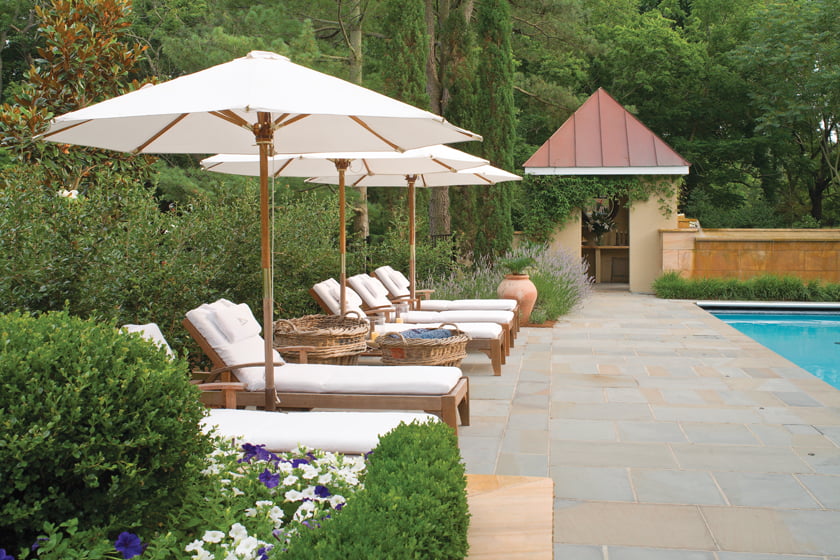
ROMANTIC RETREAT Scott Brinitzer designed the landscape surrounding a Lewes, Delaware, home in the style of a Tuscan estate. Outdoor “rooms” offer dining and lounging areas, while lush beds envelop a swimming pool, spa and stucco-clad spring house (pictured). Chaise longues and umbrellas beckon. Landscape Architecture: Scott Brinitzer Design Associates. Roger Foley, 2008.
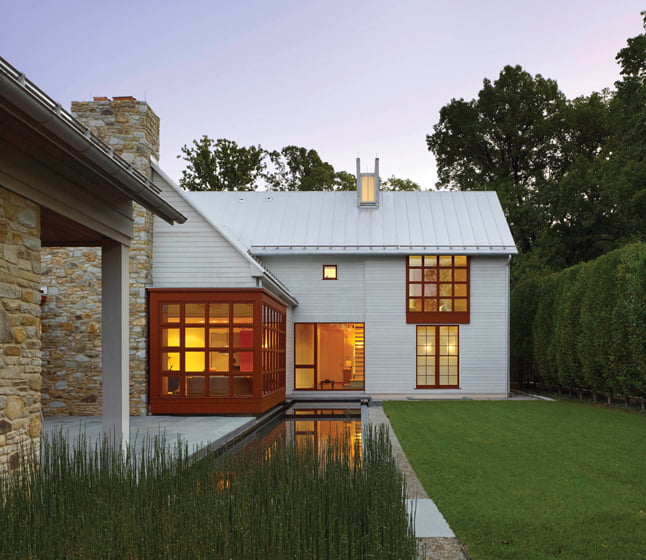
BALANCING ACT Richard Williams and team conceived a “modern farmhouse” in Victorian-era Garrett Park, Maryland, balancing contemporary and traditional elements to harmonious effect. Pitched roofs and cedar siding blend into the neighborhood, while clean lines complement a minimalist pool and garden. Walls of fir-trimmed windows admit light to open, airy interiors. Architecture: Richard Williams Architects. Landscape Architecture: Gregg Bleam Landscape Architect. Contractor: Horizon Builders. Tom Arban, 2015.

ETERNAL STYLE An eclectic art collection informed the design of a Kalorama apartment by Raji Radhakrishnan, who bridged styles, centuries and continents to enhance contemporary interiors in a neighborhood of vintage homes. In the open-plan living area (above), she created a mural by digitally enlarging a photograph of an 18th-century painting, juxtaposing it with a sleek custom dining table and vintage chairs. Interior Design: Raji RM & Associates. Rikki Snyder, 2016.

A HOUSE CREATED An Old World aesthetic characterized designer Arlene Critzos’ former custom estate home near Annapolis. In the formal living room (pictured), a neutral palette offset furnishings and art from different periods and countries; highlights included an oversized 18th-century sofa upholstered in caramel velvet and silk. Enormous windows overlooked Whitehall Creek. Architecture: Riegel Design Studio. Interior Design: Interior Concepts, Inc. Contractor: Lundberg Builders. Gordon Beall, 2006.

VAULTED MODERNISM Nestled amid Cleveland Park Victorians, a mid-century house designed in 1960 by the late I.M. Pei stands out for its unique architecture: three barrel vaults overlooking a backyard pool (pictured). When new owners purchased the house, they tapped architect Hugh Newell Jacobsen for a careful update that would respect Pei’s original design while improving modern-day functionality. Renovation Architecture: Hugh Newell Jacobsen, Architect. Landscape Architecture: Graham Landscape Architecture. Bob Narod, 2008.

HIDDEN GEM Hired to transform an outmoded 1950s split-level in DC’s Forest Hills, Nestor Santa-Cruz embraced modern design principles, opening the house up to nature via enlarged windows and doors and creating flow between rooms. In the dining room (pictured), casual and formal elements blend with Directoire seating punctuated by Philippe Starck Ghost chairs and a Mondrian-esque ceiling treatment. Bleached-wood floors unify the spaces. Interior Design: Nestor Santa-Cruz Decoration. Angie Seckinger, 2015.

GLASS HOUSE Constructed of steel, stone and abundant glass, a modern retreat on the Magothy River near Annapolis captures a sense of calm. Designed by architect Scarlett Breeding, the house embraces traditional forms—but wall and roof planes have been exchanged for glass. The master bath leads to an outdoor shower and hot tub (pictured) installed in stone. Architecture: Alt Breeding Associates Architecture. Landscape Architecture: Campion Hruby Landscape Architects. Contractor: Pyramid Builders. David Burroughs, 2015.
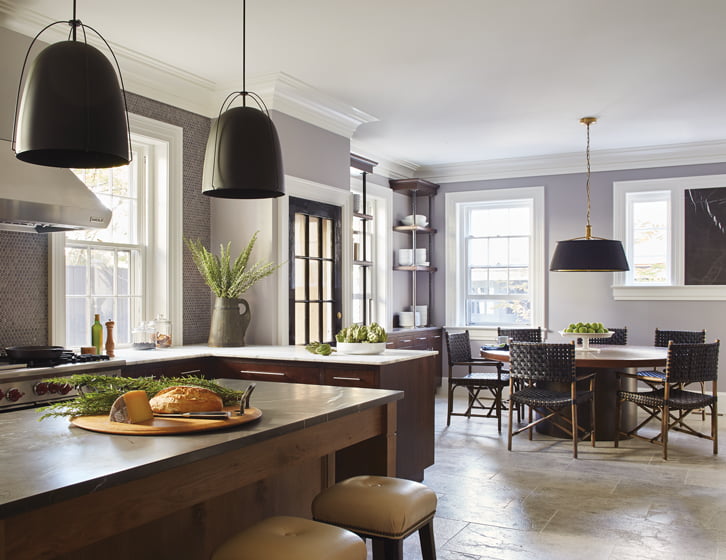
ODE TO PLACE A painstaking renovation honored a storied, 200-year-old Georgetown manse while improving its layout and functionality. Architect Anthony Barnes and interior designer Patrick Sutton also enhanced the home’s classical aesthetic; the kitchen (pictured) combines clean lines with traditional elements, featuring custom cabinetry and a penny-tile backsplash. A Baker chandelier hangs above a breakfast table crafted by Mitchell Yanosky. Renovation Architecture: Barnes Vanze. Interior Design: Patrick Sutton. Contractor: Pyramid Builders. Max Kim-Bee, 2018.

GRAND RETREAT McHale Landscape Design created a stately garden enveloping a 19th-century home in Easton, Maryland. A central fountain anchors four quadrants: a rose garden, an exotic garden, a croquet lawn and a free-form wilderness. Walking paths connect the house with its Leeds Creek locale. Pictured: Pink azalea softens the edges of a clearing where lounge chairs take in the view. Winner of the LCA 2016 Decade Award. Landscape Design & Maintenance: McHale Landscape Design. McHale Landscape Design, 2017.

RARE VINTAGE A client in Northwest DC hired Donald Lococo to create a lower-level wine cellar and gathering spot. The architect reimagined the standard basement space as a stately library, with rows of climate- and humidity-controlled cabinets storing wine behind nearly invisible glass barriers. In an adjacent space, comfortable seating beckons amid millwork and bookshelves. Architecture & Cabinetry Design: Donald Lococo Architects. Contractor: Horizon Builders. Donald Lococo, 2016.

RUSTIC + REFINED Clients building in Bethesda requested a traditional abode with a touch of French Country style. Architect Mark Sullenberger and designer Miriam Dillon combined walnut flooring and cherry paneling in the interiors as a backdrop to the owners’ extensive collection of photography. Pictured: A striking portrait by Richard Avedon creates a focal point in the entry. Architecture & Interior Design: Custom Design Concepts. Contractor: Sandy Spring Builders. Kenneth M. Wyner, 2010.
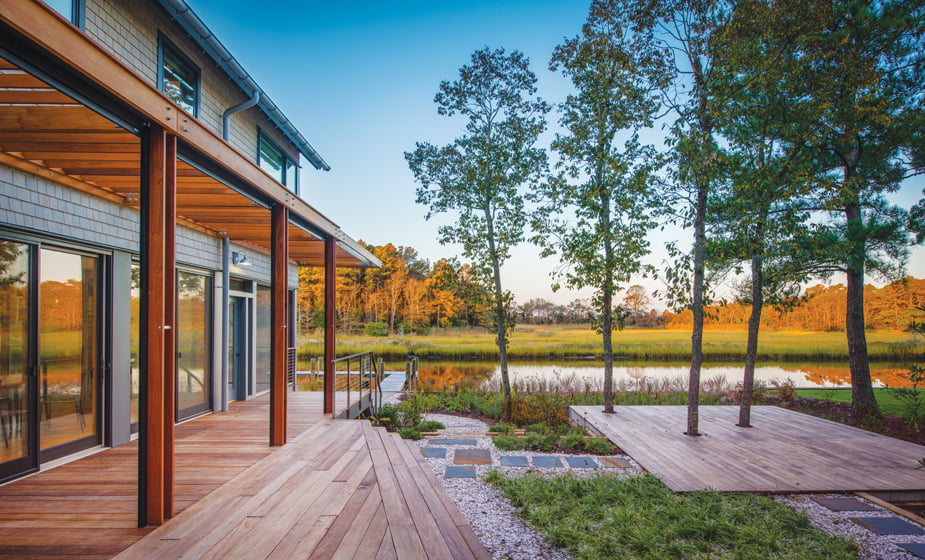
WETLANDS IDYLL After years of visiting Rehoboth Beach, a Bethesda couple decided to build a vacation home on the Lewes and Rehoboth Canal. Amy Gardner and Brittany Williams, whose practice focuses on sustainable architecture, designed an eco-friendly, L-shaped structure that maximizes views of the picturesque canal and wetlands. The home is centered around a courtyard that shelters it from the elements. Architecture: Gardner Architects. Landscape Architecture: Jordan Honeyman. Contractor: Beachwood, Inc. John Cole, 2016.

URBAN CHIC What began for Robert Cole and Sophie Prévost as a simple decorating project in an industrial-style Adams Morgan loft grew into a full-blown renovation that removed walls in the two-story, two-bedroom condo, and replaced the kitchen, bathrooms, floors and more. In the finished space, exposed concrete and steel are softened by custom details and a cool silver-and-blue palette. Renovation Architecture & Interior Design: ColePrévost, Inc. Contractor: Added Dimensions. Timothy Bell, 2011.

A CLASSIC REBORN Expanding a 1970s house in Potomac, Christian Zapatka created an elegant master suite graced with a tray ceiling painted by Lenore Winters Studio. Frank Babb Randolph infused the space with a palette of “icy blue,” from the Persian rug to the silk drapery. A Niermann Weeks chandelier provides a finishing touch. Renovation Architecture: Christian Zapatka LLC. Interior Design: Frank Babb Randolph Interior Design. Renovation Contractor: OC Builders. Gordon Beall, 2016.

CHANGE ARTIST Paul Sherrill’s 1,000-square-foot apartment in Kalorama’s Altamont building features just three rooms—but they are grand indeed, boasting 10-foot ceilings, soaring windows and two fireplaces. Sherrill, who experiments with scale, style and provenance, deftly mixed modern and traditional elements throughout. In the bedroom (pictured), a contemporary painting hangs over the fireplace and an ornate trunk occupies the foot of the bed. Interior Design: Solis, Betancourt & Sherrill. Gordon Beall, 2016.

POTOMAC PLAYGROUND Rustic stone pavilions anchor an idyllic Potomac property featuring a boulder-strewn pool scape. Architect Anne Decker designed pavilions that contain guest quarters and a pool house, with an al fresco dining area between the two. Landscape architect Lila Fendrick masterminded the dramatic site and Skip Sroka designed the interiors. Architecture: Anne Decker, AIA. Landscape Architecture: Lila Fendrick Landscape Architecture & Garden Design. Interior Design: Sroka Design. Contractor: Sandy Spring Builders. Kenneth M. Wyner, 2009.

MODERN METAPHOR After purchasing a Capitol Hill row house, a couple contacted architect Janet Bloomberg to renovate it in open, modern style. Bloomberg’s design—which won an AIA award—centers on a pristine kitchen facing a two-story living/dining space (pictured). A glass wall at the back of the house slides open to access the minimalist walled garden. Renovation Architecture: KUBE Architecture. Landscape Architecture: Campion Hruby Landscape Architects. Contractor: Housecraft, LLC. Greg Powers, 2016.

TWO-PART HARMONY Images of rising earth and clouds inspired Travis Price’s design of a Bethesda home perched high above the Potomac. Comprised of two separate wings housing living and guest quarters, the structures are capped by angled aluminum roofs that open the interiors to stunning river views. From the terrace, steps lead down to an outdoor dining area. Architecture: Travis Price Architects. Landscape Design: Thomas Tait Gardens. Kenneth M. Wyner, 2010.

ITALIAN ESCAPE Clients with a circa-1900 home on the Chesapeake Bay asked Wayne Good to transform it in the style of an Italian villa. Erin Paige Pitts designed the interiors while Jay Graham conceived the landscape; it features a pergola (pictured) for enjoying water views. Renovation Architecture: Good Architecture. Interior Design: Erin Paige Pitts Interiors. Landscape Architecture: Moody Graham. Contractor: Winchester. Geoffrey Hodgdon, 2011.

BACK IN TIME Elegant Palladian architecture inspired a sprawling, weathered-stone home in Virginia’s Albemarle County. Dalgliesh Gilpin Paxton Architects designed the residence for clients who requested single-level living, stellar views and a sense of timeless authenticity. Light pours into the solarium (pictured), adjacent to a sitting room with a vaulted ceiling clad in cypress millwork. Architecture & Interior Design: Dalgliesh Gilpin Paxton Architects. Contractor: Alterra Construction Management. Gordon Beall, 2017.

GEORGIAN REVIVAL A 1922 mansion on the Severn River boasted a colorful history—including a stint as a monastery. It was in disrepair when new owners hired Charles Anthony to remodel. He restored the core to its original Georgian Revival style, then modernized two flanking wings. Pictured: an indoor resistance pool. Renovation Architecture: Charles E. Anthony Architects, PC. Interior Design: Johnson | Berman Interior Design. Contractor: ILEX Construction. Anne Gummerson, 2011.
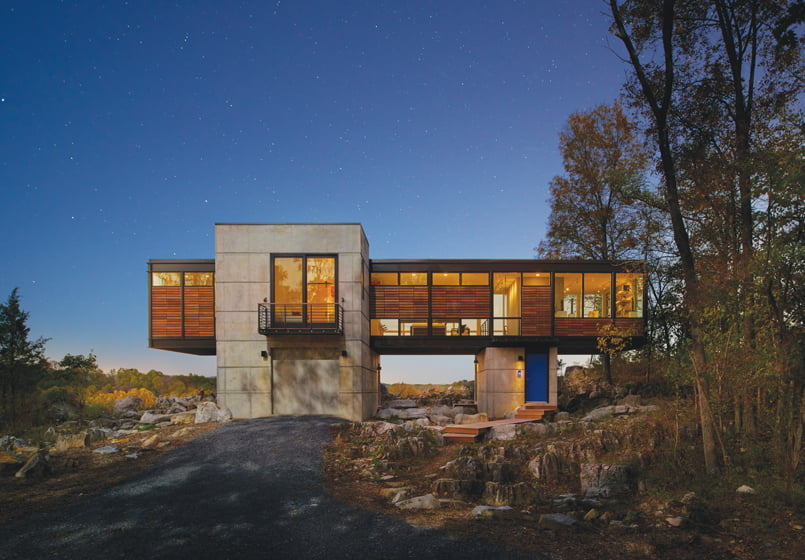
ALMOST HEAVEN Designed by architects Greg Wiedemann and Barbara Sweeney, a modern abode overlooking the Potomac River in West Virginia maintains a small footprint while optimizing river views and respecting its rocky terrain. Steel framework is clad in concrete, glass and ipe; spare, minimalist interiors showcase artwork by the owner, a sculptor. Architecture: Wiedemann Architects LLC. Contractor: Carl Petty Associates, Ltd. Anice Hoachlander, 2017.

SENSE OF HISTORY When a philanthropic couple purchased Evermay, a historic Georgetown estate, for $22 million, their goal was to create a retreat for celebrating the arts. Architect James Rill and designer Jodi Macklin preserved the Federal-style brick mansion while updating its interiors—including 12 bedrooms, conference rooms and a grand, paneled living room (pictured). Renovation Architecture: Rill Architects. Interior Design: Jodi Macklin.Contractor: B.L. Construction & Remodeling Systems, Inc. Gordon Beall, 2012.

INTO THE LIGHT A quirky layout challenged Andreas Charalambous’ redesign of a condo on DC’s 14th Street. Just inside the front door, an oddly elevated platform impeded views of the bustling urban scene. Charalambous opened up the space, creating flow into the living area (pictured), with its two-story window wall. Painting the exposed ductwork and concrete white, he made way for vibrant art and decorative accents throughout. Renovation & Interior Design: FORMA Design. Geoffrey Hodgdon, 2016.
Nancy and Travis Johnson lived in New York City for 25 years before “escaping,” as they describe it, to the quaint, historic Annapolis neighborhood of Eastport. They wanted a waterfront home within walking distance of the district’s shops and restaurants. And Travis, a Naval Academy graduate, wanted to be able to keep a sailboat nearby.
The couple purchased a property on Spa Creek that perfectly met their requirements—but it came with a dilapidated, one-story dwelling, so they decided to raze it and start afresh. While Nancy wasn’t itching to build a house, “it was on my bucket list,” she admits. A fashion designer, she brimmed with ideas for a dynamic, modern structure and specified a collaborative design process. After turning away architects who “wanted to tell us what we should live in,” she recalls, the couple tapped Alick Dearie and Brian Grieb of GriD architects for the job.
“Nancy wanted to work with someone who’d really listen,” says Dearie. “Unlike most of our clients, she preferred to source everything herself. It was like a jazz duet—she would do something and we would react to it.”
The narrow, quarter-acre lot—along with myriad site restrictions—dictated the form the house would take. The architects devised the two-bedroom abode to be restrained and efficient, encompassing just 2,200 square feet of living space. It’s organized into two boxy volumes—one contains the garage and the other the kitchen, pantry and dining area with the master suite above. These volumes are linked by the living room, staircase and upstairs office area. Setback requirements allowed the house to step up in height from the street side to the water side, creating an opportunity for window walls on both the first and second floors that dramatically frame panoramic views of Spa Creek.
After years living in an edgy, urban environment, Nancy and Travis, a technology consultant, were drawn to an industrial aesthetic. “We wanted a lot of tactility, but not necessarily from fabrics. I love the look of metal and what it becomes in different lights,” Nancy explains.
“That was really the project’s jumping off point,” Dearie notes. “We always try to simplify the material palette; here, we used wood, steel, metal and concrete. If you have more than four materials, it’s probably too many.”
The exterior is clad in horizontal cedar planks and expanses of corrugated metal in a matte finish. A concrete bench on the back deck extends inside behind the fireplace. The building’s steel inner structure is exposed in an overhang above the entry. A giant pivot front door leads into the foyer, where the architects repeated the corrugated metal surface along one wall. A short hall leads into the main living space, which encompasses seating and dining areas and a spare, minimalist kitchen—all unified by wide-plank, light-oak floors.
The sculptural staircase, with cantilevered steps made of exposed tubular steel and oak, creates a focal point. “We wanted something unique that would show the way it was made,” Nancy recounts. “The steel on the stairs connects to the steel tubes within the walls of the house.”
The living area also features a hot-rolled-steel fireplace that Dearie calls “a labor of love.” Designed by the architects, it’s an insert surrounded by a custom-designed fireplace wall with a screen that opens like a door. Nancy had the same tack bolts that hold the building’s steel structure together welded to the front as hooks for fireplace tools.
The minimalist kitchen combines sleek, white cabinetry with stainless-steel appliances and a stainless-steel island with a rustic, poured-concrete countertop. A narrow, stool-height table of rolled steel provides casual dining space. Clutter disappears into a capacious pantry closet, leaving the kitchen pristine.
The master bedroom takes full advantage of the view, with a balcony and a wall of windows that wraps around one corner to take in the bend in the creek. When the wide pivot door to the master suite is open, the vista also beckons from the hall. A pocket door encloses the guest room, while the door to the guest bath boasts bold, conspicuous hinges. In this house, “everything down to the locks is on the outside,” Nancy notes. “I like the idea of inner mechanisms showing on the outside. They break up the white expanses of the walls and doors.”
To manage storm water, Dearie and Grieb installed green roofs on each of the home’s volumes. A large window in the upstairs office overlooks the green roof over the garage. “We love looking out when the roof garden is lush green,” says Travis. “It changes all the time; it’s like a piece of art in itself.”
Accessible through sliding-glass doors in the living area, the ipe deck flows into the backyard. Stairs lead down to the dock where the Johnsons keep a small boat “for tooling into town for dinner,” Nancy says. She adds, “Sometimes we look around and can’t believe we live here. It’s pretty cool.”
Architecture: Alick Dearie, AIA, NCARB, LEED AP BD+C; Brian Grieb, AIA, NCARB, LEED AP BD+C, GriD architects pc, Annapolis, Maryland. Builder: Darren Kornas, ThinkMakeBuild, Annapolis, Maryland. Landscape Architecture: Robert Hruby, ASLA, Campion Hruby Landscape Architects, Annapolis, Maryland. Landscape Design & Installation: Walnut Hill Landscape Company, Annapolis, Maryland.