
Catherine O’Sullivan, shown here with her work, exhibits an affinity for using see-through openings as positive-negative space.

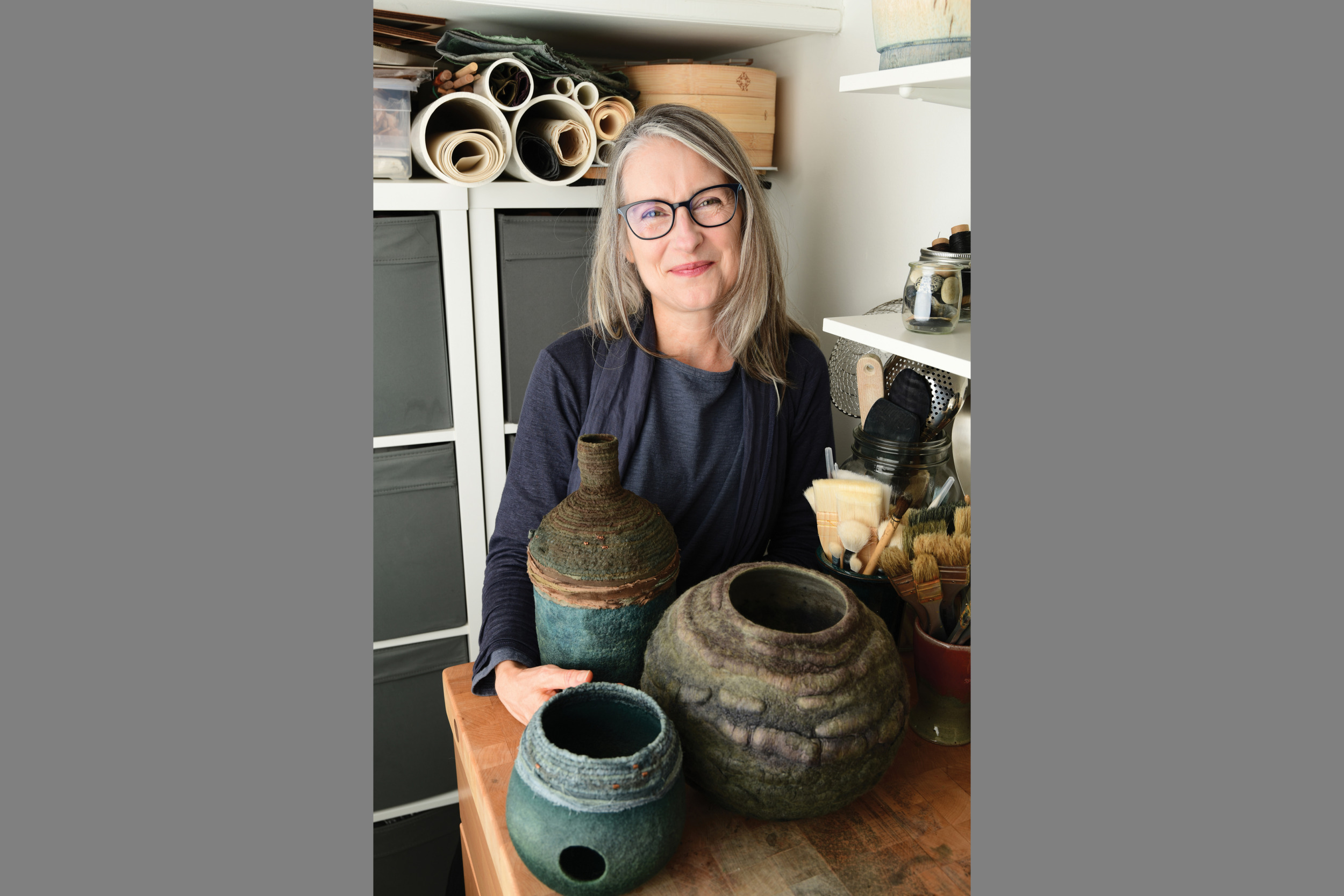
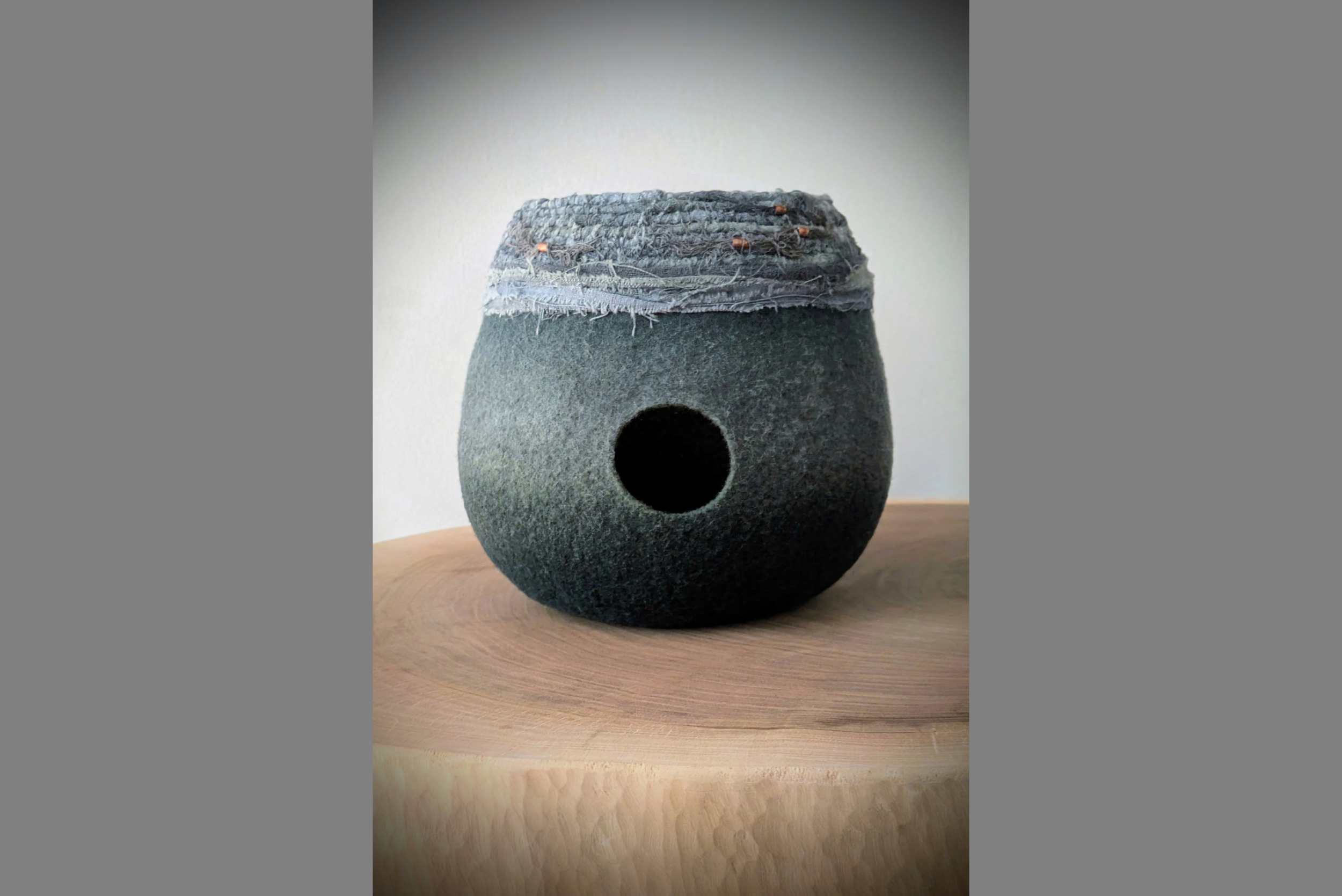
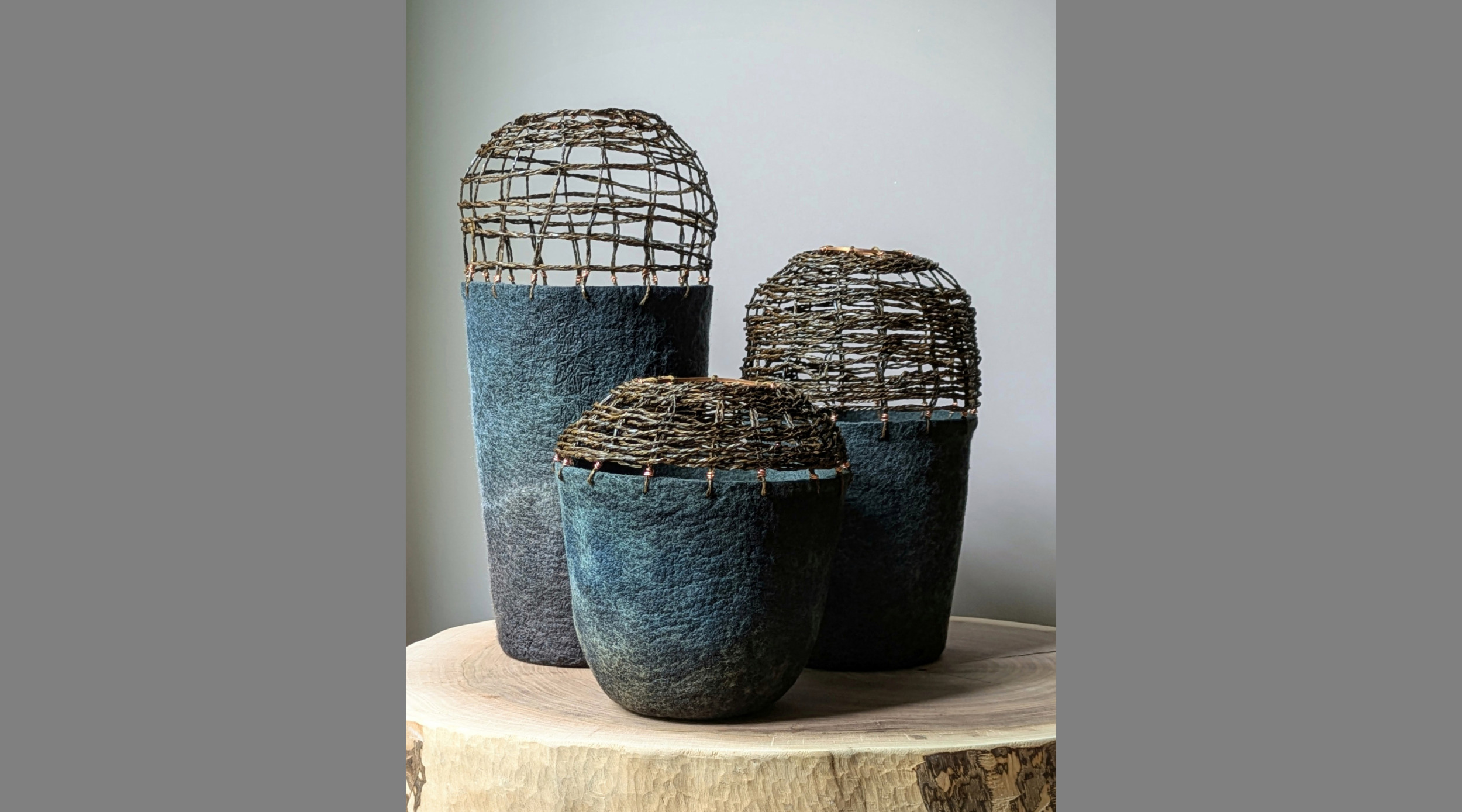
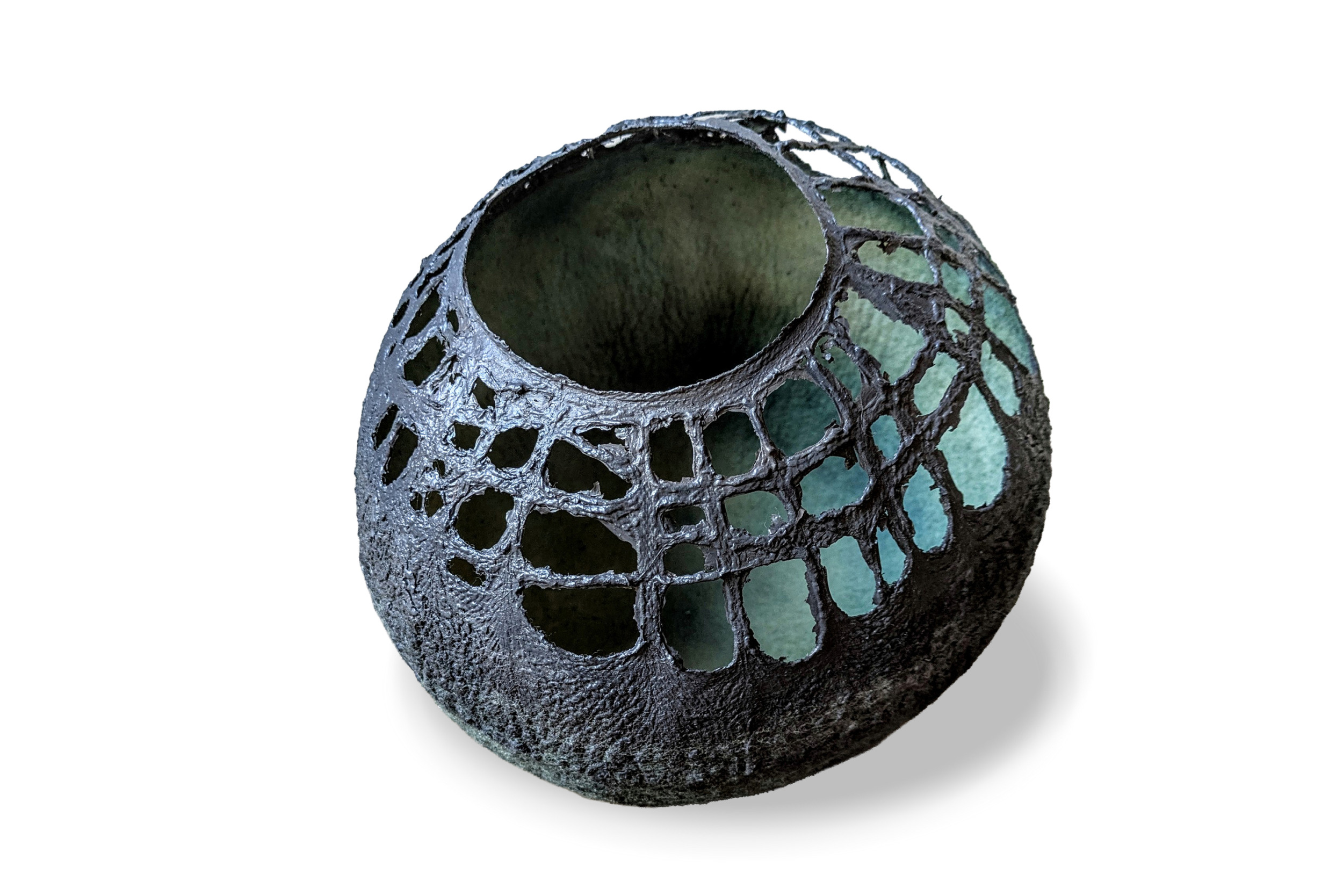
When Catherine O’Sullivan displays her felt vessels at craft shows, she often hears comments like, “Oh my gosh, I thought they were ceramic.” Another remark compares her pieces to ancient objects unearthed from tombs. The artist simply smiles, taking both as compliments.
Perhaps that’s because O’Sullivan used to be an archivist, preserving the papers of historically noteworthy people at the Smithsonian’s Museum of Natural History in DC, along with documents while working at The National Archives in New York. She also holds an undergraduate degree in anthropology, plus master’s degrees in medieval history and archival management. “My love of the past is what I’m trying to recreate,” the self-taught artist explains—“the beauty of things that have been touched by human hands, what has come before us in old books and manuscripts, the voices of history.”
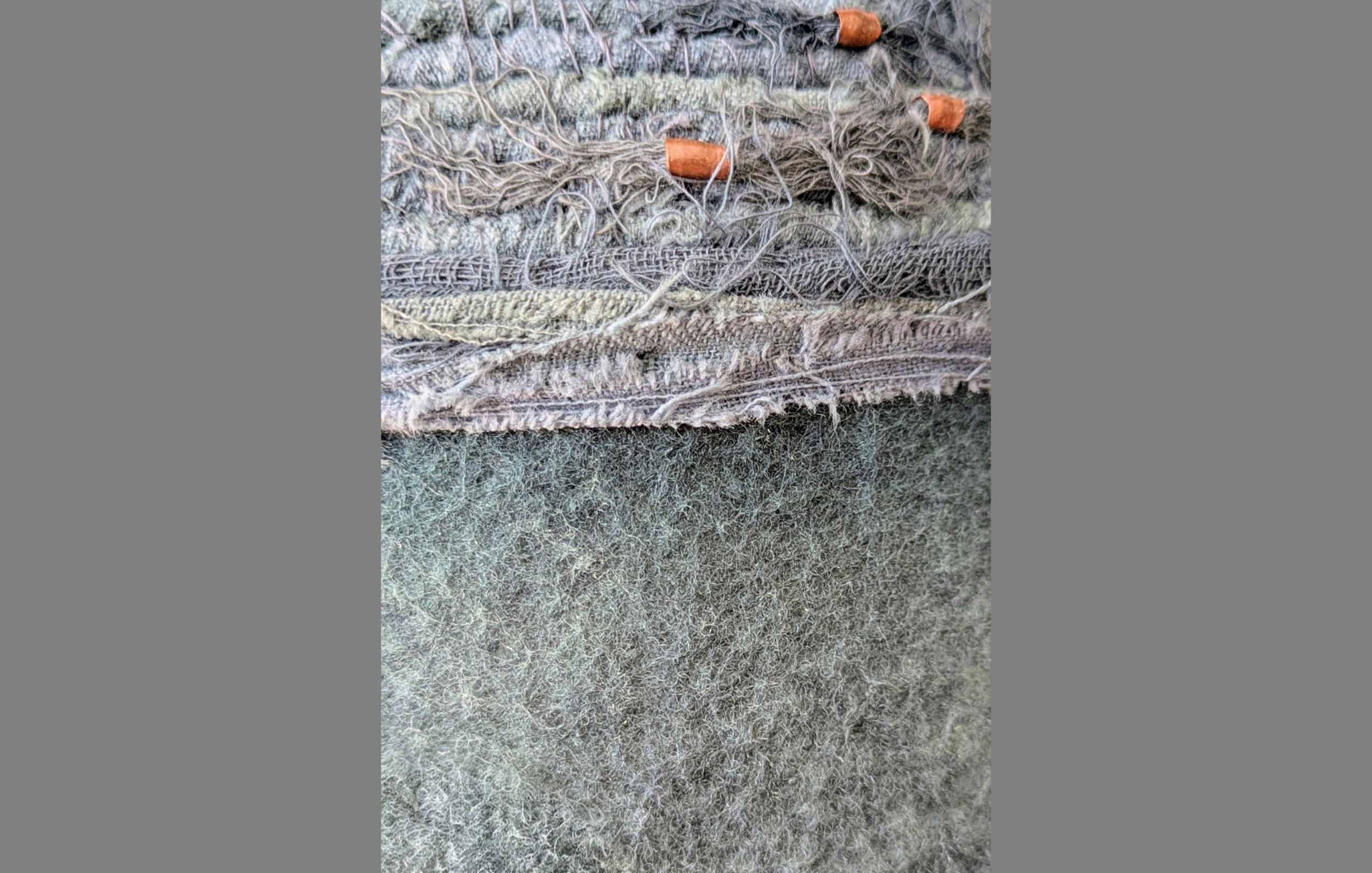
Each vessel O’Sullivan creates starts life as pearly white wool. Subtle color variations come from brushing on ground-earth pigments or immersing the object in plant dyes. Her serenely proportioned pieces also may incorporate, in moderation, bent-wood handles, shiny copper wire, rusty washers or hand-dyed linen painstakingly wrapped around cording.
Despite the complexity, vessels seem to be distilled to an organic essence. They derive harmony from an earthy blend of colors, transitioning from deep plum to mellow greens or rich indigo blues. O’Sullivan sometimes applies encaustic wax for added rigidity and permanence. And her love of the natural world is apparent: “I often tell people that if they decide they’re finished with my art—and I hope they’ll keep my pieces forever—all the ingredients are compostable. Everything will just break down. It’s like the paper that would be gone if archivists didn’t save it.”
O’Sullivan carefully constructs the felt at her home studio in Takoma Park, Maryland. She starts by drawing out fibers from a hank of Merino wool. Each section is layered in a cross-hatch pattern on a plastic template called a resist. The 18-inch-long resist is larger than the intended vessel, since the wool will shrink by about 50 percent. In all, the artist stacks three layers in each direction.
Next, she places a sheet of Thai mulberry paper on top, wets everything down with a mild soap solution and applies pressure by hand. When completed, the resist is removed as the artist gently flips over the wool layers, repeating the entire process on the reverse side. “If I were to try to do anything with this now and rush it, I’d just be left with a big mess,” O’Sullivan observes, marveling, “you can take something so precarious and so loosely laid out—just these thin little fibers—but in about an hour or so, they’ll start to become solid. And after a day, you’ll have a vessel that stands on its own. This whole process is like alchemy to me.”
While the felt is still malleable, the sculptor shapes her vessels over pottery found at thrift shops. Or she may decide to manipulate pieces by hand, assisted by wooden spatulas, spoons and potter’s tools. After the felt has become solid and dry, she applies color, taking care not to fully submerge the vessel in dye before any embellishments are added. O’Sullivan also may eco-print a piece, using leaves as stamps to transfer color directly onto the mulberry paper. About the coloring process, she notes, “I only have so much control. At a certain point, nature takes over.”
In her small, bright studio, wooden hat forms occupy the top shelf. They represent an earlier era when she used the same felting technique to handcraft fedoras, ponchos and felt toys for her two boys, now 18 and 21. In a sense, the lads were responsible for her felt-making journey.
Taking them on regular pick-your-own-produce excursions led the family to nearby animal farms, where the future artist discovered that this region has a “massive fiber shed,” she says. “It seems every other farm has sheep, cattle or alpaca.” At first taking basic wool-dying classes, she and her sons moved on to spinning and knitting. At one of the classes, O’Sullivan discovered felting—and “absolutely fell in love with it.”
Now, she declares, “I feel I’ve found my groove. What I was doing earlier on perfected the craft, but I needed to elevate it to my own artistic expression. That’s how the vessels came about.” As symbolic containers, possibly for treasures, they tie together diverse elements from O’Sullivan’s past, in the process becoming new treasures of their own.
O’Sullivan’s art will be on exhibit at the James Renwick Alliance’s JRACraft Day on December 5; jracraft.org.
For more information, visit catherineosullivan.art.