
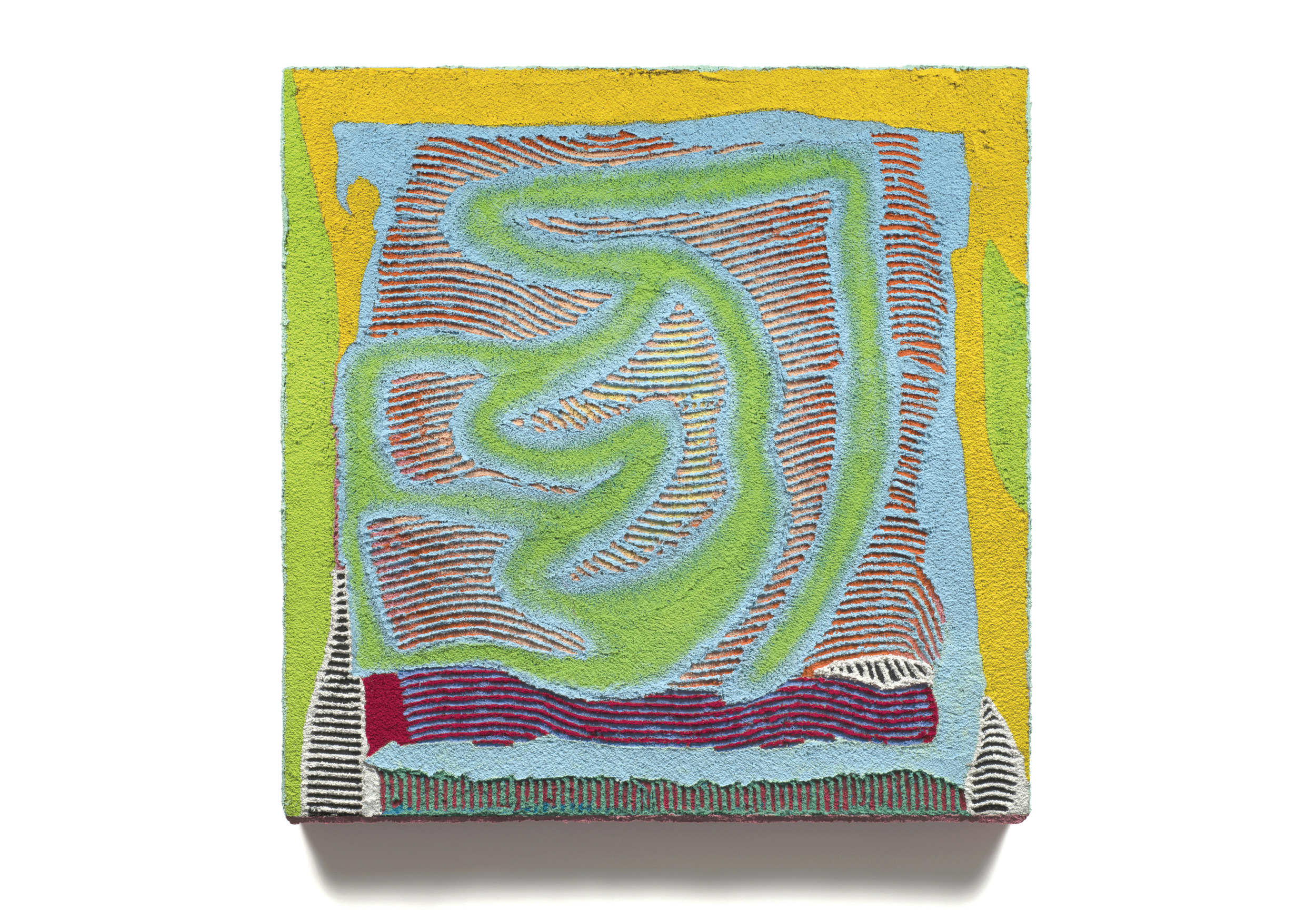
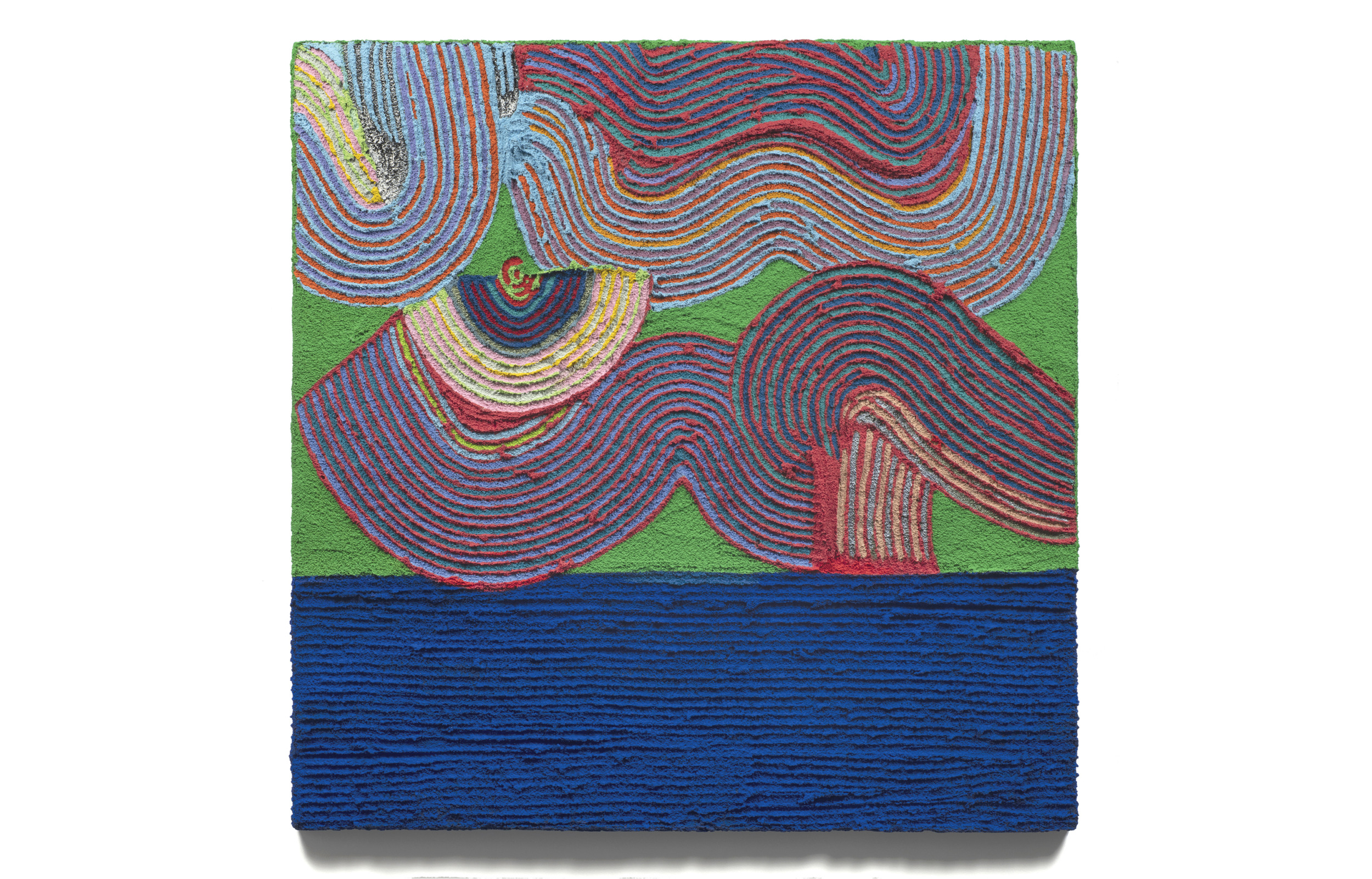
The artist uses pumice gel extracted from volcanic rock to shape the surface of his paintings, as in the four-by-four-foot "Bouncing Light Path."

At the tender age of two, Wayson Jones recalls traveling by ship from Baltimore to Germany, where his dad was stationed at the Bad Kreuznach Army base. The artist remembers going on deck during the journey, cradled in his mother’s arms.
“It was overcast almost all the time. There was nothing but light gray sky and dark gray ocean with this absolutely perfect horizon line. We didn’t say anything. We just looked. It was my first aesthetic experience.”
The impression was indelible. In Jones’ abstract paintings, horizon lines universally appear. Departing from his remembrance of pervasive grayness, the painter now harnesses glorious color. And that vaporous scene of early memory has been transformed into gritty surfaces, thanks to his primary medium—pumice gel, derived from volcanic rock. All combine in synergistic ensembles of color and texture that almost vibrate. “The work is so frontal,” says the artist. “It’s vividly colorful and opaque; there’s no real transparency as in a lot of my earlier work.”
A self-taught painter, Jones found that growing up in DC and visiting museums led to his art literacy. “As an untrained artist,” he concedes, “painting seemed really intimidating for me. Picking up a paint brush or stretching a canvas was like picking up 400 years of art history.”
Jones has been painting for nearly 20 years at studios in the Gateway Arts District of Brentwood, Maryland. At first sidestepping any need for paintbrushes, he applied pastel chalks directly on paper; his intuitive affinity for color emerged immediately. A few years later, he started using foam brushes with acrylic paint, a technique he’s continued while also adopting brushes. During a lengthy period, he focused on work in black-and-white, including a 2013 abstract series titled The Black President. In retrospect, Jones considers that group an outlier. “I’m not a believer in art as a political tool. We are the tools,” he says in characteristic soft tones.
In that view, the artist differs from ideas expressed by his first roommate at the University of Maryland, Essex Hemphill, the poet and activist who was recently featured in a Phillips Collection exhibition, Essex Hemphill: Take Care of Your Blessings. Jones, who received a bachelor’s degree in music in 1980, at first accompanied Hemphill’s spoken-word performances on guitar and percussion, and soon became a full participant. “It sounds cliché,” the artist says, “but I don’t know who I would be if I hadn’t known Essex and done the work that we did. The discipline we had in rehearsing and making the work was grounding. Everything was performed from memory.”
Jones also has been influenced by Sam Gilliam’s brilliantly colored, draped canvases. “I’m inspired by his paint mastery, but his materiality is really the main thing,” Jones attests. He was awed as well by Wolfgang Laib’s laborious 2004 achievement, “Pollen from Hazelnut,” in which Laib gathered pollen by hand and then sifted it to form an 18-by-21-foot rectangle on the Hirshhorn’s floor. “The feeling it evoked—expressing yellow that just glowed—inspired thoughts about discipline in your practice,” Jones comments. “Seeing it was really seminal to how I feel about being a painter.”
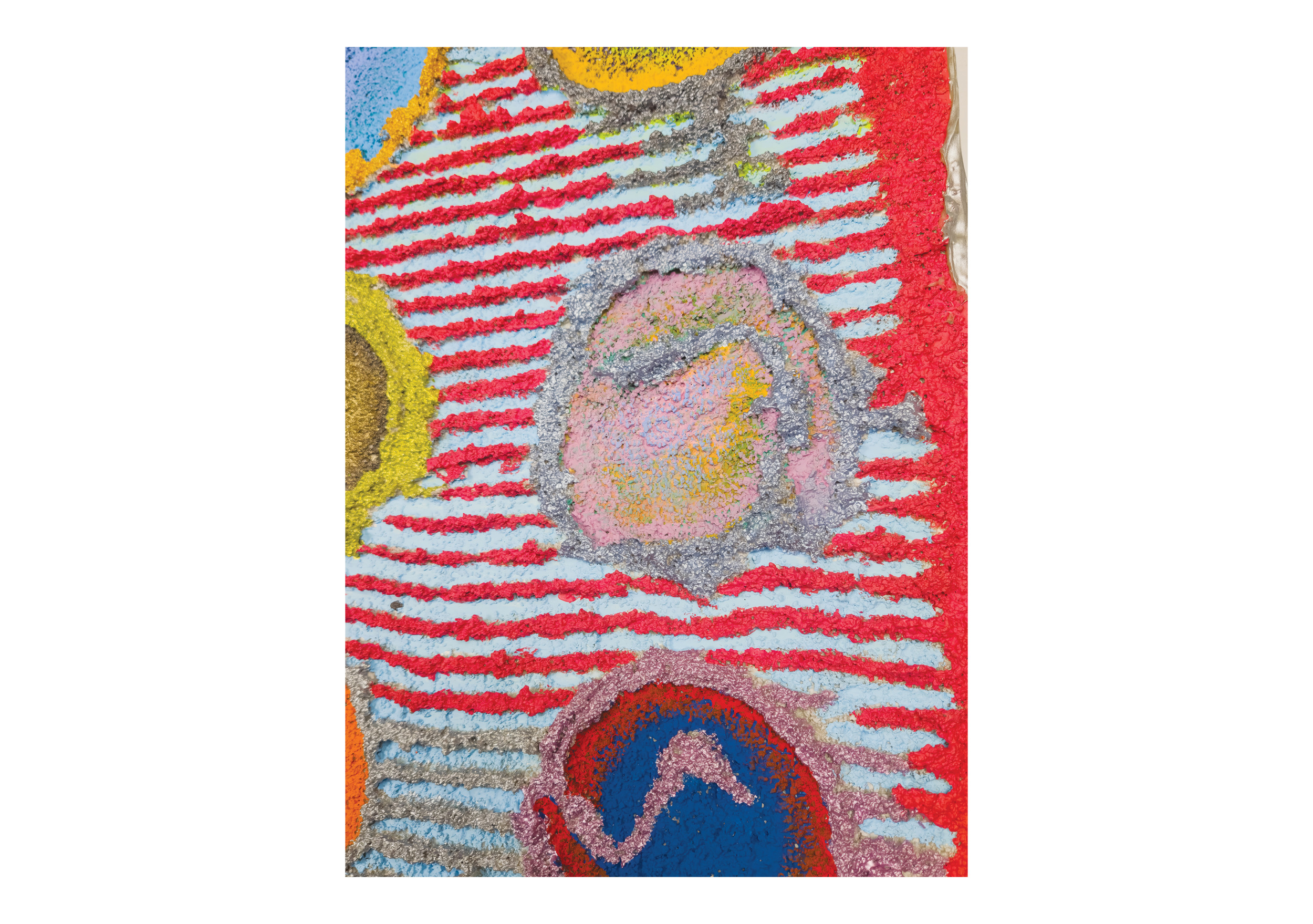
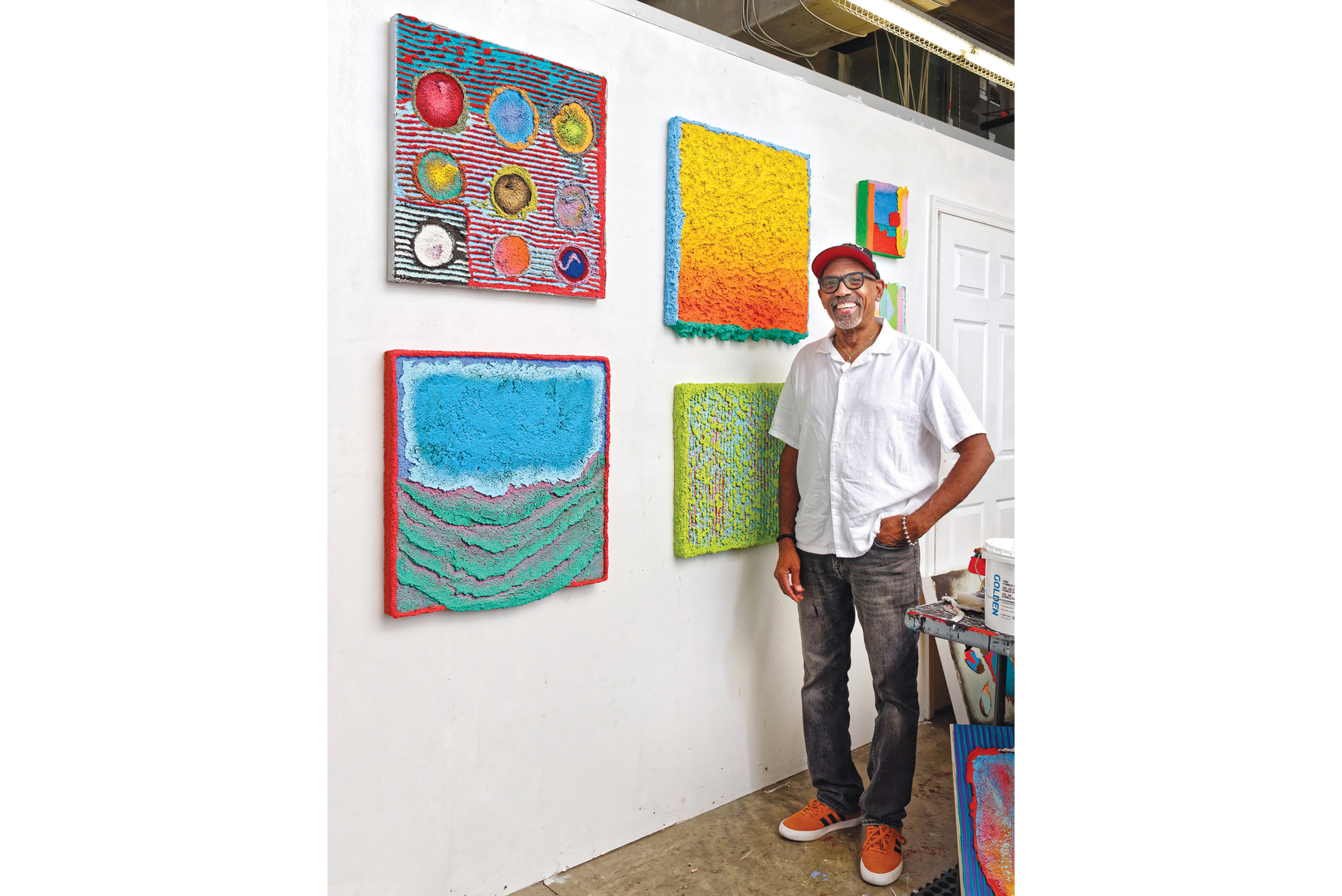
His newest work explores materiality, as the artist assertively sculpts the surfaces of his paintings. In addition to stretching canvas, he now layers pumice gel on wood panels, especially in larger paintings up to four by four feet. One recent group features a grid of roughly symmetrical circles superimposed on a ribbed background. For the underlayment, Jones wields a small Home Depot rake designed to remove roof tiles. Then with his main tool—a leaf-shaped, beveled palette knife—he presses down and turns the implement to create the shapes. Once the uncolored acrylic gel has dried, he brushes color on top. Or colors may be mixed into the gel first, in which case he may need to brush on more paint “to achieve the maximum saturation of color,” the artist explains, adding, “My painterly skills have improved quite a bit over the course of my practice.”
An experimental series, still underway, employs collage. Using the same acrylic material, Jones harvests scraps congealed on the bottom of paint jars or peeled from his palette.
The chromatic power of Jones’ art results in some cases from exploiting complementary colors, such as orange and blue, which are found on opposite poles of the color wheel. When placed side by side, each gains vibrancy from the other. His purpose: “I want to make beautiful objects within the whole realm that beauty is to me.”
The painter Delacroix repeated a familiar saying when he wrote, “Draftsmen may be made, but colorists are born.”
Jones expresses his own intention: “To make work that’s authentic. When the artist’s energy is present in the work, you feel it.” He continues, “I want the pieces to be imbued with some part of myself. And they are.”
Wayson Jones’ art is available through Hemphill in DC; hemphillartworks.com. A solo exhibition of his work, hosted by Tephra ICA at Signature in Reston, is on view through February 7, 2026; tephraica.org. For more information, visit waysonjones.com.