
The residence stands to the right of the white-trimmed John Logan House.



Washington’s Logan Circle boasts a storied past. Part of Pierre L’Enfant’s original 1791 city plan, it remains a hub in Northwest DC, presided over by a statue of Civil War general John Logan and surrounded by late-19th-century manses.
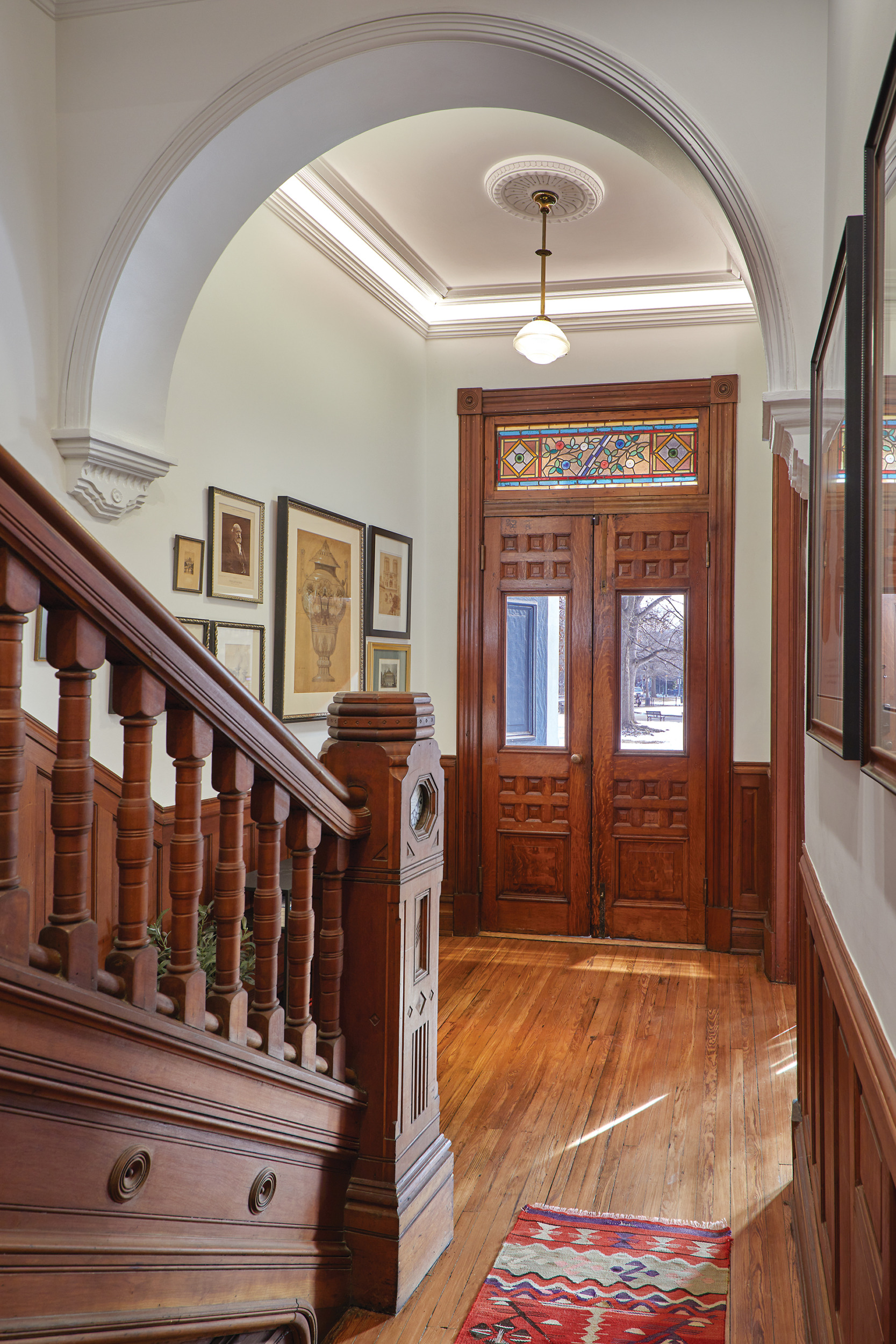
Among these venerable landmarks, an 1882 Italianate residence in red brick fairly gleams. It was designed by Prussian architect Emil Sophus Friedrich for diplomat Dwight Partello, who requested grandly scaled rooms adorned with heavy cherry millwork, elaborate ceiling medallions, handcrafted stained glass and 10 fireplaces.
Until recently, the dwelling was dingy and dilapidated, untouched since a 1979 makeover. Yet even in this sad state, it caught the eye of architect Bill Bonstra and his wife, pastry chef Penny Karas, who were then living around the corner. In 2014, the couple knocked on the door. “We told the owner we’d like to buy his house,” Bonstra recounts. “He said it wasn’t for sale.”
Undaunted, they knocked again the following year, and then every year after that—until 2019, when their persistence finally paid off: The owner knocked on their door and finally announced he wanted to sell.
Bonstra and Karas were ready. Once they owned the property, they jumped right in, embarking on a painstaking, three-year restoration that would modernize the home while preserving its history. Contractor John Allen of AllenBuilt Inc. collaborated on the project.
The imposing, 7,600-square-foot residence now spans five stories. The couple resides on the first and second floors (the latter contains the primary suite and guest room). The third level harbors a two-bedroom in-law suite complete with a kitchenette and a loft. The garden-level basement was overhauled to create two one-bedroom rental properties.
Bonstra tried to salvage as many original elements as possible when updating the home’s front areas, which encompass the entry and a double parlor. The irregular-width, heart-pine floors were sanded and refinished and abundant cherry millwork revived. Plaster cornices and ceiling medallions were preserved and stained-glass windows—imported from Germany when the house was built—were cleaned. Dual 10-foot-tall, paneled cherry pocket doors separate what’s now the living/dining area from the stair hall.
Structural alterations took place at the rear—starting with the original dining room, which is now an expansive kitchen perfect for a pastry chef. Bonstra and Karas worked with kitchen designer Andrea Finn to create timeless style via marble surfaces and navy-blue cabinetry. The tiny former kitchen became a mudroom leading out past an elevator to a new back deck.
Despite its Victorian character, the house reveals some modern surprises. One is a 50-foot-high atrium at its center, illuminated by a massive skylight. The atrium was created during the 1979 redo, which replaced the second floor in that spot with a wooden bridge that channels light to the ground level while connecting the second floor sleeping areas; apertures in existing walls carry light into the stair hall on two levels. In Bonstra’s iteration, the bridge is made of frosted glass supported by reclaimed heart pine beams found in New England. He also incorporated a three-story air shaft into the interior, making room for a chic wet bar at atrium level.
The couple worked together on finishes and fixtures. In the kitchen, limestone-look floor tile is laid in a herringbone pattern, and Grigio Venato marble tops peripheral cabinetry as well as the wet bar. The island countertop and backsplash are made of marble-look Italian porcelain. Upstairs, Carrara clads the primary bathroom, which was enlarged during the remodel, while terrazzo imparts a modern feel to the hall bath. When it came to furniture, “we kept everything we had and reused it throughout the house,” Karas says.
Now that the abode is finished, the duo is thrilled with the outcome. “I pinch myself every day,” Bonstra enthuses, pointing to a host of architectural elements that now look fresh. “It’s magical.”
Karas adds, “We feel we are stewards of this house. We are grateful to live here and that we could preserve it for the future.”
Renovation Architecture: William J. Bonstra, FAIA, LEED AP, Bonstra | Haresign Architects, Washington, DC. Renovation Contractor: John Allen, AllenBuilt Inc., Bethesda, Maryland. Kitchen Design: Andrea Finn, CKD, CLIPP, AHF Designs, Kentlands, Maryland. Automation: Chase Systems, Rockville, Maryland.