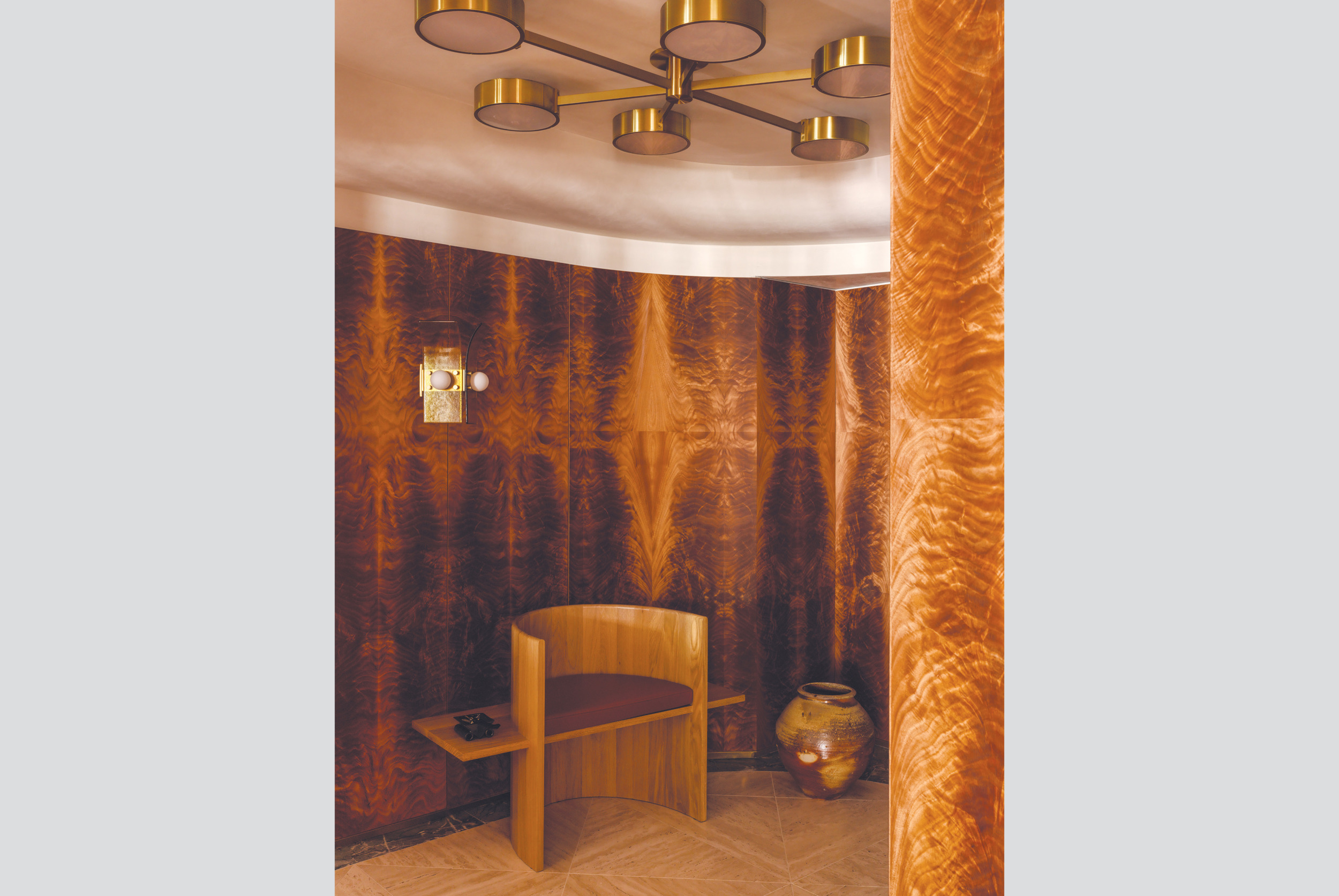
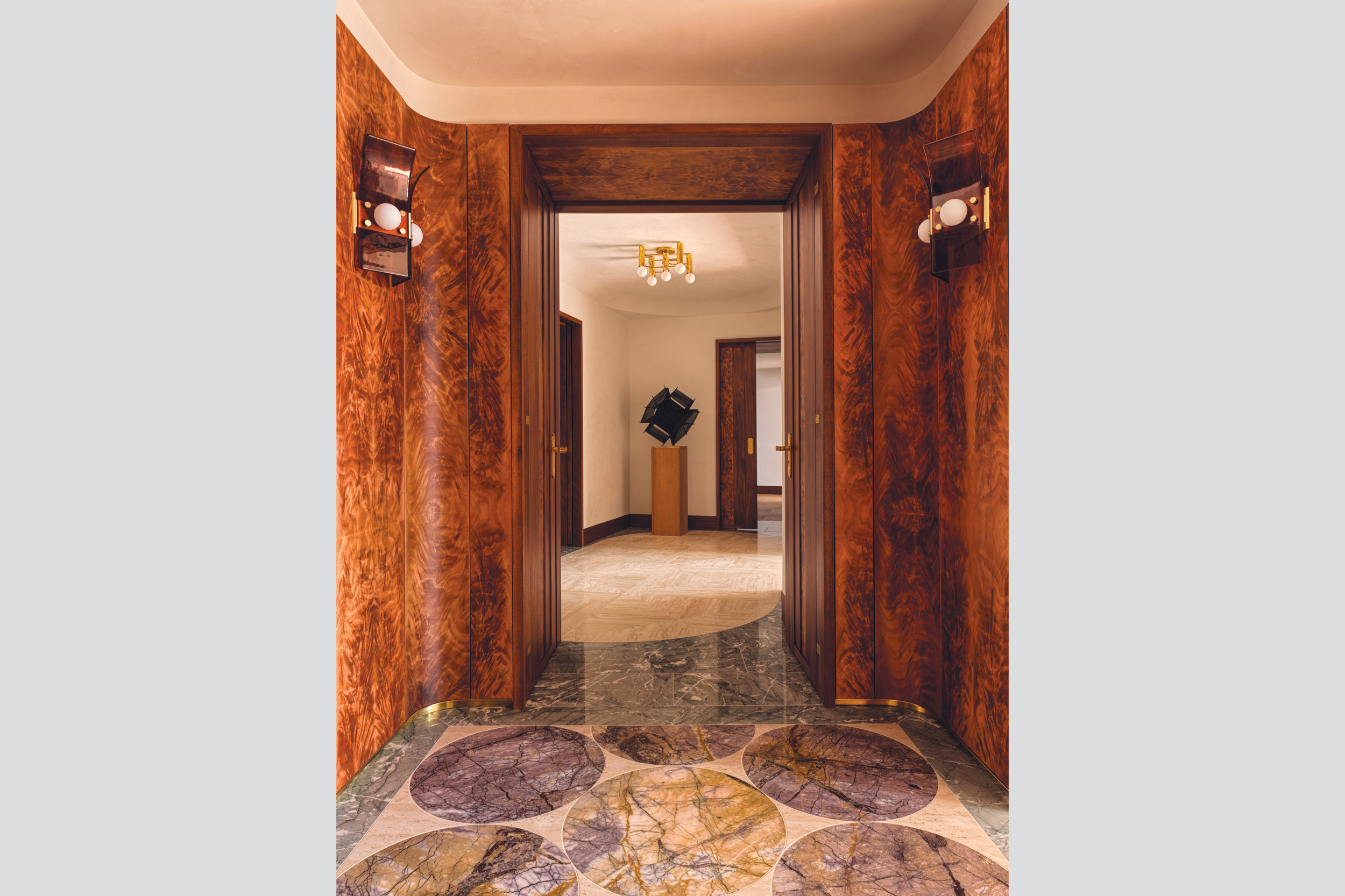
Book-matched okoume wood clads the curved walls of the foyer.

Looming over the Potomac River as it winds around Washington, the legendary Watergate complex conjures an era—in more ways than one. Besides its infamous role in that eponymous scandal, the bold, modernist structure designed by Italian architect Luigi Moretti and completed in 1971 is widely recognizable for its curvilinear geometry and cantilevered concrete balconies with their signature saw-tooth railings.
Searching for a pied-à-terre in DC, a buyer was smitten with the building and its history. She purchased a 3,000-square-foot, 12th-floor unit, envisioning a complete overhaul of the dated space. The team she assembled for the job included BOWA Design + Build, with whom she’d collaborated previously, and architect and interior designer Nicholas Potts, who practices in DC and New York.
“The apartment held remarkable potential but felt disjointed and constrained by past renovations,” says BOWA project leader Steve Kirstein. “The owner wanted to reimagine it from top to bottom as a space that would embrace the best of the building’s period while also being highly functional for her lifestyle.”
Potts’ plan overhauled the unit, taking it down to the studs. It had begun life as two separate apartments that were combined during a 1980s renovation; the larger one became a warren of bedrooms while the smaller one housed the public spaces. “Because the building is curved, the width of the rooms changes as you move through them,” notes Potts. “We flipped the spaces to give the wider side to the public area.”
Those curves presented their share of challenges to both architect and builder. “Nothing is rectangular and the ceiling heights are low,” Potts points out. “Every millimeter of cabinetry, joinery and lighting had to be planned, and we introduced visual tricks and sightlines to give the sensation of expansive horizontality.”
The BOWA team meticulously orchestrated the process, collaborating with subcontractors and artisans to create a flawless, bespoke result. “We integrated lighting, introduced curved walls and reworked sightlines and radius ceilings that echo the Watergate’s arc,” says Kirstein. They executed Potts’ elegant solutions to intrusive pipes, chases and ductwork: curvaceous bulkheads that add grace and interest to flat ceilings.
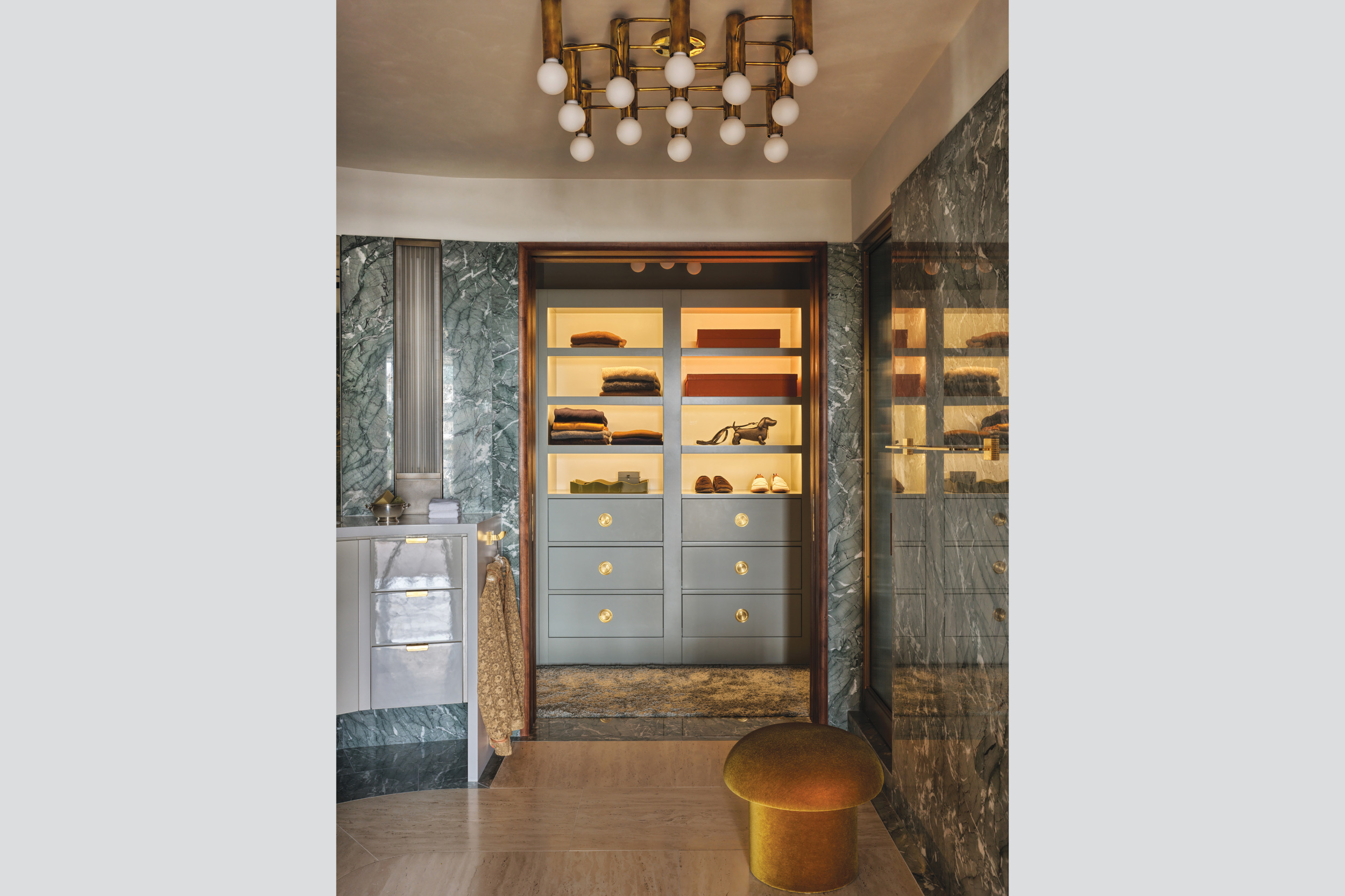
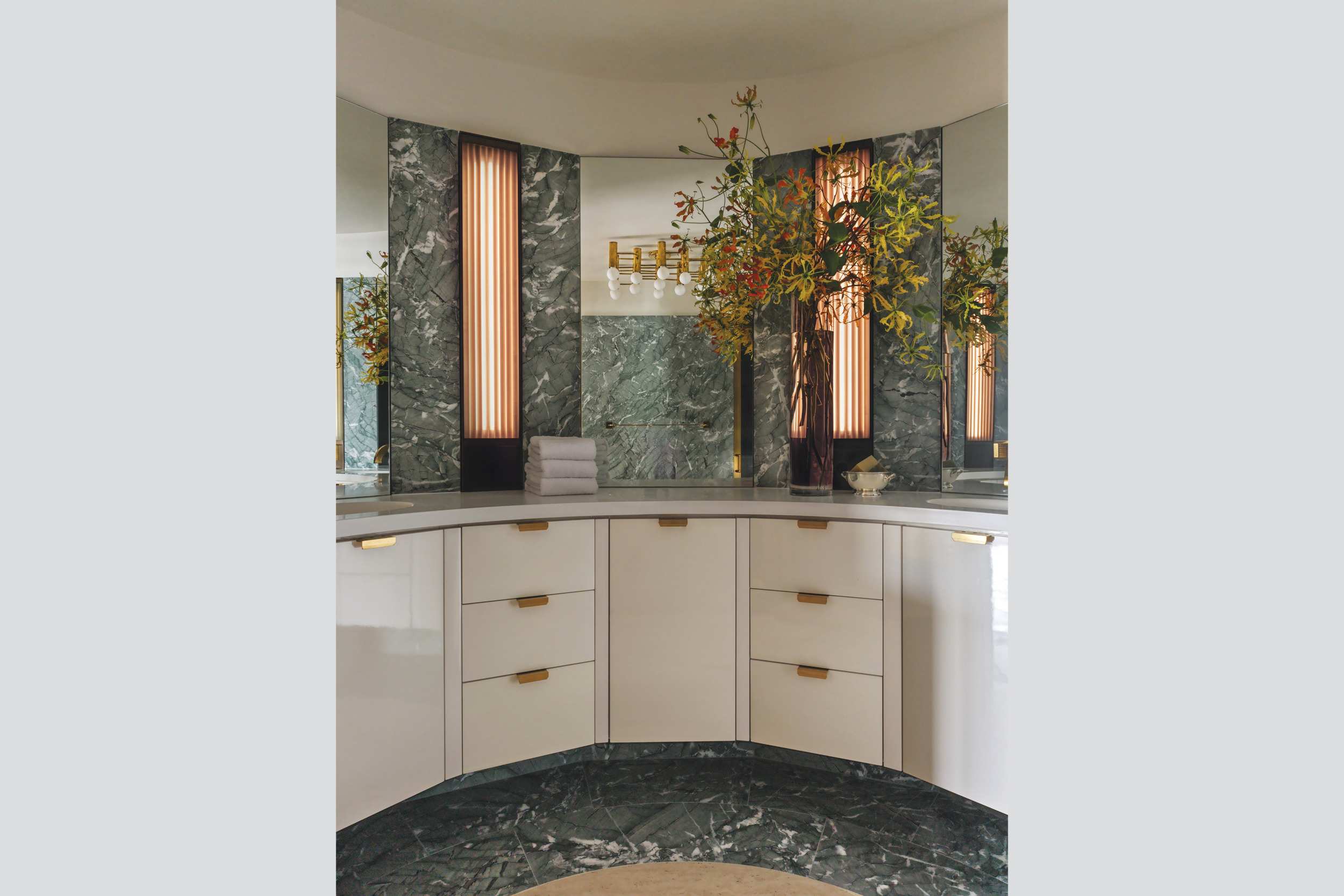
The redo created airy, open public spaces encompassing a living/dining area and kitchen that focus on panoramic river views; off the foyer, a short hallway leads to powder and laundry rooms. The private wing houses a hall bath, home office, yoga studio and the river-facing primary bedroom, with its wall of sliders opening out to a balcony. Nodding to the building’s shape, Potts ingeniously designed the primary bath as a circle; it flows into a huge, luxurious closet inspired by the interior of a Prada boutique.
Potts quickly gleaned the owner’s wish to pay tribute to the Watergate. “She used the term ‘1970s apartment glamour,’” he recalls. “The brief was for a pied-à-terre that would feel as much like a three-dimensional artwork as a functioning residence.”
With his client’s input, the architect embraced rich materiality in a host of opulent, yet carefully curated surfaces. “It’s maximalist, but also restrained,” he comments. “If you go overboard, you can’t read the materials and things get lost in the clutter.”
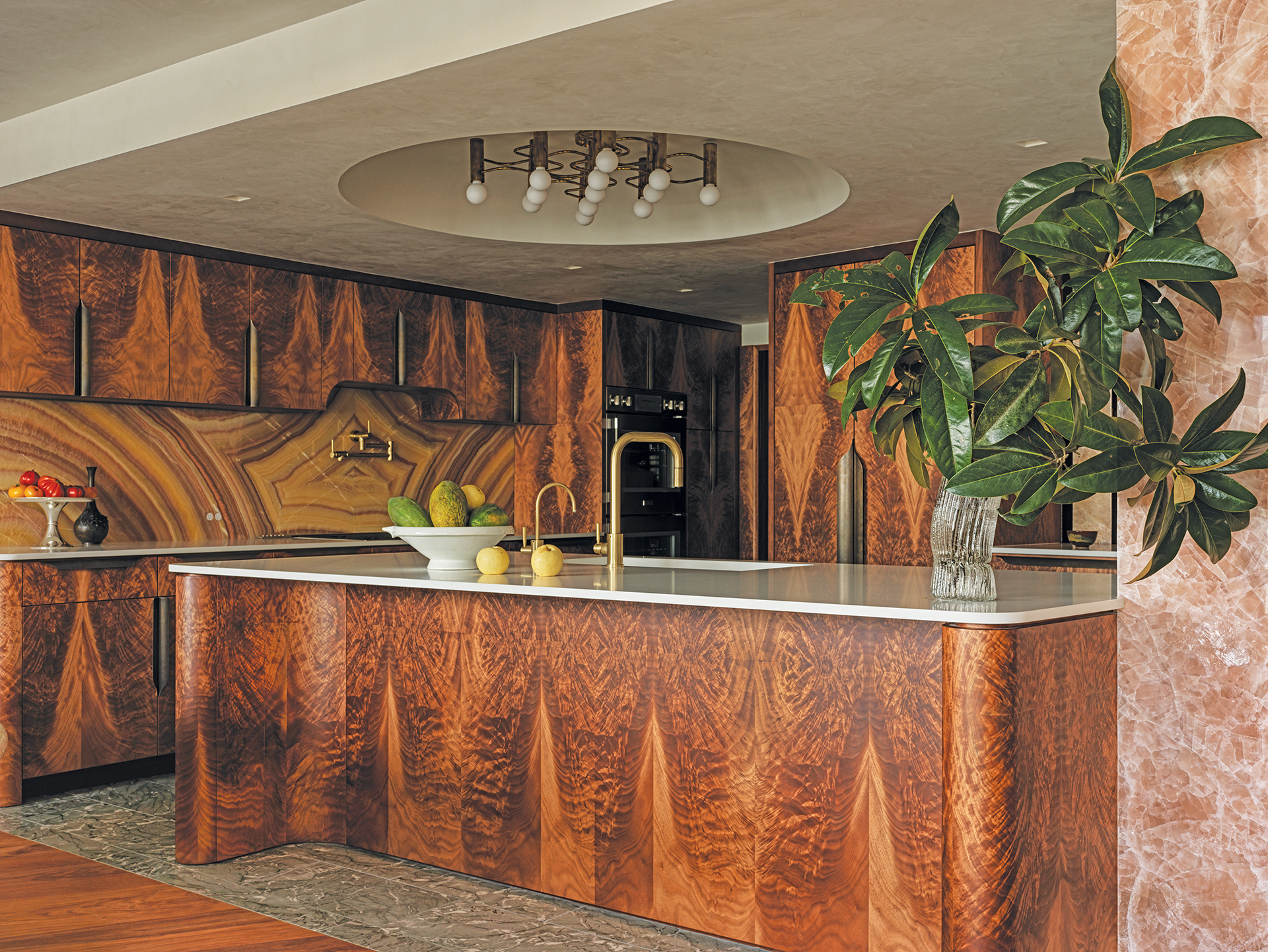
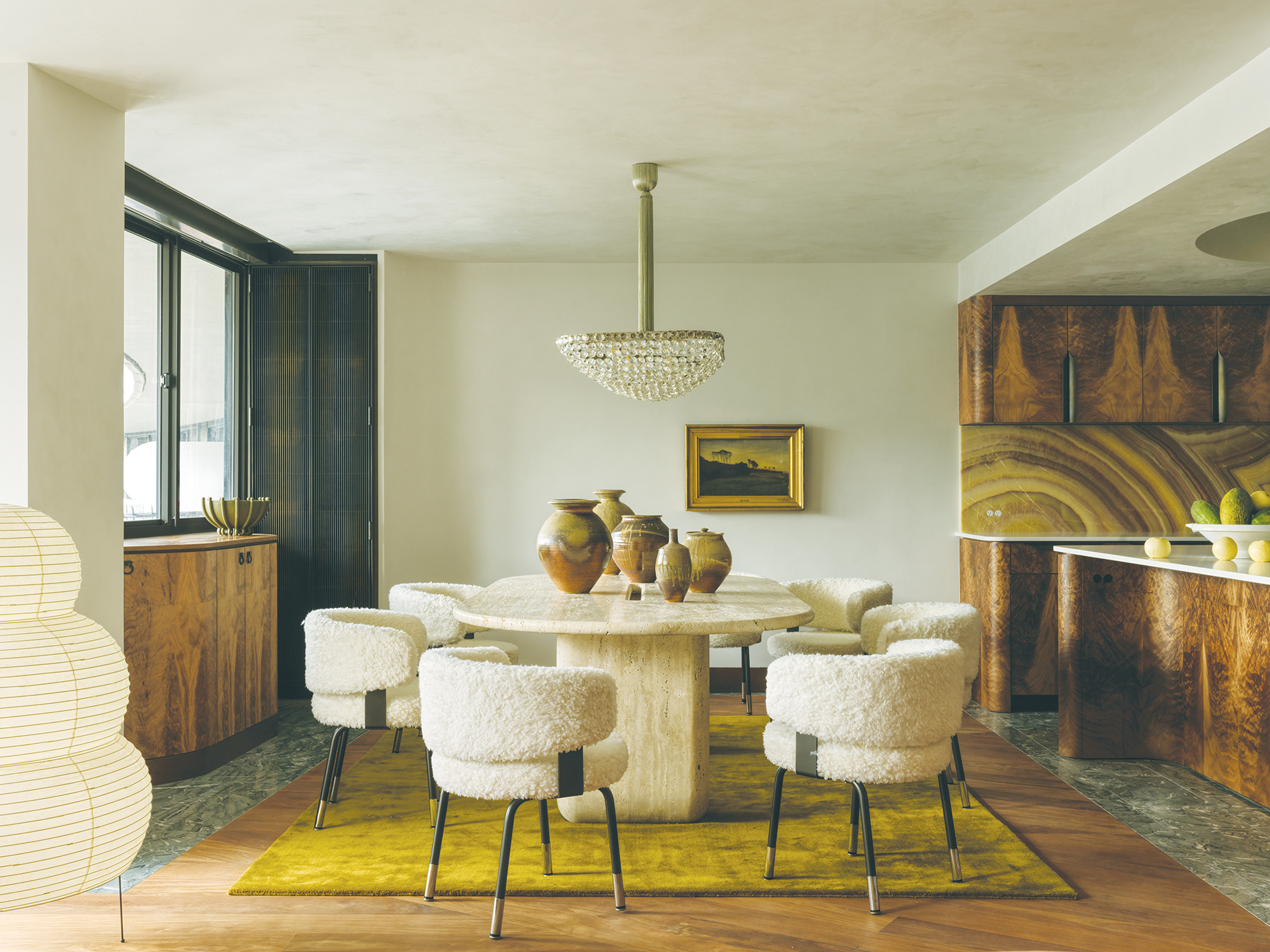
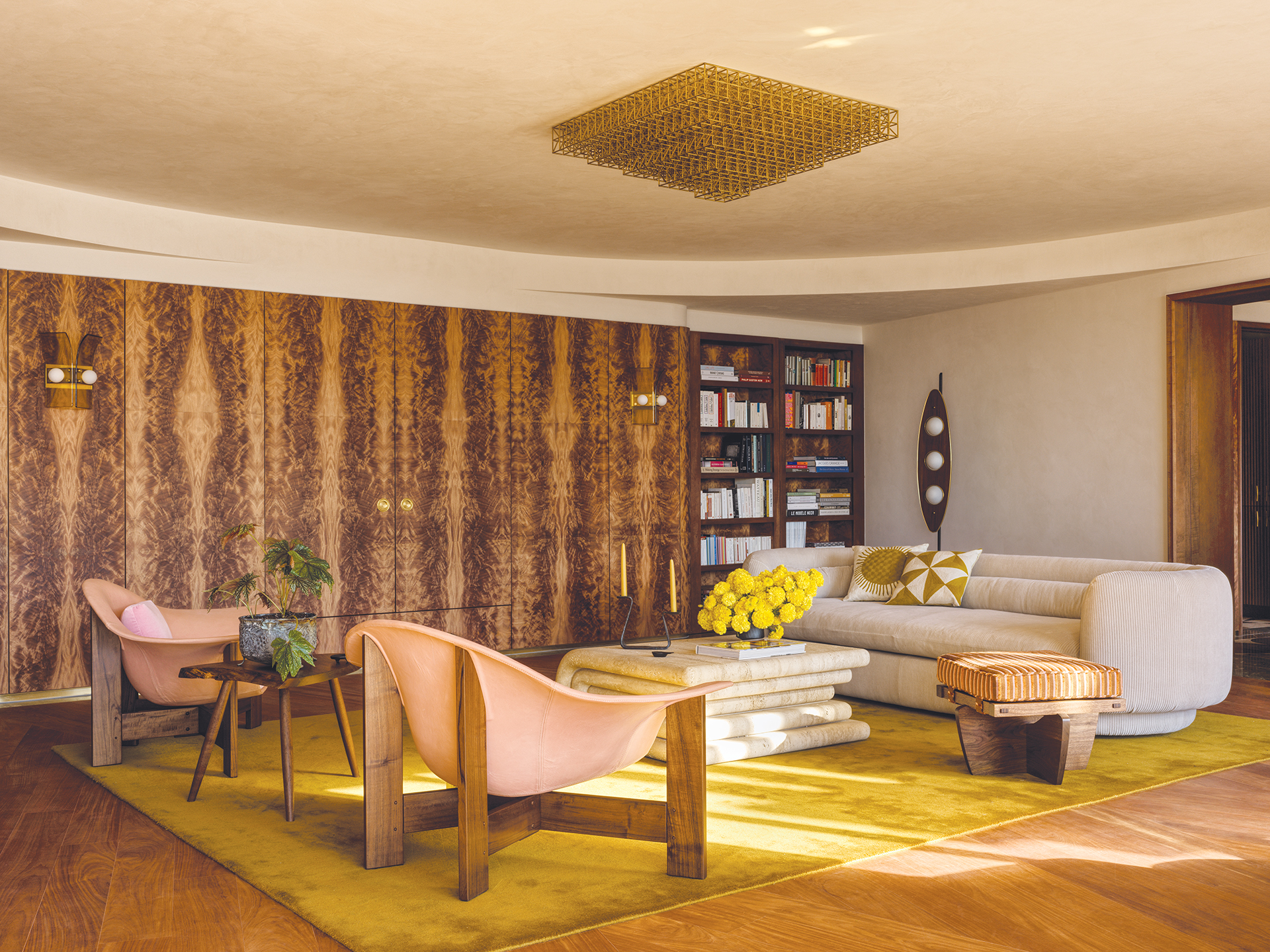
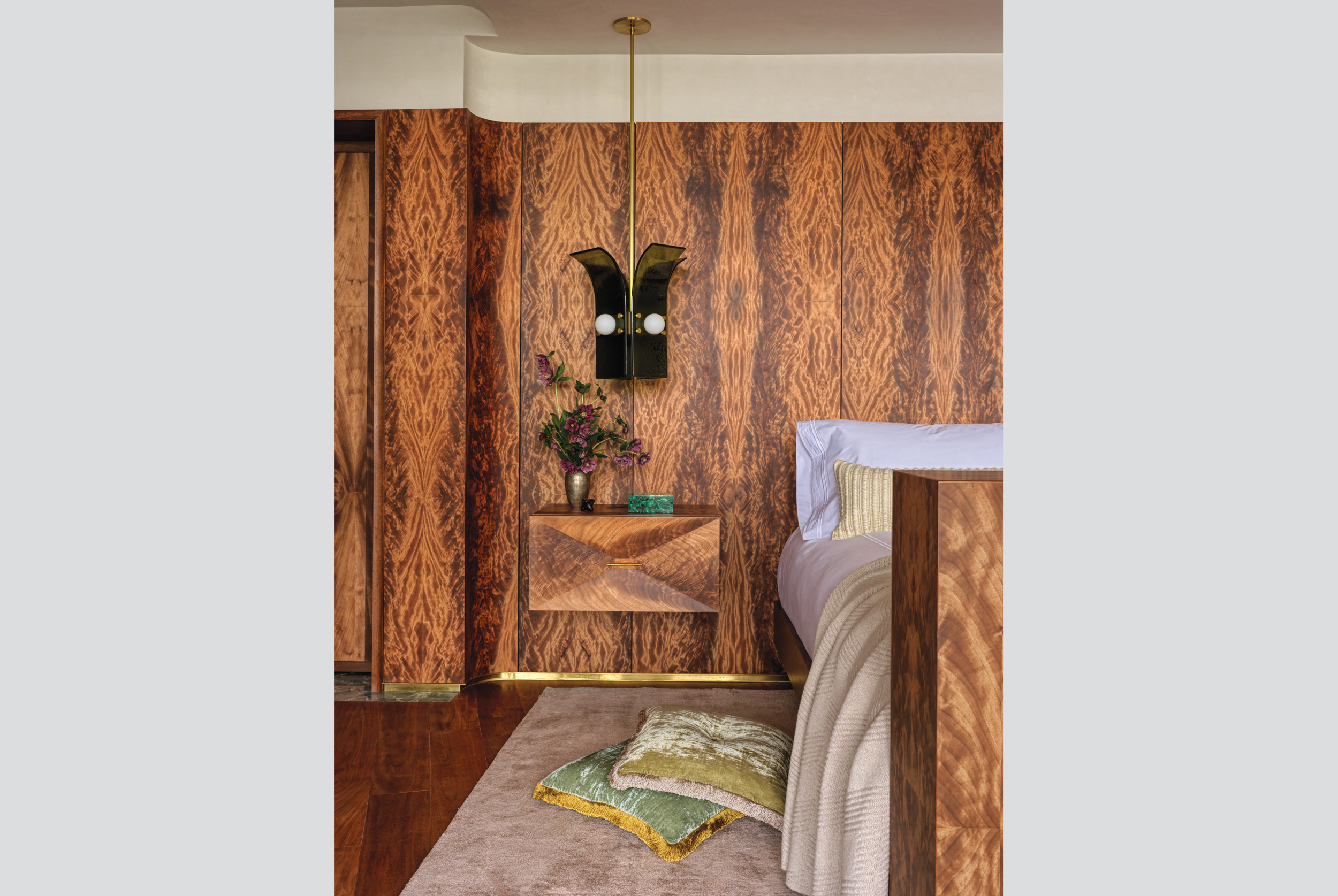
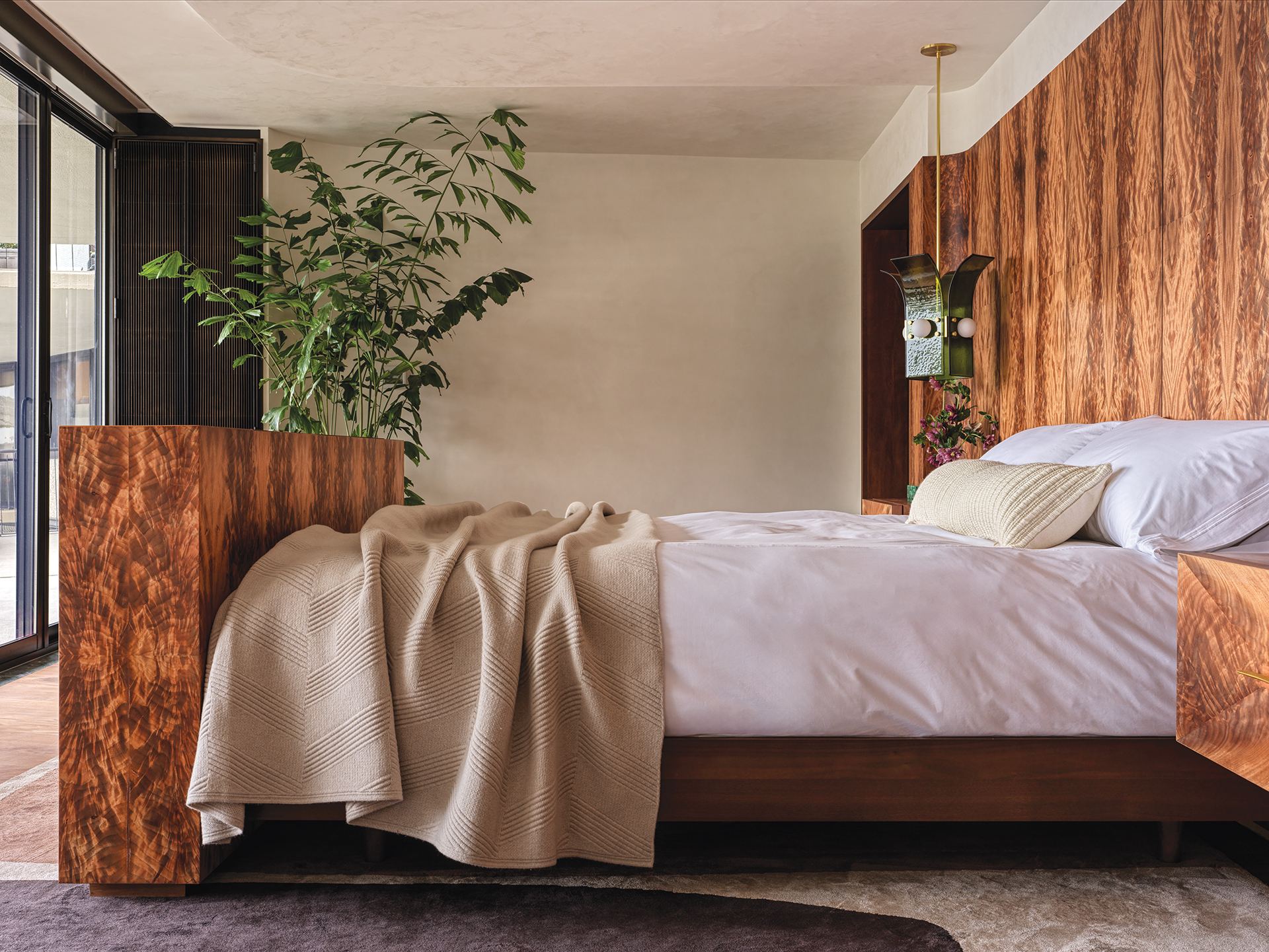
The foyer sets the tone, with the front door facing a wall of translucent Onice Gioiello onyx punctured by vertical slats that let in light while concealing the river views that await around the corner. Sumptuous okoume wood panels clad gently curved walls, then continue throughout the apartment to unify the spaces. The okoume, an exotic African hardwood, was milled from just two logs, so its grain evolves in book-matched segments, cropping up on the kitchen cabinets, on built-ins in the dining area, and on a wall in the living area where it incorporates shelving. In the bedroom, the material covers one wall, doubling as a headboard. All pocket and regular doors were crafted of the same wood.
More luxurious stone surfaces abound. In the kitchen, a slab of Onice Arco onyx forms a dramatic backsplash and Verde Antigua marble tiles cover the floor; the same marble frames sections of travertine flooring as well as the matte-finished mahogany floor, laid out in a radial pattern. Verde Antigua also clads the primary bathroom walls and floor and is paired with Lilac Reale marble in the guest bath.
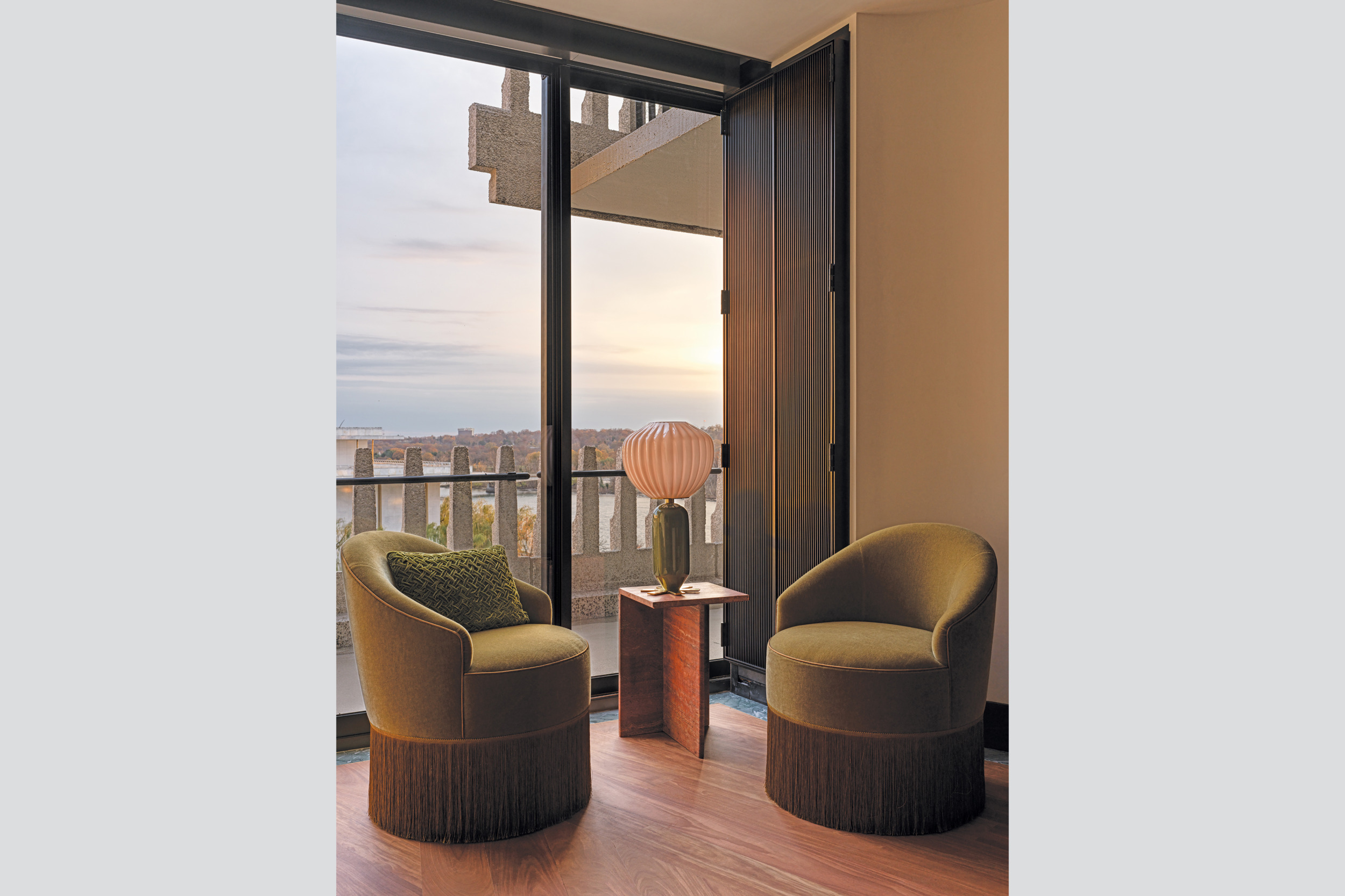
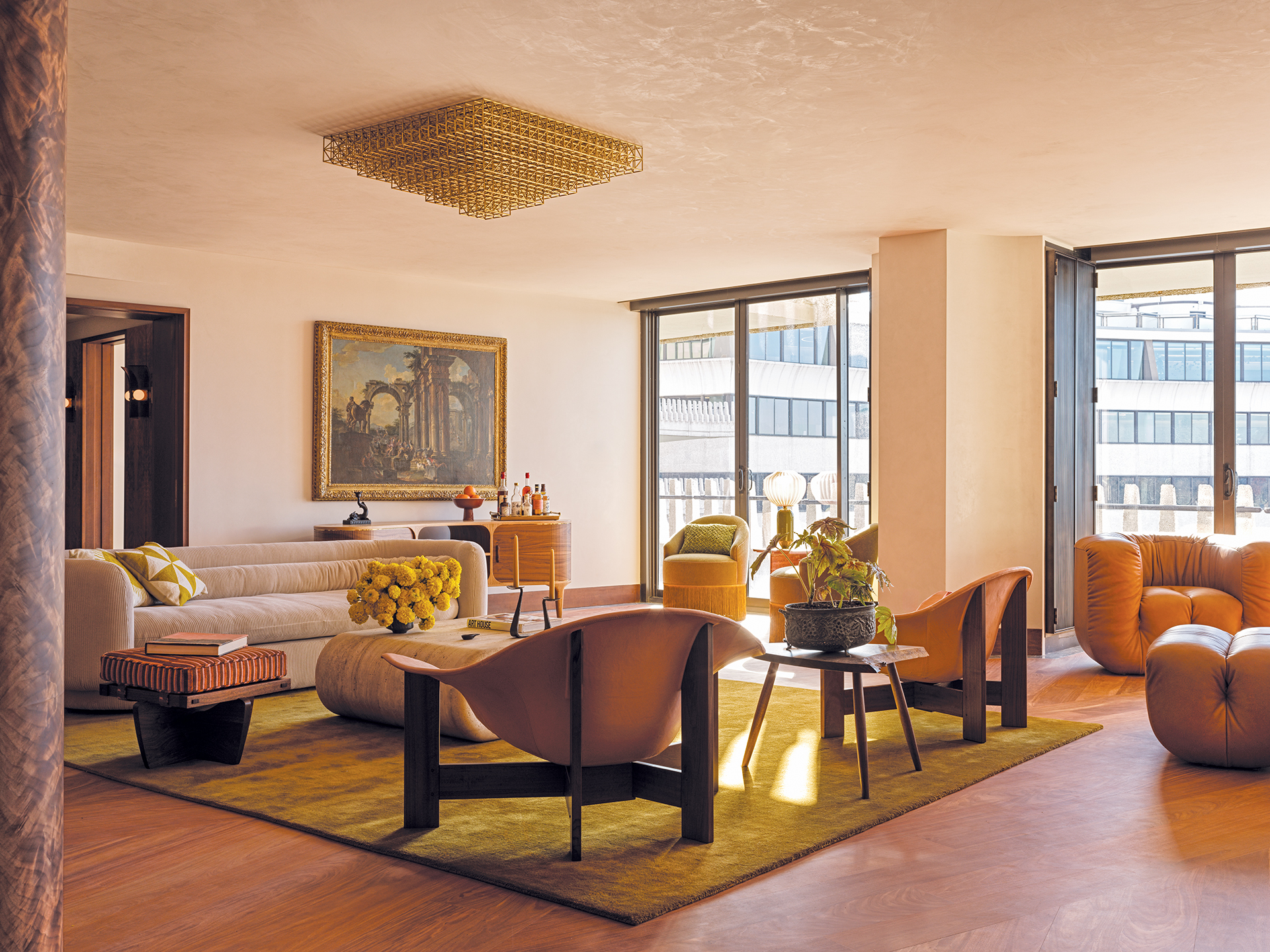
Bespoke touches rule, from luminous, burnished-plaster walls and ceilings to hand-forged metal cabinet pulls and sculptural door hardware. Vintage and custom fixtures illuminate rooms furnished with chic pieces found at auction or commissioned for the space. Comfortable, low-slung seating in earth tones threaded with gold ensures the views take center stage.
Working together harmoniously, the design team made a challenging, 14-month process seamless—and the owner is thrilled with the results. “As much as the apartment appropriates a museum-quality level of finishes,” says Potts, “it is also livable.”
Award: Entire House over $750,000. Renovation Architecture & Interior Design: Nicholas Potts, AIA, Nicholas Potts Studio, Washington, DC, and New York, New York. Renovation Contractor: Steve Kirstein, project lead; Eddie Mejia, project manager, BOWA Design + Build, McLean, Virginia. Styling: Tessa Watson.
Q+A with the team
What advice do you give homeowners embarking on a condo renovation?
Eddie Mejia, BOWA: You should meet with the builder for a pre-construction walk-though. And be sure to ask them to open up walls before they start so there are no surprises.
What is your philosophy on using high-end materials?
Nicholas Potts: We put a huge amount of thought into how we use materials. We have great respect for what is being mined from the earth or created by a maker. We want to make them their best selves and don’t want to waste anything.
How do you help clients decide where to splurge?
Nicholas Potts: First, the infrastructure has to work, so don’t cut costs on the contractor. As far as spending, you get more bang for your buck on things you interact with daily, like doorknobs and hardware. You can cut cost on things you don’t see or touch as often.