
Another vibrant form rises seven feet tall and three feet in circumference. “I like the work having a weight and a presence that’s larger than me,” says the artist. PHOTO: PETE DUVALL

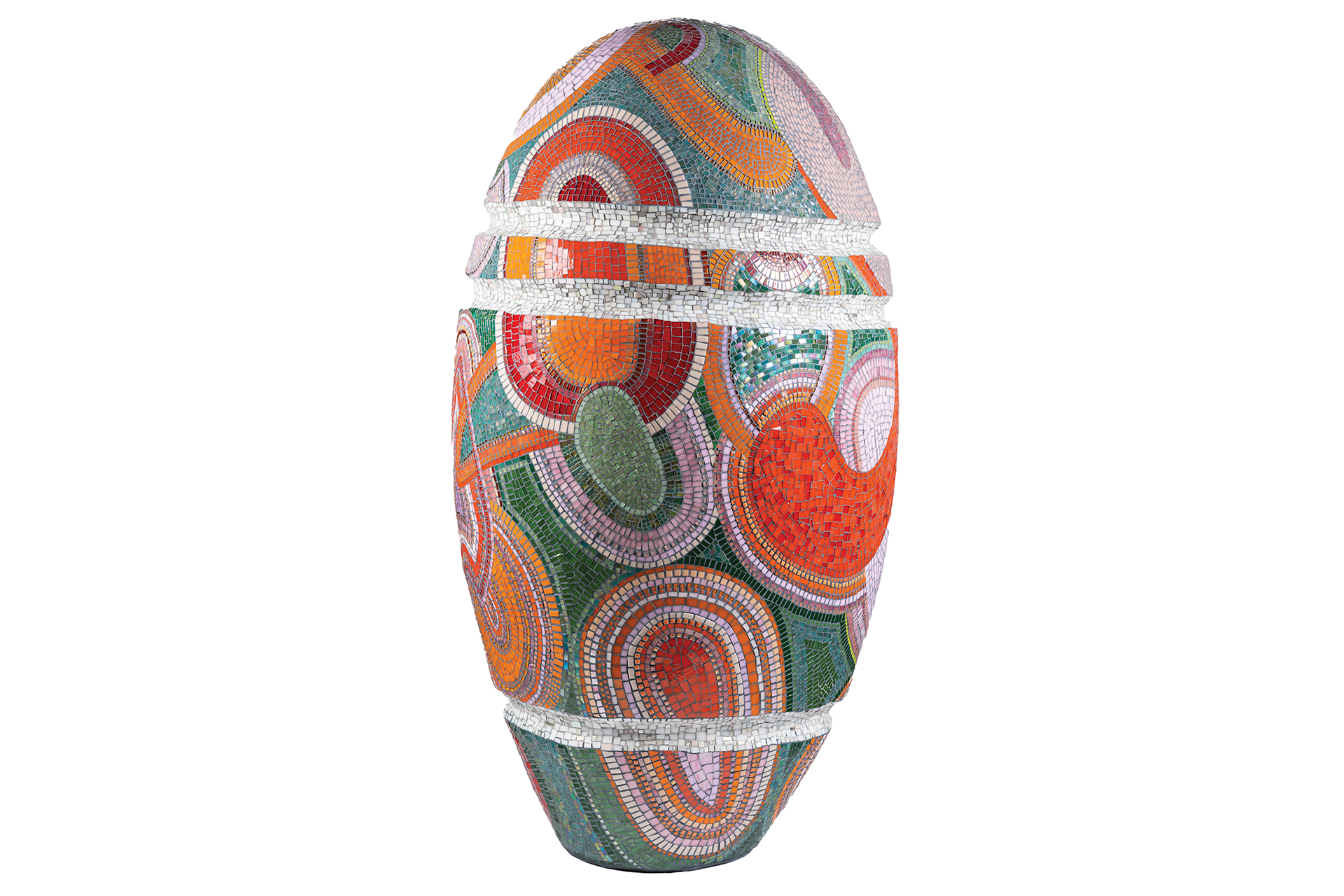
“I love reflective pieces, things that sparkle,” Valerie Theberge says about the iridescent glass, some flecked with gold, that dances across her art. “You can’t help but smile when you see colorful, sparkly things. I want something that lifts people up,” she adds. “That’s what I’m aiming for—to have people feel an elevation and expansiveness.” It’s part of an inner world, our deeper nature, that Theberge hopes viewers will tap into through her sculpture.
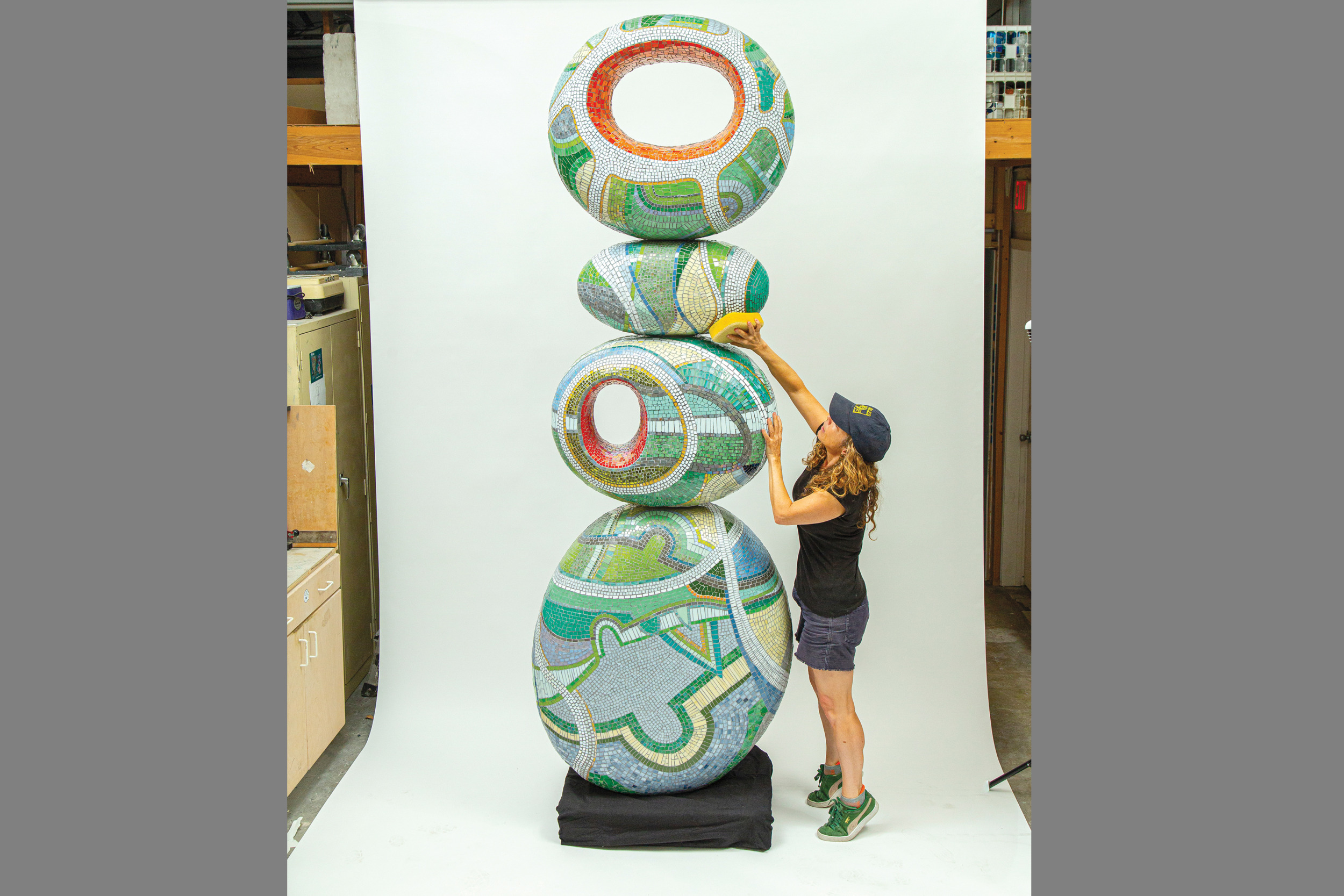
In her skilled hands, gently rounded forms appear to flow as well as sparkle. Patterned surfaces glide with organic ease. Serpentine lines weave among biomorphic sections and circles, lending the hard surfaces a sense of movement and dynamism. Some sculptures are stacked like piles of brilliantly hued pebbles. Others may be pierced with portals, as if opening to another realm.
On a recent visit to Theberge’s studio in Mount Rainier, Maryland, her worktable was weighted with containers full of glass pieces in different shapes and sizes. She was working on a large-scale installation for Metro’s Purple Line. When completed, eight objects “will be threaded like beads on two steel poles,” she explains. The sculptor had just returned from residential installations in Boca Raton and Key Largo, and had recently shipped pieces to a show in The Hamptons. In Washington, passersby can contemplate four of her sculptures permanently animating the corners of 19th Street and Pennsylvania Avenue, NW.
Theberge hand-cuts glass pieces, arranged by color on shelves in her studio. Before getting started, she usually has a color scheme in mind. The Metro project, for example, primarily entails yellows and blues. Her drawings, prepared in advance, point a general direction. “When I get to the object, it’s freehand,” she observes. “I just pull out the colors and line them up.” Her labor-intensive process starts with polystyrene foam forms, designed and amended by the artist then fabricated by a colleague in Cambridge, Maryland. Assistants help prepare the forms, coating them in eight layers of mortar and fiberglass mesh; each requires curing overnight before the next coat can be applied.
Once the surfaces have hardened, Theberge mixes up a new batch of mortar and adheres each glass piece individually by hand. As a final touch, grout fills in spaces between the glass. Using industrial-grade mortar and grout assures that sculptures can remain outdoors; as the artist points out, mosaics have been around for millennia.
The sculptor further explains her process: “I started meditating in college, and I think it’s the most important part of my work. When I’m putting colors together, they either have to hum or not hum. It’s a gut feeling for me,” she says. “I’m not thinking about it, I’m feeling it. And that feeling comes from a deeper space. I don’t do things in a calculated way. Everything for me is intuitive.”
That approach also describes her art education. After studying painting and drawing at the San Francisco Art Institute, she moved to China and received a certificate in Chinese painting in 1992. She later learned the glass mosaic technique as an apprentice to British artists in Hong Kong. Theberge then went out on her own, and in 2000 returned to her hometown of Washington, DC.
“It took me a while to find my voice in the medium,” she muses. “There’s a rigidity to the material that’s different from the fluidity of paint.” Her bulbous forms and flowing patterns reflect the influence of women sculptors, especially modernist Barbara Hepworth and Niki de Saint Phalle, whose colorful, oversized forms abstract women’s figures.
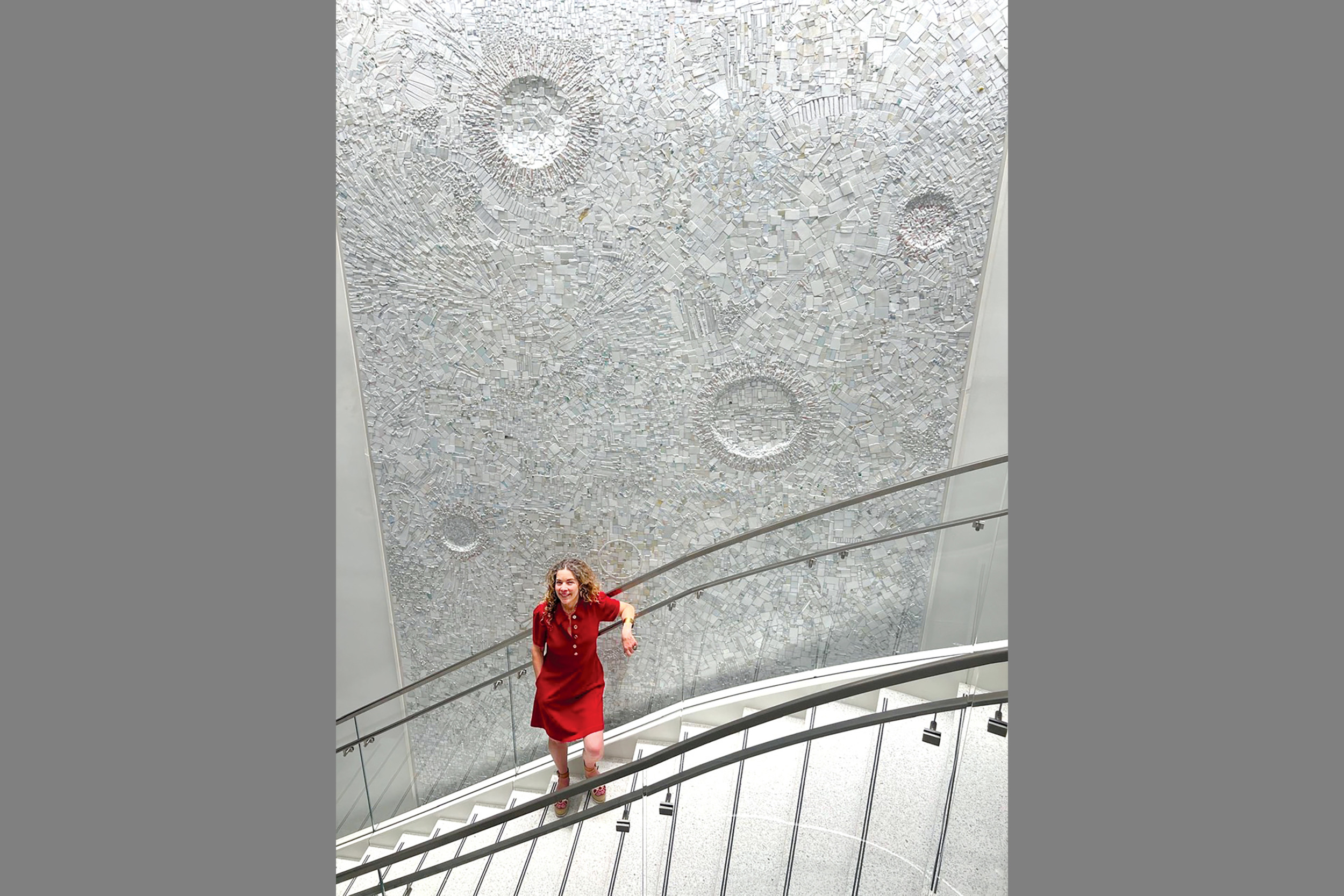
Theberge also creates wall panels that, from a distance, appear flat and all white. On closer examination, surfaces gently undulate, as pale greens and pinks along with pearly whites run through. When a law firm asked if she’d enlarge a piece on hand to 30 feet high and 11 feet across, she was delighted, especially since she had free rein. “I’ve always felt total autonomy in my work,” the artist acknowledges.
Though most of her sculptures rise from six to 10 feet tall, she’d like them to soar even higher. “I like the work having a weight and a presence that’s larger than me, to move away from hyper-individualism,” the sculptor says. “Each one of us is super-important, but we’re all part of something greater. And that idea is embodied in the work—in the tens of thousands of pieces fitted together. If they’re not harmonizing, then I have to take them off and go with what works for the greater piece.”
A tour of Theberge’s studio, along with those of 30 nearby artists, will take place on December 12. For more information, visit valerietheberge.com.