
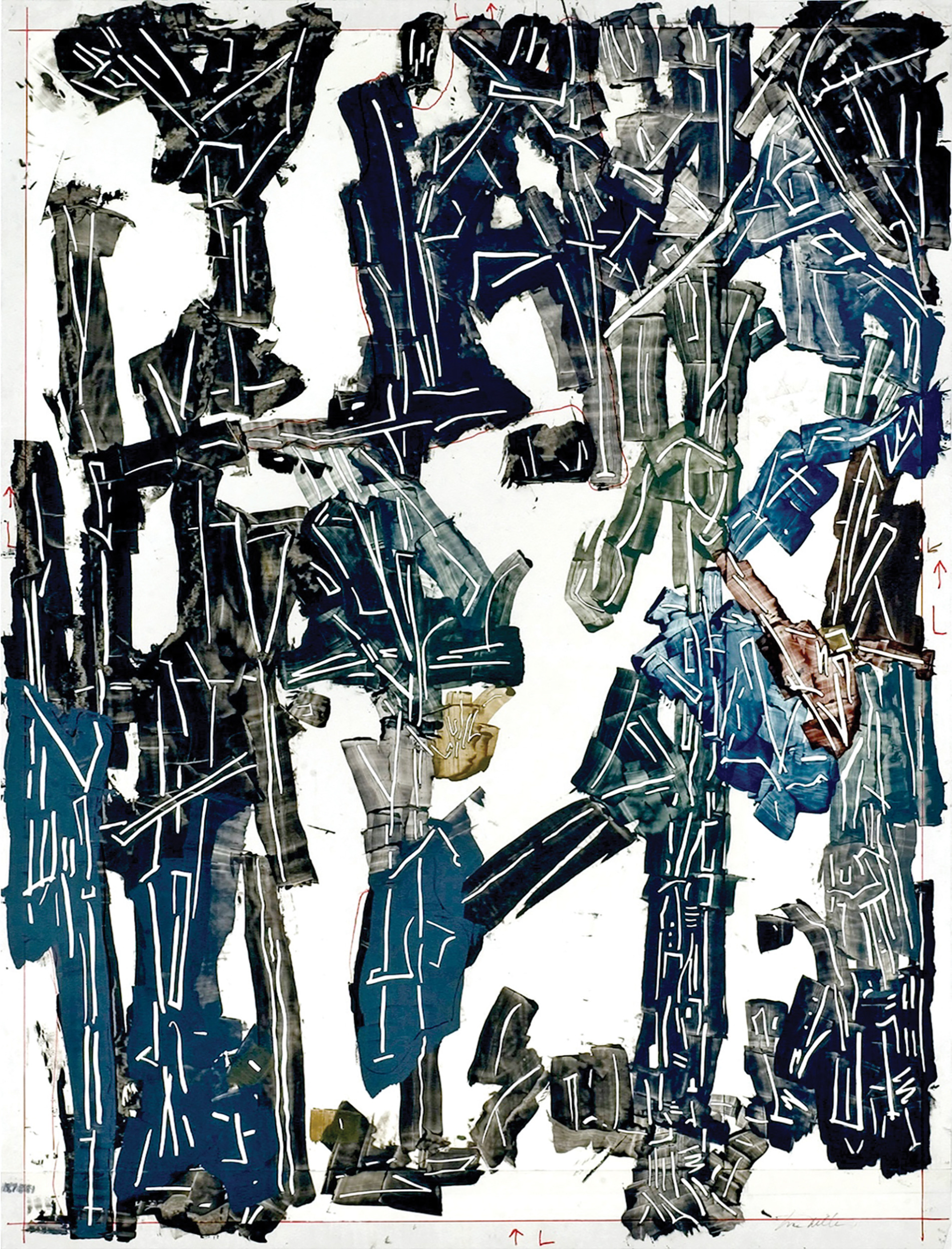
At times his work remains more abstract as in the oil painting Entanglement.

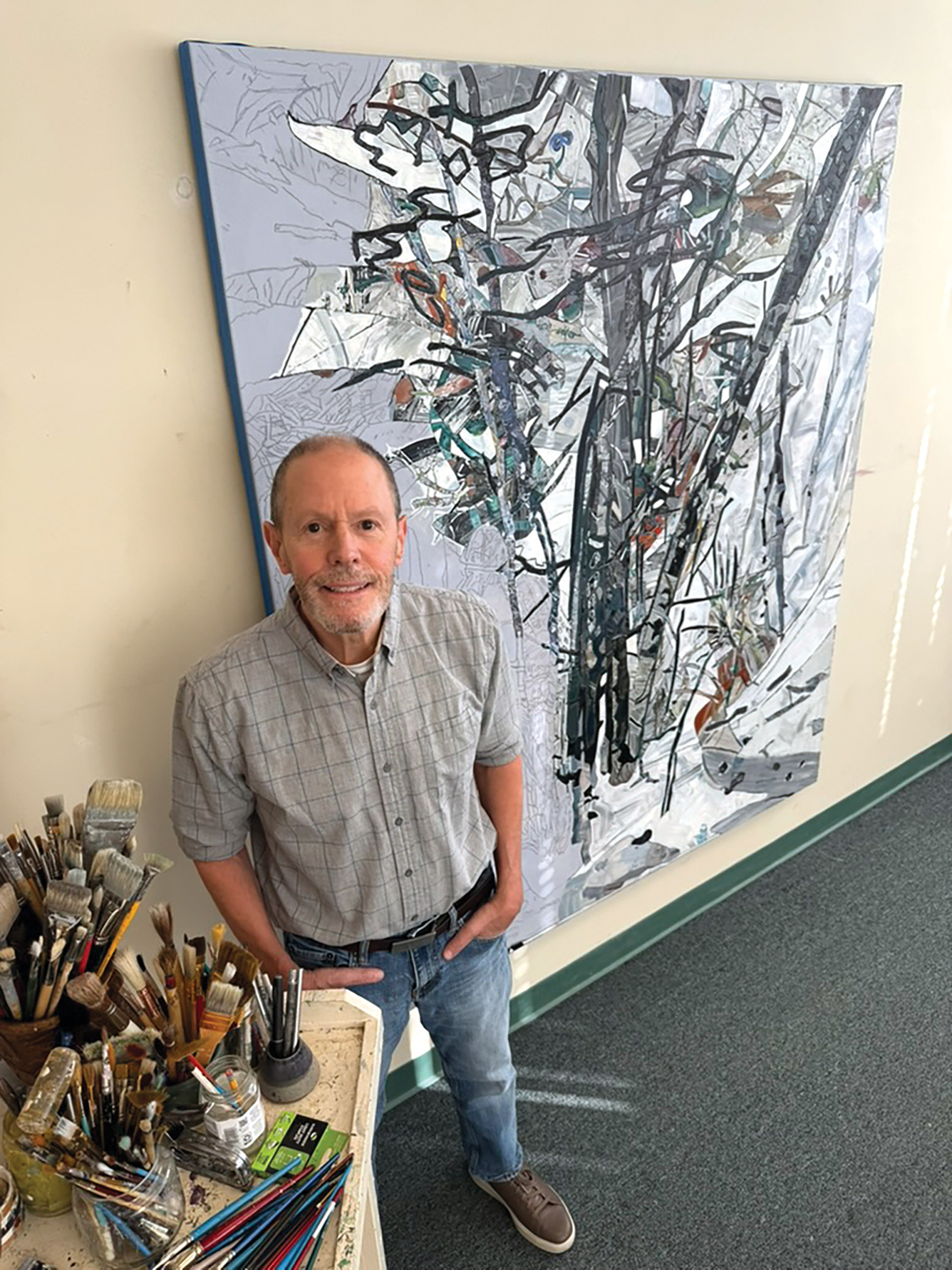
Every morning, seven days a week, artist Trace Miller walks from his home in Towson to his studio. It’s a short stroll but the time is well spent. “It’s much better than driving,” he muses. “It gives me the opportunity to think about what I’m going to work on. The walk puts me in the right headspace.”
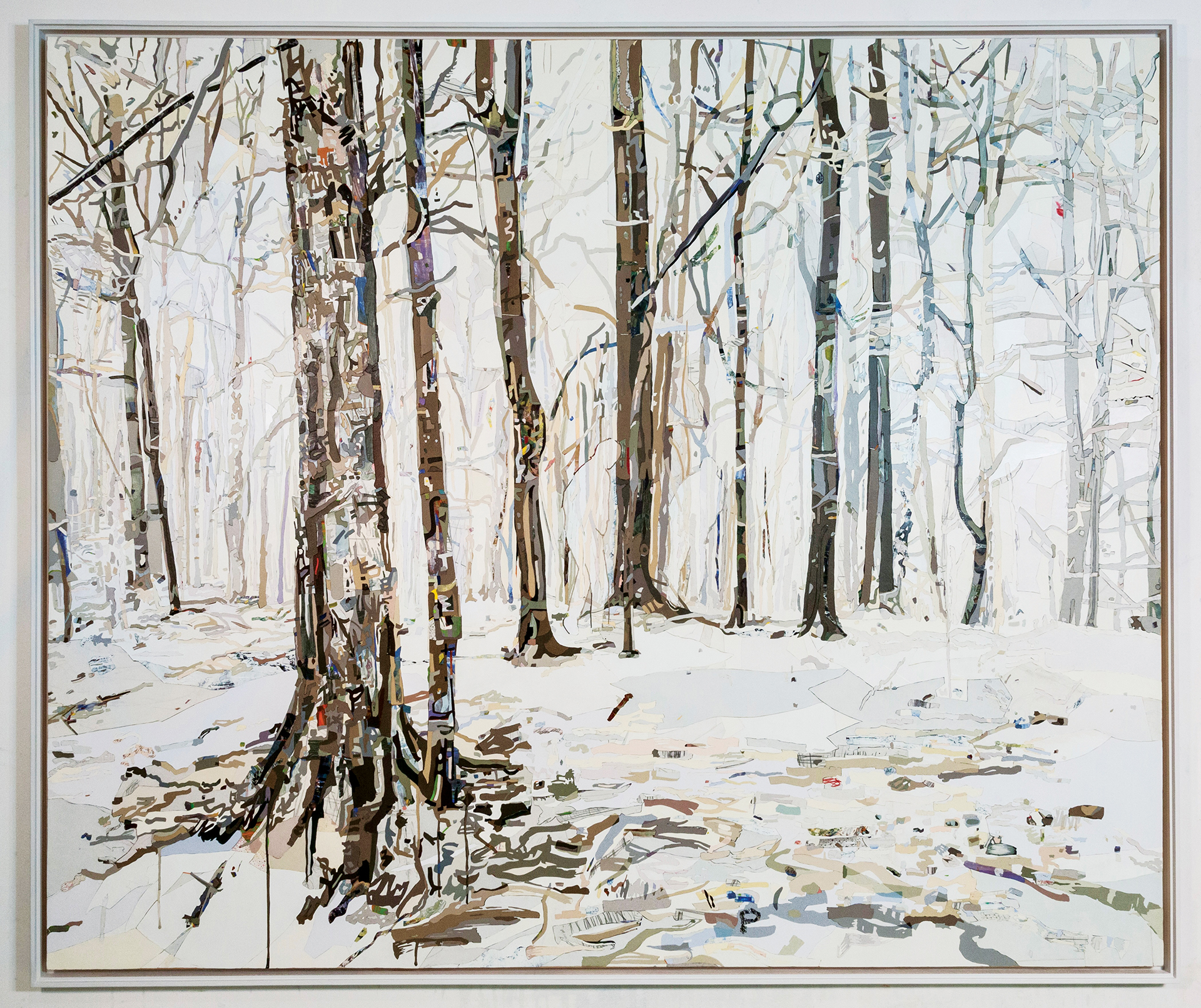
Inside his light-filled studio, Miller begins most paintings from a place of abstraction. His first marks tend to be expressive and exploratory, more concerned with movement than depiction. As he builds the surface, certain forms start to emerge—often the wintry trees that he has woven through his work for decades. “My paintings never cease to fall back on something narrative, whether it’s the trees or the figures walking through trees,” says the artist. “But I don’t look at my work as landscapes. They’re about the paint, the movement, the energy and the color.”
The arboreal thread emerged in the early 1980s, during a period when Miller lost both his father and older brother within two weeks of each other. The bare branches in the forests of his native rural Western Pennsylvania served as a metaphor. “During that time of year the trees appear lifeless and dead, only to come back to life once spring arrives,” he says. “I’ve created those paintings ever since. Sometimes the figures are my brother and dad walking into the forest into new surroundings, a new existence.”
Miller was drawn to art from an early age. “I wasn’t the best at school,” he recalls. “But I was the best at art.” That talent brought him to Philadelphia’s Tyler School of Art & Architecture at Temple University. During those undergraduate years, Miller studied abroad in Rome—an experience that was formative to his approach. “My work has changed quite a bit over the years, but how I look at art was very much influenced by that time,” he says. “There were no textbooks. We instead went to churches and museums and saw the original Renaissance works.”
Half a decade of adventure followed Miller’s graduation. He moved to New York City, bartending at a disco, and then became a flight attendant, which offered international travel opportunities. The job brought him to Baltimore, where he decided to revisit his passion. “If I was ever going to get serious about my work again, I needed to go to grad school,” he says. “So I applied to the Hoffberger School of Painting at Maryland Institute College of Art.” While there, he studied under renowned abstract expressionist Grace Hartigan, whom he credits as being one of the most influential artists on his career.
It was a turning point for Miller. “Ever since then I have been actively showing and maintaining a studio practice,” he says. In addition to working as an artist, he taught painting at Towson University for nearly 30 years.
Teaching allowed Miller to pass on the knowledge he gained from his own mentors. At Towson, he emphasized fundamentals—drawing, rendering and composition—before encouraging students to pursue personal imagery in their developing work. “You don’t just start with abstraction,” he says. “Technical skills are important to have no matter what work you do later in your career.”
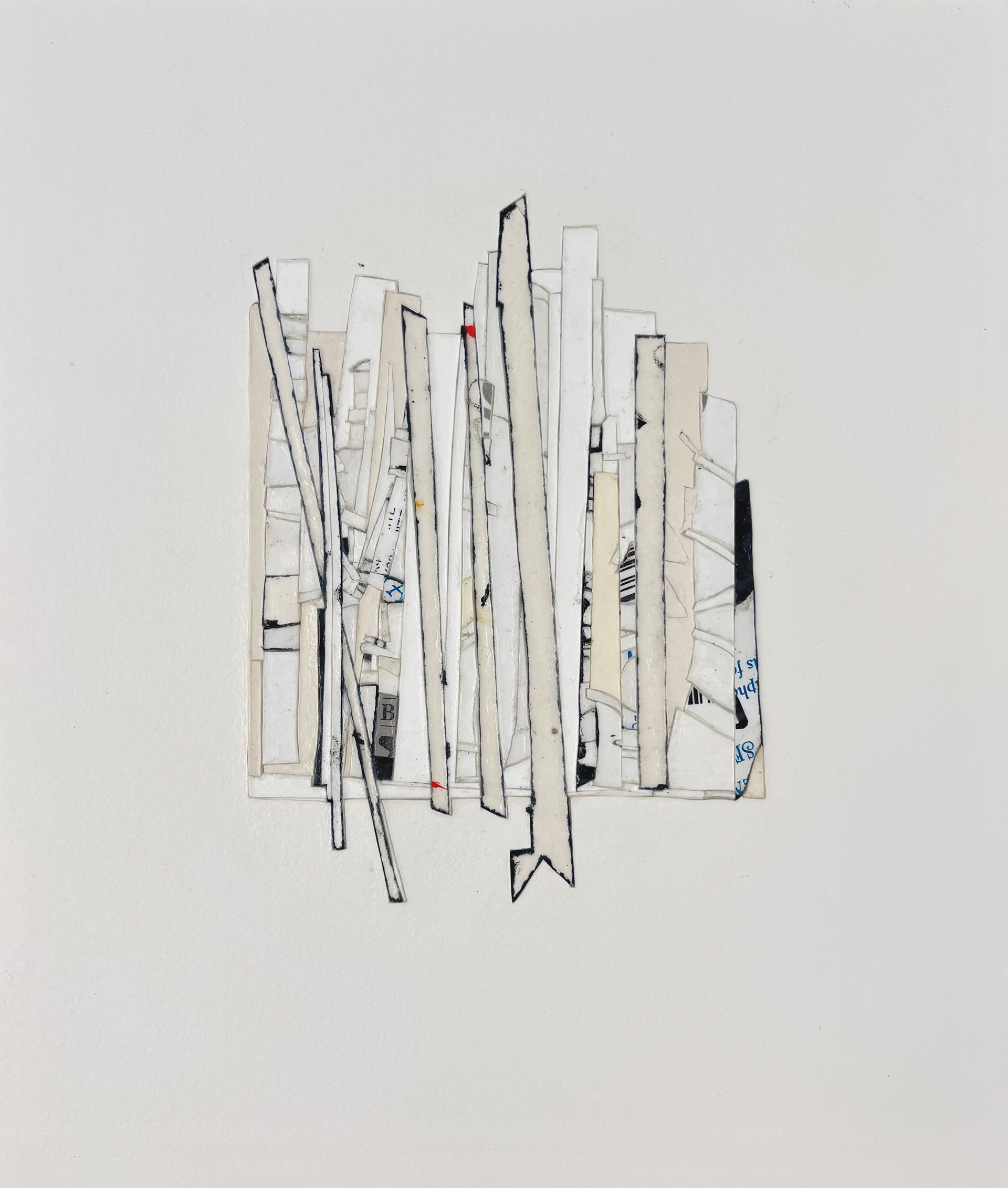
In terms of his own evolution, Miller is experimenting with a different approach as of late, making mixed-media collages that he then draws and paints upon. Occasionally the collages remain independent works. Others become the foundation for larger canvases. “Not all of them translate,” he says. “Some stay small. Some push me to go bigger.”
But no matter how Miller’s work has grown and changed, one thing has remained the same—his use of oil paint. “There’s something that’s very earthy and the color feels pure,” he says of the medium. “It’s very seductive.” Oils allow him to use gestures and rhythm that acrylics don’t, giving the surface a physical presence he values. He points to artists such as Cy Twombly, Terry Winters and Joan Mitchell as influential figures in this evolution—not because of their style, but rather their similar way of allowing a painting to unfold. His own works occupy that same space between abstraction and suggestion, where the marks carry as much weight as the imagery they hint at.
Miller’s upcoming exhibition at Goya Contemporary in April highlights the ongoing direction of his studio practice. It is, he says, a spiritual journey that continues to guide his work. “I see the growth from one painting to the next,” he reflects. “And I just want to keep going in that direction.”
Trace Miller’s work will be on view at Goya Contemporary in Baltimore from April 9 to May 2, 2026. For more information on the artist, visit tracemillerart.com.